






 Distyl
The short answer
Private company data providers sell what private companies do not publish: funding rounds, revenue estimates, ownership and the people in charge. PitchBook, Crunchbase and CB Insights lead on venture and private equity funding. FactSet and S&P Global add financials and ownership at scale, Dakota and PrivCo focus on US private companies with contacts and revenue estimates, and Dun & Bradstreet covers company records and credit. Free official sources fill gaps: SEC Form D filings show US companies raising money, and Companies House publishes UK company filings.
Once you know which private companies to target, the contact finder finds the people at each one and verifies their work email, inside a free workspace of Cleanlist AI (our product).
What counts as private company data?
A public company files its financials, owners and officers with a regulator. A private company mostly does not, so providers collect or estimate the same facts from other sources. The data falls into five groups:
| Data | What it tells you | Where providers get it |
|---|---|---|
| Funding | Rounds, amounts, investors, valuations | Press, regulatory filings, surveys of investors and companies |
| Financials | Revenue, EBITDA, growth | Estimates from headcount and other signals, tax-based models, company-reported figures |
| Ownership | Parent companies, sponsors, cap tables, subsidiaries | Filings, registries, deal records |
| People | Founders, executives, board members, contacts | Company sites, filings, provider research |
| Deals | Acquisitions, buyouts, exits, multiples | Filings, press, transaction databases |
Treat private company revenue as an estimate unless the company reported it. Good providers show how they got there: PrivCo prints a range and a confidence level on each estimate, and FactSet says it uses imputed tax-based financials where available (both read November 10, 2026). Private company data is one kind of third-party data, and our third-party data providers guide covers the other kinds.
8 private company data providers compared
Every count below is the provider's own figure, read on its own page on November 10, 2026.
| # | Provider | Best for | Coverage, by its own count | Price |
|---|---|---|---|---|
| 1 | PitchBook | Venture, private equity and M&A research | 12.7M+ companies, 3.1M+ deals, 634K+ investors | Not published; free trial on request |
| 2 | Crunchbase | Startup and funding research on a budget | Private company profiles, funding, forecasts | Pro $49 a month billed annually in the first year, or $99 monthly |
| 3 | CB Insights | Market maps and emerging tech | 13M company and investor profiles, 2M financial transactions | On request |
| 4 | S&P Global Market Intelligence | Financial statements at global scale | 60M+ private companies, 14M+ recent financial statements | On request |
| 5 | FactSet | Private and public data in one workflow | Up to 90 financial data points per private company | Not published; free trial |
| 6 | Dakota | US private companies with C-suite contacts | 642,000+ private companies, 26,000+ GP accounts | $9,500 a year for 5 users |
| 7 | PrivCo | US companies that never raised venture money | 2M+ US private companies, 4M+ executive contacts | On request |
| 8 | Dun & Bradstreet | Company records, corporate families and credit | 600M+ organizations | D&B Hoovers Essentials $49 a month |
1. PitchBook: best for venture, private equity and M&A research
PitchBook says it covers 12.7M+ companies, 3.1M+ deals, 634K+ investors, 170K+ funds and 4.2M+ professionals. It says a data operations team of 1,800+ people vets the data, which is updated several times a day from sources including survey requests, regulatory filings and public records requests. PitchBook data reaches Salesforce, Microsoft Dynamics and HubSpot through CRM integrations, and through an API, a data feed and an MCP server. It publishes no price and offers a free trial on request.
Holds: funding, valuations, deal multiples, investors and funds, people. Best for: investors, bankers and corporate development teams.
2. Crunchbase: best for startup and funding research on a budget
Crunchbase sells self-serve plans with prices on its site. Pro lists $79 a month billed annually, discounted to $49 a month for the first year, or $99 billed monthly, with 2,000 exported rows a month. Business starts at $199 a month billed annually, with 5,000 rows a month and CRM integrations, including Salesforce and HubSpot. Custom data deals cover APIs and bulk delivery. Its plans include company firmographics, financial and funding data, valuation estimates and forecasts of funding, acquisitions and IPOs.
Holds: funding, investors, valuation estimates, growth signals, people. Best for: sales and marketing teams that target funded startups, and individual researchers.
3. CB Insights: best for market maps and emerging tech
CB Insights says it holds 13M company and investor profiles, 2M financial transactions with valuations, multiples and cap tables, 4M founders, operators and tech talent with contact information, and rankings across 1,700+ markets. It describes private company revenues as sourced from startups directly and from public and non-public sources. Prices come on request, either per seat for its terminal and AI agents or by consumption for data feeds and APIs.
Holds: funding, cap tables, revenue figures, market classification, people. Best for: strategy and corporate development teams tracking emerging markets.
4. S&P Global Market Intelligence: best for financial statements at global scale
S&P Global says its private company data covers 60M+ private companies worldwide, with 70M+ company profiles, 14M+ recent financial statements, 113M+ professionals and 3M+ corporate structure relationships. The data is available in S&P Capital IQ Pro and through feeds, APIs and its marketplace. It publishes no price, and the page offers a demo.
Holds: financial statements, corporate structures, transactions, people, headcount. Best for: credit, M&A and finance teams that need filed financials across many countries.
5. FactSet: best for private and public data in one workflow
FactSet says its private company data is built from imputed tax financials, local registries, SEC filings and collected deal and fund data. Profiles include ownership structures, M&A and funding history and executive contacts, with up to 90 financial data points for a private company. It is delivered in FactSet's workstation and through APIs and data feeds. FactSet publishes no price and offers a free trial.
Holds: financials, ownership, funding, deals, executives. Best for: banks, asset managers and corporate teams already working in FactSet.
6. Dakota: best for US private companies with C-suite contacts
Dakota Private Markets is one of the few platforms with a published price: $9,500 a year for 5 users. Dakota says it covers 642,000+ private companies across 11 sectors, including 143,000+ sponsor-backed portfolio companies and 500,000+ independent US businesses, with verified C-suite contacts, revenue and employee estimates and ownership structure. It also tracks 26,000+ fund manager accounts across private equity, venture, credit and other strategies, 57,000+ funds and 20,000+ verified transactions, and it runs natively in Salesforce.
Holds: ownership, revenue estimates, contacts, deals, fund data. Best for: deal teams and private markets sales teams that want contacts inside the platform.
7. PrivCo: best for US companies that never raised venture money
PrivCo covers 2M+ US private companies, with revenue, EBITDA and valuation estimates, 100K+ tracked M&A deals and 4M+ executive contacts. It argues that over 95% of US private companies never raised institutional capital, so a database built from funding announcements misses them. Each estimate shows a range, a confidence level and when it was last updated. Prices come on request.
Holds: revenue and EBITDA estimates, ownership, deals, executives. Best for: private equity, lenders and sales teams targeting founder-owned businesses.
8. Dun & Bradstreet: best for company records, corporate families and credit
Dun & Bradstreet says it has data on over 600M organizations in over 250 markets, and it issues the D-U-N-S Number, its ID for a business. D&B Hoovers Essentials costs $49 a month for 150 company credits and 150 contact credits, or $529 a year for 1,800 of each, with the first month free. Our Dun and Bradstreet pricing guide covers D&B's credit reports and what larger contracts cost.
Holds: company records, parent and subsidiary links, credit scores, contacts. Best for: finance, procurement and sales teams that need company records with credit data.
Free official sources for private company information
Two government sources answer some questions for free, and providers draw on both.
SEC Form D (US). The SEC says Form D is used to file a notice of an exempt offering of securities, and a company must file it within 15 days after the first sale in the offering. Notices are filed on EDGAR, which the SEC says gives free public access to millions of documents, with full-text search across more than 20 years of filings (SEC, read November 10, 2026). Searching recent Form D notices is a quick way to spot private companies that just raised money.
Companies House (UK). Companies House registers company information and makes it available to the public, and its search covers company names, company numbers and officer names. GOV.UK says every private limited company must send its statutory accounts, a balance sheet and a profit and loss account among them, to Companies House, and that small companies and micro-entities may send simpler accounts (GOV.UK, read November 10, 2026). For UK private companies, that makes basic financials and officers public in a way US private companies are not. For contact data and the marketing rules in the UK, see our UK B2B data providers guide.
Which private company data provider fits which job?
| Your job | Start with | Why |
|---|---|---|
| Research startups and their funding | Crunchbase, PitchBook, CB Insights | Round-level funding and investor data |
| Source private equity deals | PitchBook, Dakota, PrivCo | Ownership, sponsor and deal history |
| Model a private company's financials | S&P Global, FactSet, PrivCo | Filed or estimated financials with methods shown |
| Map an emerging market | CB Insights | Companies classified into markets |
| Check a supplier or customer's credit | Dun & Bradstreet | Credit reports and corporate families |
| Research UK private companies for free | Companies House | Filed accounts and officers |
| Contact the people at private companies | Any of the above plus a contact data tool | Company data says who to target, contact data says how to reach them |
For company records priced per record, such as industry, headcount and location, our firmographic data providers comparison covers twelve providers, and the firmographic data glossary entry defines the fields.
How do you reach the people at private companies?
Most of these providers tell you which companies to target, and some list executives. For a sales team, the next job is finding the right people at each company and a verified way to reach them. That is the part Cleanlist AI (our product) does.
Disclosure. We make Cleanlist AI. Its 98% verified email and 85% direct dial figures come from our own 500-lead benchmark, which named no other vendor.
Cleanlist AI sells no funding history, financial statements or ownership data, and it has no intent data or technographic filters. Its Company Search filters accounts by industry, employee count range, funding stage, location, company name and domain, and the app adds revenue. Searching costs 0 credits on every plan. Then it finds the people and their contact details: Cleanlist AI runs waterfall enrichment across 25+ data providers in sequence and stops at the first deliverable result, at 1 credit per verified work email and 10 per phone number. A missed email or phone number costs nothing.
On our own tests, all first-party, the waterfall returned 98% verified work emails and 85% phone numbers on the Cleanlist AI 500-Lead Enrichment Benchmark, our own test run on a 500-lead sample. Our 100-lead test ran one list through the Cleanlist AI waterfall and through Apollo alone, returning 98% verified email and 85% phone for the waterfall against roughly 80% and 45% for Apollo. A separate 1,000-lead test in March 2026, with no Cleanlist AI arm, found ZoomInfo returning a verified email for 84% of leads and Apollo for 78%. The benchmark write-up has the method.
- List the companies. Export your target list from PitchBook, Crunchbase or any provider above, or build it in Company Search with funding stage, industry and headcount filters.
- Find the people. Select the accounts and run People Search across their domains, filtered by seniority, department or title. It searches 1B+ profiles at 0 credits.
- Get verified contact details. A verified work email is 1 credit and a phone number 10, and a lookup that finds nothing costs nothing.
- Look up one person. Give the contact finder or the email finder a name and a company.
- Sync it. On Pro, records write to HubSpot or Salesforce. From Starter, people can go into a Cleanlist AI sequence that sends from your own inbox.
What it costs: every new workspace starts with a 14-day Pro trial with up to 3 seats and 250 credits, plus 100 more when you register with a work email, and a card is required. After that, Starter is $49 a seat a month with 750 credits a seat, Pro is $89 with 1,500, and the Free plan keeps 50 credits a month.
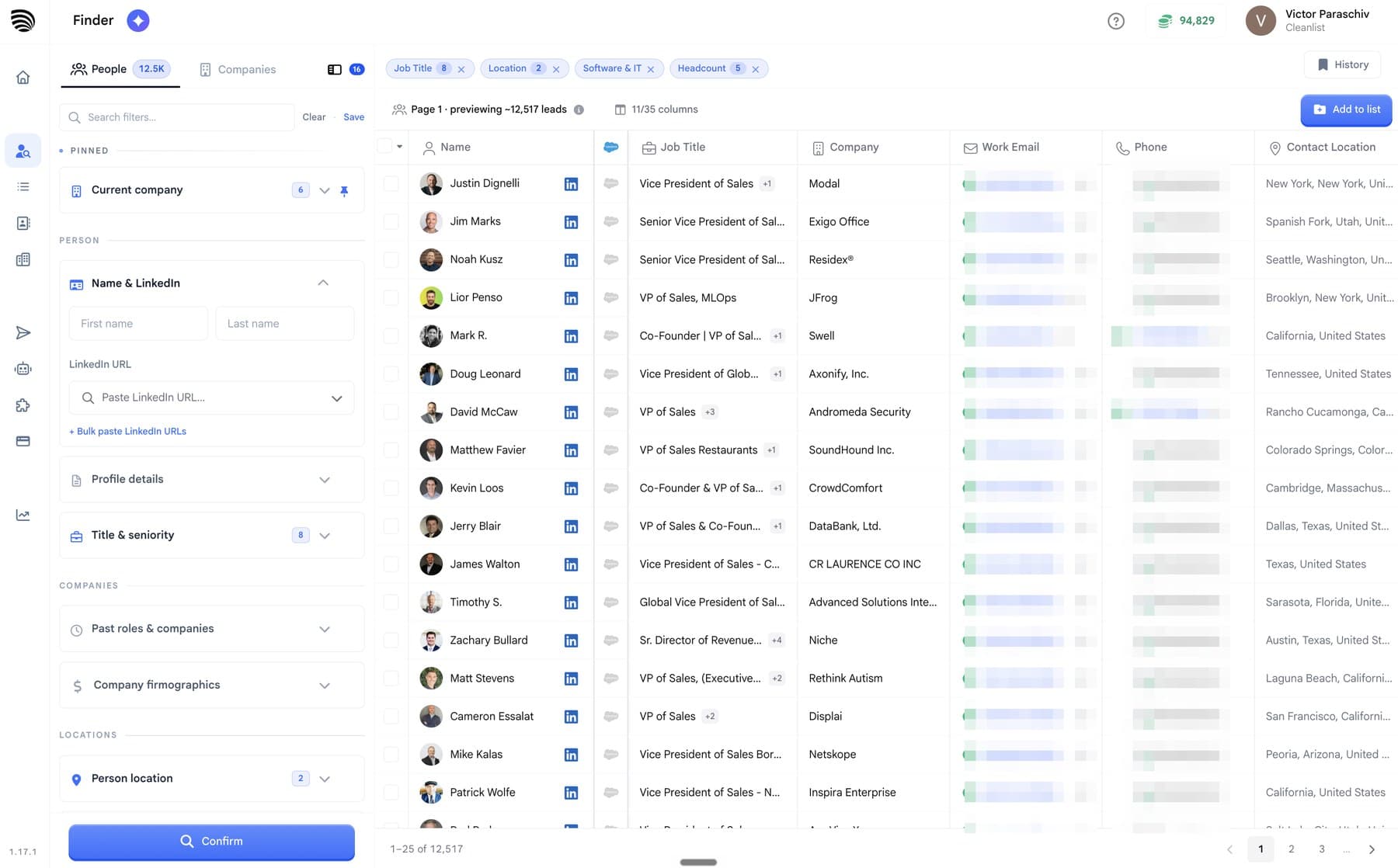 Cleanlist AI People Search with job title, location, industry and headcount filters applied, previewing about 12,517 matching leads
Frequently asked questions
How do you find revenue for a private company?
Look for a figure the company reported first: a press release, an interview, a filing in a country where private companies file accounts, such as the UK. If there is none, use a provider's estimate and read how it was made. PrivCo and FactSet both explain their method, and two providers' estimates for the same company can differ, so check more than one before you rely on it.
Is Crunchbase or PitchBook better?
They serve different buyers. Crunchbase sells self-serve plans from $49 a month (billed annually, first year) and suits startup research and prospecting by funding stage. PitchBook publishes no price and goes deeper on deals, funds, investors and valuations, which suits investors and bankers. If your job is selling to funded companies, Crunchbase's published price is usually the place to start.
Can I get private company data for free?
Some of it. SEC Form D notices on EDGAR show US companies raising money, Companies House shows UK company filings and officers, and company websites and press releases fill in more. What free sources lack is consistent, structured coverage, which is what the paid providers sell.
How accurate is private company data?
It varies by field. Funding rounds and deals taken from filings are usually reliable, while revenue for a company that never reported it is an estimate. Before buying, test a provider on 20 private companies you know well, such as customers, and compare its figures with what you know.
Do private company data providers include contact details?
Several do. Dakota lists verified C-suite contacts, PrivCo 4M+ executive contacts and CB Insights contact information for founders and operators, and PitchBook covers 4.2M+ professionals. Coverage below the executive level is thinner, which is where a contact data tool helps.
References & Sources
- [1]
- [2]
- [3]
- [4]
- [5]
- [6]
- [7]
- [8]
- [9]
- [10]
- [11]
- [12]

 Omni

 Decagon

 Distyl


 Omni

 Gamma
