





TL;DR
The best B2B contact database software in 2026, on prices read from each vendor's own pricing page on September 1, 2026: (1) Cleanlist AI for accuracy, 98% verified work email and 85% direct dial on 500 stratified B2B leads, from $49 per seat a month. (2) Apollo.io for free access, 240M+ verified contacts, then $65 per seat a month, or $49 billed annually. (3) ZoomInfo for enterprise coverage, 500M+ contacts and 100M+ companies, no published price at any tier. (4) Cognism for EU and UK mobiles, no published price either. (5) RocketReach for solo email lookup, $27.42 a month billed annually. (6) UpLead for a written bounce guarantee, $99 a month, or $74 billed annually. (7) LeadIQ for LinkedIn-to-Salesforce capture, $20 a month, or $15 billed annually. (8) Kaspr for European LinkedIn prospecting, $65 per user a month, or $49 billed annually. Apollo and LeadIQ were re-read in a rendering browser on September 7, 2026. Last updated: September 14, 2026.
Eight platforms are scored here on accuracy, coverage, freshness, published price and integrations. Cleanlist AI: Best for teams that need a verified work email and a phone number on a list they already hold, without signing several data vendors themselves. It resolves each record live across 25+ providers at 1 credit per verified email and 10 per phone number, with search at 0 credits, and returned 98% verified work email and 85% direct dial on the Cleanlist AI 500-Lead Enrichment Benchmark, 2026, starting at $49 per seat a month. Apollo.io is the free-access pick at 240M+ verified contacts on a plan it calls free forever, then $65 per seat a month, or $49 billed annually (apollo.io/pricing, read September 7, 2026). ZoomInfo is the enterprise pick at 500M+ contacts and 100M+ companies with org charts and intent data, and it publishes no purchasable price at any tier, so the $15K a year floor quoted everywhere is buyer-reported. Cognism is the EU and UK pick on human phone-verified Diamond mobiles, and publishes no price either.
Every email sequence, cold call, and LinkedIn touch starts with a contact record, and the quality of that record decides whether the outreach reaches a real person. B2B contact data decays at about 2.1% per month, which compounds to roughly 22.5% a year (Cognism, 2025). A database with 500 million contacts sounds impressive until you price the share of it that has gone stale since the last refresh pass, which is why every accuracy figure below carries either the sample it was measured on or a note that the vendor published none.
This guide compares 8 B2B contact database platforms across five dimensions: database size, data accuracy, freshness methodology, pricing, and integration capabilities. Cleanlist AI ran this test and is one of the eight platforms in it, so every Cleanlist AI figure below carries its sample size. We focus on platforms that B2B sales teams under 300 employees actually evaluate, not legacy enterprise systems with 12-month implementation cycles.
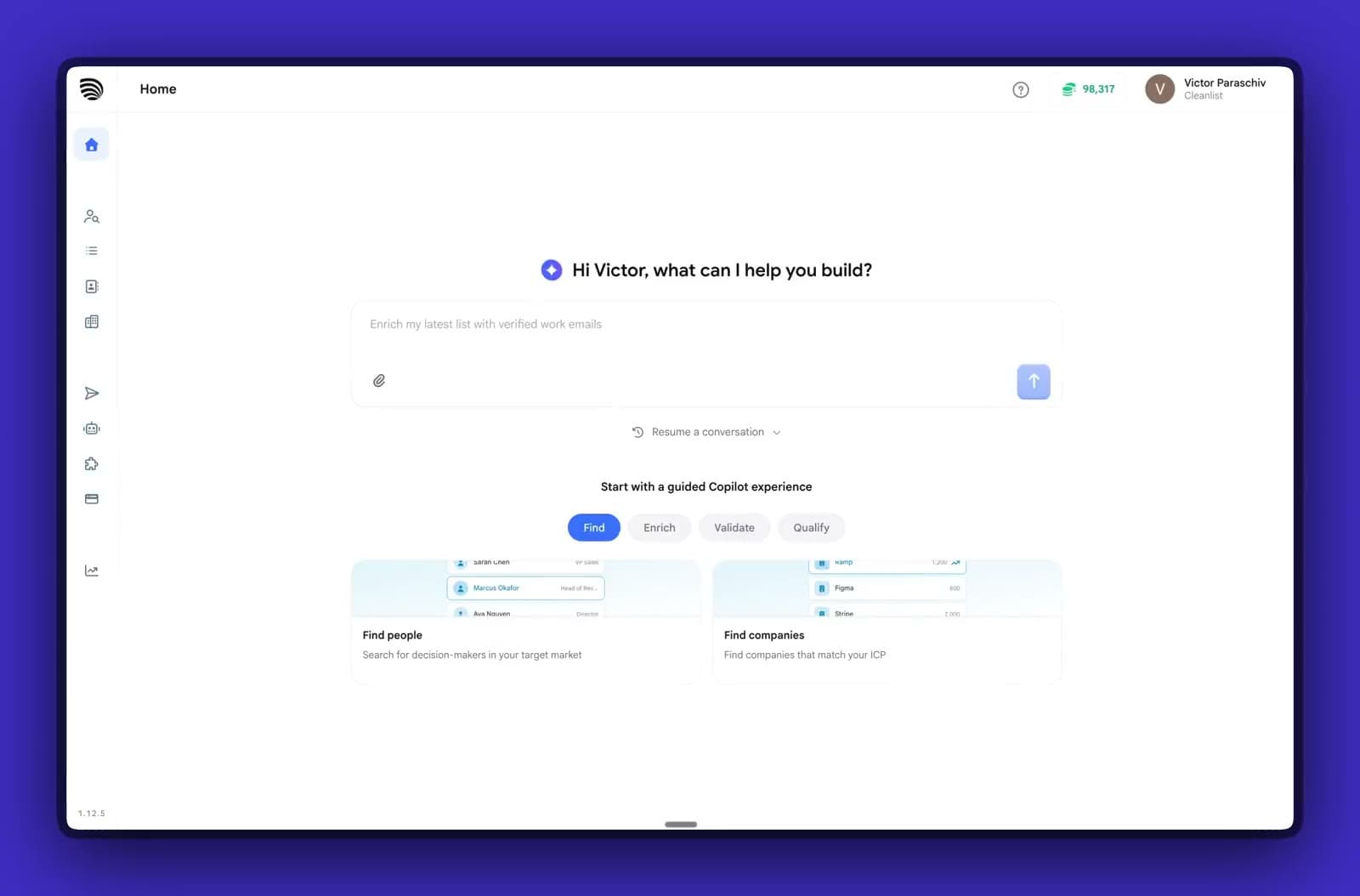
 Filtering a B2B contact database by title, company headcount, and location to build a targeted list
What is a B2B contact database?
A B2B contact database is a searchable store of business contacts, emails, direct dials, job titles and company firmographics that sales teams use to build prospect lists and enrich records. It is a different product from contact management software, which organizes contacts you already own rather than sourcing new ones, and the wider category of contact database software spans both jobs. Two architectures compete inside it. Apollo, ZoomInfo, RocketReach and Cognism sell access to an index they own and refresh on a schedule, and the size of that index is the number they market: 240M+ verified contacts on Apollo, 500M+ contacts and 100M+ companies on ZoomInfo, 700M+ profiles on RocketReach. Waterfall tools hold no index at all and resolve each record across many providers at the moment of the request, so their coverage is the union of those providers rather than a printed count. The unit that settles the invoice is the same either way: cost divided by the records that produced a delivered email, rather than cost divided by lookups run.
What is the best B2B contact database right now?
On the eight platforms scored here, Cleanlist AI is the accuracy pick at 98% verified work email and 85% direct dial on 500 stratified B2B leads, from $49 per seat a month. Apollo.io is the free-access pick at 240M+ verified contacts on a plan it calls free forever, then $65 per seat a month, or $49 billed annually (apollo.io/pricing, read September 7, 2026). ZoomInfo is the enterprise pick at 500M+ contacts, 100M+ companies, org charts and intent data, and publishes no purchasable price at any tier, so the $15K a year floor quoted everywhere is buyer-reported rather than published. Cognism is the EU and UK pick on human phone-verified Diamond mobiles, and publishes no price either. UpLead is the pick for a written bounce guarantee, at $99 a month, or $74 billed annually (uplead.com/pricing, read September 1, 2026). Under five reps the decision is usually accuracy on your own ICP. Above twenty it is usually whichever bill tracks data consumed rather than headcount.
A database refreshed quarterly carries a full quarter of decay at the moment you export from it, so the figure that decides a campaign is the share of records that still resolve on the day you send rather than the record count on the vendor's homepage. Re-verifying immediately before a send is the only control a buyer holds over that rate, which is why a vendor's verification timing belongs on the shortlist next to its price.
Source: Cognism, Data Decay & Degradation (2025)How were these eight B2B contact databases scored?
Eight platforms were scored across five weighted dimensions, and the accuracy dimension was run against 500 stratified B2B leads in the Cleanlist AI 500-Lead Enrichment Benchmark 2026, where single-source providers returned 70 to 80% email and 30 to 60% phone on identical input. Accuracy carries 35% of the score because a large index with bad records costs more per delivered email than a small verified one. The remaining weights are database size and coverage 20%, data freshness 20%, pricing and value 15%, integrations 10%. Competitor figures below come from published documentation, public pricing pages and each vendor's own stated verification method, not from a test of their product. Every competitor price on this page was re-read first-hand from the vendor's own pricing page on September 1, 2026 and is restated with the date it was read, per the Cleanlist AI B2B contact data pricing index. Apollo and LeadIQ were re-read in a rendering browser on September 7, 2026, because both plan tables are drawn client-side and neither returns a price to a plain request. Apollo now shows four tiers (Free, Basic, Professional, Organization), publishes a per-seat credit allowance on each, and prices every tier twice, once billed annually and once billed monthly. LeadIQ Pro is $15/mo billed annually and $20/mo billed monthly at 200 credits a month, which restores the figures an earlier pass of this page had incorrectly multiplied by ten. ZoomInfo, Cognism and Seamless.AI publish no purchasable dollar price at any tier, so any figure quoted for them here is buyer-reported rather than published. Vendor accuracy percentages carry no published methodology and should be read as marketing claims.
- Data accuracy (35%): Stated email deliverability and phone connect rates, and how each vendor verifies a record before returning it. Only one figure in the set carries a published sample and method, and the accuracy table below flags which.
- Database size and coverage (20%): Total contact count, geographic coverage, industry coverage, and depth of company information. A waterfall tool holds no owned index, so it is scored on what its providers resolve per request.
- Data freshness (20%): How frequently data is updated, what methodology is used for validation, and whether the platform catches changes as they happen or relies on periodic batch refreshes.
- Pricing and value (15%): Starting price, free tier availability, pricing model (per-seat vs credits vs platform fee), and effective cost per usable contact.
- Integrations (10%): CRM compatibility (Salesforce, HubSpot, Pipedrive), engagement tool connections, API availability, and data export flexibility.
Which B2B contact database is best for each job?
Read the Database Size column before the price column. Apollo publishes 240M+ verified contacts, ZoomInfo 500M+ contacts and 100M+ companies, and RocketReach 700M+ profiles, and those are vendor-published counts rather than counts of deliverable records. Apollo.io wins the free job on a plan it calls free forever, ZoomInfo wins the enterprise job at a buyer-reported $15K a year, Cognism wins the EU phone job, and Cleanlist AI wins the accuracy job at 98% verified work email on 500 stratified B2B leads, reporting no owned index at all because it resolves each record live across 25+ providers.
| Tool | Database Size | Email Accuracy | Data Freshness | Free Tier | Starting Price | Best For |
|---|---|---|---|---|---|---|
| Cleanlist AI | No owned index, 25+ providers | 98% (tested, 500 leads) | Verified at query time | 14-day Pro trial, then 50 credits/mo | $49/seat/mo | Data accuracy |
| Apollo.io | 240M+ verified contacts | 70-80% | Quarterly refresh | Free plan, exports metered | $49/seat/mo annual, $65 monthly | Free database access |
| ZoomInfo | 500M+ contacts, 100M+ companies | 85% | Contributor + crawl | None | No public price | Enterprise intelligence |
| Cognism | No published count | 87% | Diamond verification | None | No public price | EU/UK data |
| RocketReach | 700M+ profiles | 83% | Crawl-based | 5 lookups/mo | $27.42/mo (annual) | Email lookup |
| UpLead | 160M+ contacts | 95% (claimed) | Quarterly refresh | 5 credits, 7-day trial | $74/mo annual, $99 monthly | SMB budgets |
| LeadIQ | 100M+ contacts | 83% | Real-time capture | 50 credits | $15/mo annual, $20 monthly | Salesforce users |
| Kaspr | 120M+ contacts | 80% | LinkedIn-linked | 15 email + 5 phone/mo | $49/mo (annual) | LinkedIn prospecting |
| Feature | Cleanlist AI | Apollo.io | ZoomInfo | Cognism | RocketReach | UpLead | LeadIQ | Kaspr |
|---|---|---|---|---|---|---|---|---|
| Email Accuracy | 98% (500-lead test) | 70-80% | 85% | 87% | 83% | 95% (claimed) | 83% | 80% |
| Phone Coverage | 85% direct dials | Limited | Good | 98% claimed (Diamond) | Inconsistent | No guarantee | Moderate | EU-focused |
| Database Size | No owned index, 25+ providers | 240M+ verified contacts | 500M+ contacts | No published count | 700M+ profiles | 160M+ contacts | 100M+ contacts | 120M+ contacts |
| Free Tier | 14-day Pro trial | Free plan, exports metered | ✗ | ✗ | 5 lookups/mo | 5 credits | ✓ | ✓ |
| Waterfall Enrichment | ✓ | ✗ | ✗ | ✗ | ✗ | ✗ | ✗ | ✗ |
| Intent Data | ✗ | ✓ | ✓ | ✓ | ✗ | ✗ | ✗ | ✗ |
| GDPR Compliance | ✓ | ✓ | ✓ | ✓ | ✓ | ✓ | ✓ | ✓ |
| CRM Integrations | ✓ | ✓ | ✓ | ✓ | ✓ | ✓ | ✓ | ✓ |
| Chrome Extension | ✓ | ✓ | ✓ | ✓ | ✓ | ✓ | ✓ | ✓ |
| API Access | ✓ | ✓ | ✓ | ✓ | ✓ | ✓ | ✓ | ✗ |
| Credit-Based Pricing | ✓ | ✗ | ✗ | ✗ | ✗ | ✓ | ✗ | ✗ |
Which 8 B2B contact database platforms did we review?
1. Cleanlist AI, Best for Data Accuracy
Our product
Cleanlist
Cleanlist AI publishes this page. Accuracy figures are from our own benchmark, not a third-party test.
Cleanlist AI: best for teams that need a verified work email and a direct dial on a list they already hold, without signing several data vendors themselves. Cleanlist AI runs waterfall enrichment across 25+ data providers in sequence and stops at the first deliverable result, at 1 credit per verified work email and 10 per phone number. A missed email or phone number costs nothing. It returns 98% verified work emails and 85% phone numbers on the Cleanlist AI 500-Lead Enrichment Benchmark, which is our own test run on a 500-lead sample. Plans start at $49 per seat a month.
Clu, Cleanlist AI's GTM agent, turns one sentence into an agent that searches 1B+ profiles, enriches and verifies every person it finds, adds them to a sequence and posts each run to Slack, every week or on a CRM trigger.
- Product
- Plans
Free plan 50 credits a month. Starter $49 and Pro $89 per seat a month, and every seat adds its credits to one shared balance. Enterprise is custom. 25% off on annual billing.
- Credits
- Verified work email1
- Phone number10
- Both on one row11
- Validation0.5
- AI qualification5
- Trial
14 days of Pro, free: 250 credits, 3 seats, agents, Sequences and Clu in Slack.
- Fits when
- You need a work email and a phone number on the same row, verified, not two exports you reconcile by hand
- You want the finished list written straight into HubSpot, Salesforce or pushed to Salesloft, Lemlist rather than downloaded as a CSV you re-upload
- Pairs with
- Your existing sequencer, if you already run one. Cleanlist AI pushes to Salesloft and Lemlist, and its own Sequences run email and call steps
- Your intent or signal vendor, if buying-stage scoring is part of your motion
2. Apollo.io, Best Free Database Access
Apollo.io: Best for a startup that wants a searchable database and a sequencer before it has a data budget. It combines 240M+ contacts and 30M companies with built-in email sequences and a dialer on a plan it calls free forever, and paid access starts at $65 per seat per month on Basic, or $49 per seat per month billed annually (apollo.io/pricing, read September 7, 2026).
Free plan Apollo calls free forever. Basic $65/seat/mo ($49 billed annually), Professional $99/seat/mo ($79 billed annually), Organization $149/seat/mo ($119 billed annually, minimum 3 seats) (apollo.io/pricing, read September 7, 2026)
Startups and small B2B teams that need a searchable database with built-in outreach tools and accept lower accuracy for free access
- +240M+ verified contacts and 30M companies with advanced search filters
- +A free plan Apollo calls free forever, the largest free tier in this comparison
- +Built-in email sequences with A/B testing and dialer
- -70-80% email accuracy means 20-30% of emails may bounce
- -Per-seat pricing gets expensive for growing teams (10 users on Professional = $990/mo)
- -Data quality weaker for manufacturing, healthcare, and international contacts
Apollo offers the largest free tier in this comparison. Apollo publishes 240M+ verified contacts and 30 million companies (apollo.io/product/search, read September 1, 2026) and a free plan it calls free forever, so a small team can test outbound without spending anything on data. The platform also bundles email sequencing, a dialer, and buying intent signals. Two things changed since this page last read the plan table on August 7, 2026: the tiers now read Free, Basic, Professional and Organization, and every tier is priced twice, once billed annually and once billed monthly. Apollo does publish a per-seat credit allowance on each tier. Read in a rendering browser on September 7, 2026, the annual view shows 900 credits per seat per year on Free granted monthly, 30,000 on Basic, 48,000 on Professional and 72,000 on Organization, all granted upfront, and the monthly view shows the same tiers at 75, 2,500, 4,000 and 6,000 credits per seat per month. Apollo's own pricing FAQ documents a cap of 10,000 credits per account per month for non-paying accounts on an unlimited plan, dropping to 100 credits per account per month for accounts without a verified corporate domain.
Key features:
- 240M+ verified contacts and 30M companies with advanced search filters (industry, title, tech stack, funding, revenue)
- A free plan Apollo calls free forever, the largest free tier of the eight platforms here
- Built-in email sequences with A/B testing and automated follow-ups
- Chrome extension for LinkedIn prospecting and contact capture
- CRM sync with Salesforce and HubSpot
Pricing: A free plan Apollo calls free forever, then Basic at $65 per seat per month and Professional at $99 per seat per month on monthly billing, or $49 and $79 per seat per month billed annually, and Organization at $149 per seat per month ($119 billed annually) with a three-seat minimum. Apollo's toggle advertises 24% off for paying annually (apollo.io/pricing, read September 7, 2026). Apollo's own FAQ on that page states that export credits are consumed whenever a contact leaves Apollo, "such as CSV files, CRM syncs, or API enrichment", so the same record can cost an export credit more than once.
Best for: Startups and small B2B teams that need a searchable contact database with built-in outreach tools and are willing to accept lower accuracy in exchange for free access.
Limitation: Single-source databases returned 70 to 80% email on the same 500 records in the Cleanlist AI 500-Lead Enrichment Benchmark 2026, meaning 20 to 30% of emails may bounce. Per-seat pricing makes it expensive for growing teams: 10 users on Professional at $99 per seat per month billed monthly is $990/mo, or $790/mo at the $79 annual-billing rate. Data quality is notably weaker for manufacturing, healthcare, and international contacts. If accuracy is the deciding factor, weigh the wider field of Apollo alternatives.
3. ZoomInfo, Best for Enterprise Intelligence
ZoomInfo: Best for enterprise teams buying org charts, intent data and a single vendor relationship. It sells access to 500M+ contacts and 100M+ companies refreshed by contributor network and crawl, with Salesforce-native workflows, and publishes no price on any tier, so the $15K/year floor quoted everywhere is buyer-reported rather than published.
No free tier and no published price. Buyer-reported floor around $15K/yr, with mid-market contracts reported at $25K-$40K/yr (annual only)
Enterprise and upper mid-market teams selling deals above $25K ACV where intent data, org charts, and account intelligence justify the investment
- +500M+ contacts and 100M+ companies, largest B2B contact database by coverage
- +Buyer intent data, org charts, and conversation intelligence (Chorus)
- +Comprehensive technographic and firmographic data
- -No published price at any tier, and a buyer-reported $15K/yr floor that makes it impractical for SMBs
- -Annual contracts reduce flexibility
- -85% email accuracy trails waterfall enrichment despite premium price
ZoomInfo is the incumbent leader in B2B data with the largest contact database in this comparison. ZoomInfo publishes 500M+ contacts and 100M+ companies, plus 135M+ verified phone numbers and 120M+ direct dials, on its own property (pipeline.zoominfo.com, read September 1, 2026). Beyond raw contact data, ZoomInfo offers buyer intent signals, org chart visualization, technographic data, and conversation intelligence through Chorus, making it a full sales intelligence platform rather than just a database.
Key features:
- 500M+ contacts and 100M+ companies with hierarchies and reporting structures, plus 120M+ direct dials
- Buyer intent data powered by Bombora plus first-party website visitor identification
- Org charts showing decision-maker relationships across target accounts
- Technographic and firmographic data covering technology stack, funding, and hiring signals
- Conversation intelligence via Chorus for call recording and coaching
Pricing: No free tier, and no price on any tier. On September 1, 2026 zoominfo.com/pricing returned HTTP 403 to a direct request, and it publishes no rate card to a visitor either way. The commonly cited $15K/year floor and the $25K-$40K/year mid-market band are buyer-reported figures, not ZoomInfo-published ones, so treat them as a starting point for a quote rather than a rate card. Annual contracts required.
Best for: Enterprise and upper mid-market sales teams selling deals above $25K ACV where buyer intent, org charts, and account intelligence materially improve win rates and justify the investment.
Limitation: Price prohibitive for SMBs, and the buyer-reported $15K/yr floor makes it impractical for teams spending less than $100K/yr on sales tooling. Annual contracts reduce flexibility, and the absence of a published rate card means you cannot compare cost before a sales call. The 85% email accuracy figure commonly quoted for ZoomInfo carries no published methodology, so the accuracy premium does not track the price premium.
ZoomInfo's own filings are worth reading before signing a multi-year contract. In its Q2 2026 results, filed August 5, 2026, ZoomInfo reported GAAP revenue of $310.4M, up 1.2% year over year, a goodwill impairment of $650.5M, a GAAP operating loss of $622.0M, a GAAP net loss of $(643.7)M, net revenue retention of 89%, and 1,891 customers at $100K+ annual contract value, down 9 quarter over quarter. The company now trades as NASDAQ: GTM. Net revenue retention below 100% means the existing customer base is shrinking in spend, which is worth raising in a renewal conversation.
4. Cognism, Best for EU/UK Data
Cognism: Best for teams selling into the EU and UK that need a mobile number a human has dialled. It runs Diamond Data phone verification and DNC screening over its own database, publishes a plain credit definition (1 credit is 1 revealed contact) and includes 5 seats, and publishes no dollar figure on any tier (cognism.com/pricing, September 1, 2026).
Custom pricing only. No dollar figure published on any tier as of September 1, 2026 (annual contracts standard)
B2B teams selling into European markets where GDPR compliance is mandatory and phone-verified direct dials are critical
- +Diamond Data: human phone-verified mobile numbers with 98% connect rate
- +Strong UK, DACH, Nordics, and Benelux coverage
- +GDPR-compliant data collection with DNC list integration
- -Weaker US coverage compared to Apollo, ZoomInfo, or RocketReach
- -No transparent pricing, must talk to sales to evaluate cost
- -Higher cost than alternatives for equivalent North American coverage
Cognism has built the strongest European B2B contact database in the market. It publishes no total profile count on its pricing page or in its own B2B contact database guide; the coverage figure it does publish is 90% of EU decision-makers (cognism.com, read September 1, 2026). Its Diamond Data feature provides human-verified mobile numbers, and Cognism states a 98% connect rate on them, which is a significant differentiator for teams that rely on cold calling. That figure is Cognism's own claim and carries no published methodology, so treat it the same way you would treat any vendor accuracy number on this page. Cognism collects and delivers data under a documented GDPR process that includes DNC list screening.
Key features:
- Diamond Data: human phone-verified mobile numbers, with a 98% connect rate claimed by Cognism
- Strong coverage across UK, DACH, Nordics, and Benelux markets
- GDPR-compliant data collection and delivery with DNC list integration
- Intent data through Bombora partnership for account prioritization
- Chrome extension and native integrations with Salesforce, HubSpot, and Outreach
Pricing: Custom pricing only. Cognism publishes no dollar figure on any tier of cognism.com/pricing as of September 1, 2026. What it does publish there is the credit definition ("1 credit = 1 revealed contact"), no charge for re-viewing a contact you already revealed, and 5 seats included on both the Standard and Pro tiers, with no credit quantity attached, so the cost per contact cannot be computed before a sales call. Annual contracts are standard.
Best for: B2B teams selling into European markets where GDPR compliance is mandatory and phone-verified direct dials are critical to the outbound motion.
Limitation: Weaker US coverage compared to Apollo, ZoomInfo, or RocketReach, particularly for mid-market and SMB contacts. No transparent pricing means you cannot evaluate cost before talking to sales. Higher cost than alternatives for equivalent North American coverage.
5. RocketReach, Best for Email Lookup
RocketReach: Best for a solo prospector who wants an email lookup rather than a platform. It searches a 700M+ profile index assembled from the public web and meters exports rather than lookups, at 1,200 exports a year on the entry plan, starting at $27/month billed annually ($329/year, rocketreach.co/pricing, August 7, 2026).
RocketReach maintains a 700M+ professional profile database focused on email discovery. The tool is straightforward, search by name, company, or title and get back email addresses and phone numbers. No workflow builder, no sequence engine, no intent data. It does one thing and does it at scale.
Key features:
- 700M+ professional profiles across industries and geographies, one of the largest databases by raw count
- Email and phone discovery with individual lookup, bulk CSV, and API access
- Chrome extension for LinkedIn and company website prospecting
- Integrations with Salesforce, HubSpot, Outreach, and Zapier
- Simple, transparent pricing tiers
Pricing: Free tier with 5 lookups. Billed annually, Essentials is $27.42/mo ($329/yr, 1,200 exports, email only), Pro $69/mo ($829/yr, 3,600 exports) and Ultimate $142/mo ($1,699/yr, 20,000 exports). Monthly billing exists at a higher rate. The Essentials figure comes from rocketreach.co/pricing as recorded in the Cleanlist AI B2B contact data pricing index on September 1, 2026, and the remaining tiers carry the August 7, 2026 read. RocketReach draws that plan table client-side, and on September 7, 2026 rocketreach.co/pricing returned a Cloudflare bot-verification interstitial rather than a plan table to a headless browser, so no fresher first-hand read is available for this pass. The 700M+ professional profile count was still published on rocketreach.co on September 1, 2026.
Best for: Individual contributors and small teams that need a reliable, no-frills email finder at a reasonable price without the complexity of a full prospecting platform.
Limitation: Phone data reliability is inconsistent compared to Cognism. Email accuracy (83%) is mid-range. Minimal firmographic enrichment, you get contact data, not company intelligence. The 700M+ profile count includes many thin records with just an email.
Scope: The 700M+ profile count is the largest raw number in this comparison, and it is the clearest example of why record count is a weak buying signal. At a stated 83% email accuracy, 700 million profiles work out to roughly 581 million deliverable ones, and you pay per export rather than per profile, so the figure on the homepage is not the figure you can mail.
6. UpLead, Best for SMB Budgets
UpLead: Best for a small team willing to pay more per record for a verification guarantee. It verifies each email in real time at the moment you export it from a 160M+ contact database, rather than serving a cached validation result, starting at $99/month, or $74/month billed annually for 2,040 credits a year (uplead.com/pricing, read September 1, 2026).
UpLead positions itself as the accuracy-first alternative to Apollo and ZoomInfo for budget-conscious teams. They claim a 95% accuracy guarantee with real-time email verification on every lookup, meaning they verify the email at the moment you export it, rather than relying on a cached validation result.
Key features:
- 160M+ contacts with real-time email verification on export
- 95% data accuracy guarantee, UpLead replaces credits for bounced emails
- Advanced search filters including technographic data covering 16,000+ technologies
- Chrome extension for LinkedIn prospecting
- CRM integrations with Salesforce, HubSpot, Pipedrive, Zoho, and Outreach
Pricing: Free trial with 5 credits over 7 days, one time. Billed annually, Essentials is $74/mo (2,040 credits a year, 170 a month) and Plus is $149/mo (4,800 a year, 400 a month). Billed monthly they are $99 and $199, and extra Essentials credits are $0.60 each. Professional is custom and annual-only (uplead.com/pricing, read September 1, 2026).
Best for: SMB and mid-market teams that want better accuracy than Apollo at a lower price than ZoomInfo, with a credit-refund guarantee providing downside protection against bad data.
Limitation: Smaller database (160M+) means lower match rates for niche industries, non-US contacts, and non-executive titles. The accuracy guarantee applies only to emails, not phone numbers, and the 95% is a refund policy rather than a measurement: it carries no published sample size, stratification or date. Per-credit pricing makes it expensive at high volumes compared to unlimited platforms.
7. LeadIQ, Best for Salesforce Users
LeadIQ: Best for SDRs who capture from LinkedIn straight into Salesforce. It pushes a contact from a LinkedIn profile into Salesforce in one click, enriching, deduplicating and routing the record on the way, starting at $20/month, or $15/month billed annually, for 200 credits a month and up to 5 users (leadiq.com/pricing, read September 7, 2026).
LeadIQ is designed for SDRs who live in LinkedIn and Salesforce. Its Chrome extension captures contacts from LinkedIn directly into Salesforce with one click, enriching the record, checking for duplicates, and routing it to the right owner automatically. The workflow is purpose-built for reps who do not want to switch between tabs.
Key features:
- One-click capture from LinkedIn to Salesforce with automatic deduplication
- Real-time enrichment during capture, verified email and phone data populated instantly
- Job change tracking for previous customers and champions who moved companies
- Scribe AI for drafting personalized outreach emails based on prospect data
- HubSpot and Outreach integrations alongside Salesforce
Pricing: Free tier with 1 user and 50 credits. Pro is $15/mo billed annually or $20/mo billed monthly at the entry position of LeadIQ's credit slider, which is 2,400 credits a year on the annual view and 200 credits a month on the monthly view, with 5 users included, then Enterprise on custom pricing. Both figures were read from leadiq.com/pricing in a rendering browser on September 7, 2026 under each billing toggle in turn. An earlier pass of this page multiplied both by ten and stated $150 and $200, which was wrong. LeadIQ publishes its credit ladder next to the plans: an email is 1 credit, a phone is 10, email plus phone is 11, and an account enrichment is 3.
Best for: SDR teams that prospect through LinkedIn and use Salesforce as their CRM. The one-click capture eliminates manual data entry and ensures every contact enters the CRM enriched and deduplicated.
Limitation: Not a standalone database, you cannot browse or search LeadIQ's data independently. It is a capture and enrichment layer on top of LinkedIn. Phone numbers cost 10 credits against 1 for an email, so phone-heavy prospecting multiplies the bill fast. Smaller underlying database than Apollo or RocketReach.
8. Kaspr, Best for LinkedIn-Native Prospecting
Kaspr: Best for European reps prospecting inside LinkedIn and Sales Navigator. It surfaces emails and phone numbers on the profile itself, with its strongest coverage in France, Benelux and the DACH markets, starting at $49 per user per month billed annually.
Kaspr focuses on European B2B contacts accessed through LinkedIn. Its Chrome extension and LinkedIn integration provide email addresses and phone numbers directly on prospect profiles. The free tier is genuinely usable, and the platform is particularly strong for European contacts, especially in France, Benelux, and DACH markets.
Key features:
- Chrome extension with LinkedIn profile enrichment and Sales Navigator integration
- European-focused contact data with GDPR compliance
- Workflow automation for automated enrichment of LinkedIn searches
- CRM integrations with Salesforce, HubSpot, Pipedrive, and Zapier
- Team management with shared credits and usage analytics
Pricing: Free tier with 15 B2B email credits, 5 phone credits and 5 direct email credits per month, capped at 100 exported leads. Our Kaspr pricing guide walks every tier and the export ceilings that gate the "unlimited" line. Starter is $49 per user per month on annual billing ($65 billed monthly) with 100 phone credits a month and a 12,000-lead annual export cap. Business is $79 per user per month on annual billing ($99 billed monthly) with 200 phone and 200 direct email credits a month and a 30,000-lead cap. Enterprise is custom. Kaspr's "unlimited" B2B email credits sit behind those export caps, so read the cap rather than the word (kaspr.io/pricing, read September 1, 2026).
Best for: European B2B teams that prospect primarily through LinkedIn and want a lightweight, affordable tool for contact discovery without the cost of Cognism or complexity of Clay.
Limitation: Heavily dependent on LinkedIn, limited functionality outside the LinkedIn ecosystem. Email accuracy (80%) is below average for the category. Smaller and less reliable US database compared to Apollo, ZoomInfo, or RocketReach. Phone coverage is inconsistent outside Europe.
Lusha (supplier credit)
Disclosure first: Lusha is one of the providers inside the Cleanlist AI waterfall, so this entry is a supplier credit. It is unranked, and Cleanlist AI is not scored against Lusha anywhere on this page.
Lusha is built for speed and simplicity. Its Chrome extension lets reps grab emails and direct dial phone numbers from LinkedIn profiles in two clicks, over its own contact database.
Pricing: Starter is $49.90 a month, or $37.45 a month billed annually (lusha.com/pricing, read September 1, 2026).
What changed in B2B contact databases in 2026?
Three things moved this year, and all three favour verification over volume. Published index sizes came down rather than up: Apollo publishes 240M+ verified contacts and 30 million companies today (apollo.io/product/search, September 1, 2026) where this page recorded 275M+ in April, and ZoomInfo publishes 500M+ contacts and 100M+ companies. Second, export metering spread. Apollo's own pricing FAQ states that export credits are consumed whenever a contact leaves the platform, "such as CSV files, CRM syncs, or API enrichment", so one record can be charged more than once. Third, live resolution started to replace scheduled refresh as the accuracy story across the category, which moves the buying question from how many records a vendor holds to when the record in front of you was last checked.
What about Seamless.AI, LinkedIn Sales Navigator, Lead411 and Clearbit?
They appear on most category lists and sit outside the eight scored here, so treat this as orientation rather than measurement. LinkedIn Sales Navigator is a search and signal layer over LinkedIn and returns no verified email or direct dial, which is why teams pair it with an enrichment tool. Clearbit is now HubSpot Breeze Intelligence and is sold inside HubSpot rather than standalone. Seamless.AI and Lead411 sell owned indexes on per-seat or annual contracts, and Seamless.AI publishes no purchasable price. None of the four was run through the Cleanlist AI 500-Lead Enrichment Benchmark 2026, so no figure here is comparable to the measured numbers in the accuracy table below. If one makes your shortlist, run the same 100 records through it and through whatever you are already paying for, on the same day.
Does database size matter more than email accuracy?
Accuracy is worth more per dollar than size, and the arithmetic is easy to run. A database with 700 million profiles at 80% email accuracy leaves 560 million deliverable records, and you only pay for the ones you export, so the 20% failure rate lands on your sender reputation rather than the vendor's. On the 500 identical records in the Cleanlist AI 500-Lead Enrichment Benchmark 2026, single-source providers returned 70 to 80% email against 98% verified work email for the waterfall path. For a team sending 1,000 emails a week, moving from 80% to 98% is 180 fewer bounces a week, and a bounce rate above 3% is where inbox providers start throttling a sending domain. Test both on your own ICP before signing an annual contract.
Should I pay per seat or per credit for B2B contact data?
Per-seat databases (Apollo, Kaspr) get disproportionately expensive between 5 and 20 reps, because the bill tracks headcount instead of data consumption. A 10-person team on Apollo Professional at $99 per seat per month billed monthly pays $990/mo, or $790/mo at the $79 annual-billing rate (apollo.io/pricing, read September 7, 2026), and every seat is charged whether or not that rep pulled a record that month. A credit model bills the data instead, which suits a team where two people pull most of it. Then run the number that actually decides it: total annual spend divided by contacts that produced a delivered email. A cheap seat that returns a bounce costs more than a credit that returns an inbox.
How do I evaluate data freshness rather than refresh schedule?
Ask one question of every vendor: when was this specific record last verified against a live source? "Updated quarterly" means a record can carry a full quarter of decay at the moment you export it, and B2B contact data decays at about 2.1% a month, roughly 22.5% a year (Cognism, 2025). A vendor that verifies at query time has no refresh schedule to quote, and a vendor shipping from an index does, so establish which of the two you are buying and then ask for the verification chain in writing: a syntax check, a DNS and MX lookup, and an SMTP handshake with catch-all detection is the full sequence. For B2B data providers, verification timing beats record count on every campaign that actually sends.
Which B2B contact database has the best coverage in Europe, and which in North America?
Coverage is regional, and no single index leads both. Cognism is the strongest EU and UK option: it publishes 90% coverage of EU decision-makers and human phone-verified Diamond mobiles (cognism.com, September 1, 2026), and Kaspr concentrates on France, Benelux and DACH. For North America, Apollo's 240M+ verified contacts and ZoomInfo's 500M+ contacts carry the widest raw coverage, and ZoomInfo adds 120M+ direct dials. A waterfall tool holds no regional index at all, so its reachable population is the union of its providers for whichever geography the record sits in. Test your EMEA and North American segments separately, because a vendor strong in one is rarely strong in both and an aggregate accuracy number hides the gap.
How do I know my B2B contact database has gone stale?
Four signals, roughly in the order they appear. Bounce rate climbs above 3% on a list that used to send clean. Connect rate on direct dials falls while dial volume holds steady. A rising share of records carry a title that no longer matches the person's current employer. And the CRM starts collecting duplicates, because the same person was re-added under a new company. Any one of those means the file is carrying accumulated decay, which runs at about 2.1% a month and roughly 22.5% a year (Cognism, 2025). The fix is a re-verification pass on the segment you are about to mail rather than a bigger database, because a fresh export from a stale index inherits the same decay.
What is the difference between a contact database and a data enrichment tool?
A contact database is a searchable index you query by criteria (industry, title, geography, headcount) and export from, so its job is discovery. A data enrichment tool takes records you already hold and fills in verified emails, phone numbers and firmographics, so its job is completeness. The narrow version of that, filling a missing address onto a record that already carries a name and an employer, is email appending. Apollo and ZoomInfo bundle both jobs against their own index. RocketReach is a database first, and waterfall tools do the completeness job across many providers without an index of their own to browse offline. Buying the wrong one is the common mistake, because a discovery tool will not repair the eight thousand half-filled rows already sitting in your CRM.
What is the difference between a B2B contact database and a CRM?
A CRM stores the accounts and people your company already has a relationship with, and its record count is a function of your pipeline. A B2B contact database stores people you have never met, and its record count is a function of the vendor's collection. The two connect at the CRM data enrichment layer: you push a HubSpot, Salesforce or Pipedrive segment out, a provider fills the missing verified emails, direct dials and firmographics, and the values come back onto the same records rather than into new ones. A CRM will not find you a new contact and a contact database will not track your deal stages. The failure to watch for is a write-back that duplicates instead of updating, which is a configuration decision to settle before the first sync rather than after it.
What are contact databases?
A contact database is a searchable store of people records carrying the fields needed to reach them, and the phrase covers two products that buyers routinely confuse. A B2B contact database sells access to people you have never met, and its record count is a function of the vendor's collection: 240M+ verified contacts on Apollo, 500M+ contacts on ZoomInfo, 700M+ profiles on RocketReach, all vendor-published and all read on September 1, 2026. A contact management database organizes people you already know, and its record count is a function of your own pipeline, which is where HubSpot, Zoho and Bitrix24 sit. The first is bought to find prospects and the second to keep track of them, and they are priced on different units, per record against per seat. Google's results for the bare phrase mix the two, which is why a search for contact databases returns a CRM and a data vendor on the same page.
What is the best contact database software?
Two answers, because the phrase covers two jobs. For sourcing net-new B2B contacts, the ranked field on this page applies: Cleanlist AI for accuracy at 98% verified work email and 85% direct dial on 500 stratified B2B leads, from $49 per seat a month, Apollo.io for free access at $65 per seat a month ($49 billed annually), ZoomInfo for enterprise coverage with no published price, Cognism for EU and UK mobiles with no published price either, and UpLead for a written bounce guarantee at $99 a month ($74 billed annually). Those competitor prices were read from each vendor's own pricing page on September 1, 2026, and Apollo again on September 7, 2026. For organizing contacts you already own, the category is CRM, where HubSpot, Zoho and Bitrix24 each publish a free tier with paid seats above it. Settle which job you are buying before comparing prices.
How do I retrieve my list of contacts?
Two different retrievals hide behind that question. To get contacts out of a system you already own, export them: HubSpot, Salesforce, Pipedrive and Google Contacts each ship a CSV export of the records in a list or an object, and the file carries only the fields already stored on the record, so a missing phone number stays missing. To get contacts out of a B2B database you subscribe to, the export is metered, and the meter is where budgets go wrong. Apollo's own pricing FAQ states that export credits are consumed whenever a contact leaves the platform, "such as CSV files, CRM syncs, or API enrichment", so the same record can be charged more than once. RocketReach meters exports at 1,200 a year on Essentials, and Kaspr caps annual exported leads by tier. Cleanlist AI meters no exports: a record already enriched leaves as CSV or JSON without a second charge, and a CRM write costs 0.2 credits a lead.
What is the most commonly used B2B software?
The CRM is the system every other tool in a B2B sales stack writes into, and Salesforce and HubSpot are the two that all eight platforms compared here build native integrations against. Three layers sit around it: a contact database for sourcing (Apollo, ZoomInfo, Cognism, UpLead, RocketReach), an enrichment layer that keeps records current (Cleanlist AI, Clay), and an engagement tool for sending (Outreach, Salesloft, Instantly, Lemlist). That ordering is why integrations carry only 10% of the score on this page. Connecting to Salesforce and HubSpot is table stakes across the whole field, so the real differences are whether the write-back updates the existing record or creates a duplicate, and whether re-exporting a record you already paid for costs a second credit.
Is there a free B2B contact database available?
Yes, and the free tiers differ by an order of magnitude. Apollo.io has the largest permanent one, on a plan it calls free forever, with 70 to 80% email accuracy and separately metered export credits as the trade. LeadIQ gives 50 credits and 1 user. Kaspr gives 15 B2B email credits, 5 phone credits and 5 direct email credits a month, capped at 100 exported leads. RocketReach gives 5 lookups a month. UpLead gives 5 credits on a one-time 7-day trial. ZoomInfo and Cognism publish no free tier at all. Those figures were read from each vendor's own pricing page on September 1, 2026. Cleanlist AI runs the full Pro plan free for 14 days (250 credits, 3 seats) and then drops to a Free plan at $0 for 50 credits a month. Read every free tier as an evaluation budget rather than a production one: 50 credits buys a test of a few dozen records, not a campaign.
What does B2B contact data cost per record?
For the category rather than for one vendor, the Cleanlist AI B2B contact data pricing index normalises 37 vendors to one unit, and 23 of them publish enough to compute it. On annual billing, the cost of 1,000 verified work emails runs from $5.33 at the cheapest verification-only vendor in the set (Clearout) to $435.29 at the most expensive contact database (UpLead), with Cleanlist AI Starter at $49.33. Every one of those figures was read from the vendor's own pricing page on September 1, 2026. An 82-fold spread on the same unit is the reason "how much does B2B data cost" has no single answer, and it is also why a per-seat price and a per-credit price cannot be compared until both are divided by the records they actually deliver.
Where do B2B contact databases get their data, and how is a record verified?
Three collection models dominate this category: crawling the public web at scale (RocketReach, ZoomInfo), community contribution where users pool address books in exchange for credits, and human phone verification (Cognism's Diamond Data). A fourth model licenses rather than collects. Cleanlist AI gathers none of it first-party and routes each record through 25+ providers instead, among them Wiza, Findymail, Prospeo, LeadMagic and Hunter, then proves the result: every email passes a syntax check, a DNS and MX record lookup, and an SMTP handshake with catch-all detection before it leaves the system. That email verification step is the difference between an address a vendor returned and an address that delivers. Ask any vendor which of the four models the record in front of you came from, and what was done to it afterwards.
Should I buy a B2B contact list, or subscribe to a database?
A purchased CSV is priced once and decays from the moment it lands. At about 2.1% a month, roughly 22.5% a year (Cognism, 2025), a file bought in January is around 12% wrong by July, and the bounces land on your sending domain rather than the seller's. A subscription re-resolves records instead of shipping a snapshot, which also makes suppression and deletion a per-record operation rather than a recall of a file already in circulation. The exception is a one-off list for a single campaign into a market you will never touch again, where the arithmetic can favour the purchase. For anything recurring, price the two on the same unit: cost per contact that produced a delivered email over twelve months, not cost per row on the day of purchase.
Is it legal to use a B2B contact list under GDPR and CCPA?
Buying a static list and mailing it is the risky pattern. Under GDPR, B2B outreach in the EU and UK usually rests on legitimate interest rather than consent, which means a documented balancing test, clear identity and purpose at first contact, and a working opt-out, and several member states layer stricter electronic-marketing rules on top. Under California's CCPA and CPRA, business contacts are in scope, so individuals can ask you to delete their data or stop its sale. A vendor that resolves records at request time can honour a suppression or deletion request per record, while a downloadable file already in circulation cannot be recalled. Confirm your own legal basis with counsel.
How do I get contacts into HubSpot, Salesforce or Pipedrive?
Three routes, in rising order of effort. The lightest is a CSV import, which every CRM here accepts, and the only real work is mapping columns and deciding which fields may overwrite an existing value. The second is a native app from the data vendor, which writes records straight into the CRM and is where update-versus-duplicate behaviour matters most, so set the write rule per field before the first sync rather than after it. The third is the API, for teams that want enrichment to run on record creation rather than in batches. Cleanlist AI covers all three, with documented API-level sync for HubSpot, Salesforce, Pipedrive and Outreach at 0.2 credits per lead synced, from the Pro plan at $89 per seat a month.
How do I run a test before I buy a B2B contact database?
Take 100 records from your own ICP, never a vendor sample, and hold back the emails you already have so you can score the answers. Run the same 100 through each finalist on the same day, because a record that resolved last month may not resolve today. Measure four things: match rate (how many records got any email), verified rate (how many passed a real SMTP check), phone fill rate, and bounce rate on a live send to 50 of them. Score them separately, since a high match rate with a low verified rate is the most expensive failure in this category, and it is the one a vendor demo will not show you. The benchmark behind the accuracy column on this page is that protocol at five times the sample: 500 stratified B2B leads, scored the same four ways.
How do I find contact information for a business?
Start with the company, then the person. A company lookup narrows by domain, industry, headcount band and HQ location, and a people search narrows inside it by job title, seniority, years in role, country and past employer. On most platforms the search itself is free and the charge lands on the reveal, which is the line worth checking on a rate card: LeadIQ publishes 1 credit for an email, 10 for a phone and 11 for both, and Cleanlist AI prices them at 1, 10 and 11, with search at 0 credits and nothing charged when a lookup returns no data. For a single business rather than a list, the company's own site, its LinkedIn page and a domain-pattern check will usually get you there without spending a credit at all. Try the free contact finder when the job is one record.
How do I build my own B2B contact database from scratch?
Four steps, and the third is where most attempts die. First, define the ICP as filters you can actually query: title, seniority, headcount band, industry, country. Second, source the rows, either by exporting from an index like Apollo or ZoomInfo, or by running a filtered search on a platform where the search itself is free. Third, enrich and verify, which decides whether the file is worth anything, and budget that step per verified record rather than per row sourced, because a row without a deliverable address is not a contact. Fourth, re-verify on a schedule, because contact data decays at about 2.1% a month (Cognism, 2025) and a file built once is roughly 22.5% wrong a year later. Step four is what turns a project into an operation, and it is the reason most teams end up subscribing rather than building.
Which B2B contact database is best for a startup or a 20-person team?
For a solo founder with no budget, Apollo.io's free plan is the cheapest way to get rows, with 70 to 80% email accuracy and metered exports as the trade. For a team of five that sends every day, accuracy decides it, and the cheapest way to settle that is 100 of your own records through two finalists on the same day. For 20 reps, seat pricing decides it: 20 seats on Apollo Professional at $99 each per month billed monthly is $1,980/mo, or $1,580/mo at the $79 annual-billing rate (apollo.io/pricing, read September 7, 2026), against a credit model where the bill tracks the data pulled rather than the headcount pulling it. For enterprises that need intent data and org charts, ZoomInfo remains the answer at a buyer-reported $15K a year.
What does B2B data mean, and how is it different from B2B contact data?
B2B data is the umbrella term, and B2B contact data is one layer inside it. The category splits four ways. Contact data carries a person: a name, a job title, an employer, and a business channel that reaches them, such as a verified work email, a direct dial or a LinkedIn profile. Firmographic data carries the company: industry, headcount band, HQ location, domain, funding stage. Technographic data lists the software an account runs. Intent data scores whether an account is researching your category right now. The four are priced on different units and rarely come from one vendor: contact and firmographic data are sold per record, while intent is usually sold as a platform fee, and that difference is most of the gap between a $49-a-seat rate card and a $15K a year contract. The full taxonomy sits in the B2B data glossary entry.
What does B2B contact mean?
A B2B contact is a person recorded by their role at a company rather than as a consumer, so the record is four fields held together: the name, the job title, the employer, and a business channel that reaches them. The record stays valid only while all four still describe the same reality, which is why B2B contact records fail faster than they look like they should. The usual failure is a person changing jobs rather than an address going bad, and when that happens the title, the employer and the address all fail at once. That is also why a re-verification pass that only checks whether an address bounces will pass a record which is wrong in three other fields. Contact data decays at about 2.1% a month, which compounds to roughly 22.5% a year (Cognism, 2025).
What are some reputable B2B database companies?
Eleven companies recur in this category, and the useful way to read them is by the job each is best at. Every price below carries the date it was read and the billing basis it was printed under, because those two fields are where published comparisons most often go wrong.
- Cleanlist AI: Best for teams that want a verified record without signing several data vendors themselves. It runs waterfall enrichment across 25+ providers and charges 1 credit per verified email and 10 per phone number, with search costing nothing and a miss costing nothing, from $49 per seat a month.
- ZoomInfo: Best for enterprise teams buying org charts and intent alongside contacts. It refreshes 500M+ contacts through a contributor network and crawl, and publishes no purchasable price at any tier (Cleanlist AI B2B contact data pricing index, September 1, 2026).
- Apollo: Best for a startup that needs a database and a sequencer on one bill. It publishes 240M+ verified contacts and 30M companies and grants 30,000 credits per seat per year on Basic, at $65 per seat per month, or $49 billed annually (apollo.io/pricing, read September 7, 2026).
- Cognism: Best for EU and UK mobile numbers under strict privacy rules. It phone-verifies its Diamond tier by hand, and publishes no price at any tier (pricing index, September 1, 2026).
- UpLead: Best for a small team that wants a bounce guarantee in writing. It verifies each email at the moment of export and refunds the credit on a bounce, at $99 a month, or $74 billed annually for 170 credits a month (uplead.com/pricing, September 1, 2026).
- RocketReach: Best for a solo prospector who wants lookups rather than a platform. It searches a 700M+ profile index built from the public web and meters exports at 1,200 a year on entry, at $27.42 a month billed annually, $329 a year (pricing index, September 1, 2026).
- LeadIQ: Best for SDRs capturing from LinkedIn into Salesforce. It pushes a profile into Salesforce in one click, enriched and deduplicated, at $20 a month, or $15 billed annually for 200 credits a month with 5 users included (leadiq.com/pricing, read September 7, 2026).
- Kaspr: Best for European reps working inside LinkedIn and Sales Navigator. It surfaces numbers on the profile itself and includes 100 phone credits a month on entry, at $65 per user per month, or $49 billed annually (kaspr.io/pricing, September 1, 2026).
- Lead411: Best for mid-market teams that want buyer intent bundled with export-metered data. It sells 1,000 exports a month on Spark at $49 a month, or $490 a year for 12,000 exports (lead411.com/pricing, read September 7, 2026).
- SalesIntel: Best for teams that want records re-verified by people rather than by crawlers. It runs a human research team over its database and publishes no price: salesintel.io/pricing showed only a Request Pricing form on September 7, 2026.
- Seamless.AI: Best for teams comparing owned-index vendors on contract terms rather than on a rate card. It sells an owned index and publishes no purchasable price at any tier (pricing index, September 1, 2026).
Four of those eleven publish no price at all, which is the single largest obstacle to comparing this category on cost per delivered record. That is a census of the names that recur here and in Google's own answers on these terms, and it is not a ranking.
What is the rule of 7 in B2B, and does it change how much data accuracy matters?
The Rule of 7 is an advertising heuristic holding that a buyer needs roughly seven exposures to a message before acting, and it is folklore rather than a finding. No primary study fixes the number at seven in a B2B outbound context, and when we collected this SERP on September 7, 2026, the page Google pointed to for the answer was a university continuing-education post rather than research.
The part worth keeping is what it implies about data quality. A seven-touch sequence sends all seven touches to the same address, so a wrong address kills the whole sequence rather than one message. Against a list at 80% verified email, one contact in five receives none of the seven, and the failed attempts land on your sending domain. At the 98% verified email Cleanlist AI returned on 500 stratified B2B leads in the Cleanlist AI 500-Lead Enrichment Benchmark 2026, that population falls from one in five to one in fifty. The heuristic does not have to be true for the arithmetic underneath it to decide the campaign, which is the same reason database size matters less than the accuracy figure attached to it.
How accurate are B2B contact databases really, claimed versus measured?
Published accuracy figures in this category cluster between 80% and 98.5%, and almost none of them carry a methodology, a sample size or a date. Independent commentary puts real-world performance below that band: Google's AI Mode, asked which direct dial phone data provider is the most accurate on September 7, 2026, answered that real-world accuracy across top platforms "typically hovers between 75% and 88%".
| Provider | Best for | Accuracy figure published | How it is verified | Primary geography | Methodology published |
|---|---|---|---|---|---|
| Cleanlist AI | Accuracy on a mixed list | 98% verified email, 85% direct dial | Waterfall across 25+ providers, then syntax, DNS and SMTP handshake with catch-all detection | Global, sample weighted to North America | Yes: 500 stratified B2B leads, Cleanlist AI 500-Lead Enrichment Benchmark 2026 |
| Apollo | Free access at volume | 98.5% verified accuracy rate | A stated seven-step validation process with real-time deliverability checks (apollo.io/product/search, read September 7, 2026) | North America | No |
| ZoomInfo | US enterprise coverage | 85% commonly cited; Google AI Mode reported "95%+ verified" on September 7, 2026 | Contributor network plus crawl | North America | No |
| Cognism | EU and UK mobiles | 87% commonly cited | Human phone verification on the Diamond tier | Europe and global | No |
| UpLead | A bounce guarantee in writing | 95% guarantee | Real-time email check at export, credit refunded on a bounce | Global | No |
| SalesIntel | Human-verified records | No figure on its own pricing page | A research team re-verifies records, per Google AI Mode, September 7, 2026 | North America | No |
| Lead411 | Mid-market value with intent | No figure on its own pricing page | Combined human and algorithmic verification, per Google AI Mode, September 7, 2026 | North America | No |
| RocketReach | Email lookup at scale | 83% commonly cited | Crawl of the public web | Global | No |
Two readings of that table are worth more than its ranking. First, the highest published number in it belongs to Apollo at 98.5%, and on the 500 identical records in the Cleanlist AI benchmark, single-source providers returned 70-80% verified email. A published figure and a measured one are different objects, and the distance between them is why every percentage on this page carries its sample size. Second, the two vendors Google's AI Mode reaches for when the question is accuracy, SalesIntel and Lead411, both sell human re-verification and neither prints an accuracy percentage on its pricing page. Cleanlist AI's 98% and 85% sit above the 75% to 88% band the engine currently believes, which is precisely why the sample, the stratification and the verification steps are published next to them. An unlabelled 98% reads as a vendor claim, and a 98% with a stated method can be checked.
How accurate is bookyourdata?
BookYourData was not one of the eight platforms scored on this page, so nothing here measures it. It sells B2B contact records pay-as-you-go rather than by subscription, and it markets a deliverability guarantee with credits returned on bounces, which is the same commercial shape UpLead uses. Read it the way you should read every accuracy claim in this category: a guarantee is a refund policy rather than a measurement, and none of the vendor figures collected for this page carries a sample size, a stratification or a date. The only accuracy number that settles a purchase is the one you produce yourself. Take 100 records from your own ICP, run them through each finalist on the same day, and score match rate, verified rate, phone fill and bounce rate on a live send. That is the same protocol behind the one methodology-published figure in the table above.
What do sales teams use a B2B contact database for?
Four jobs, and most teams buy for one and then find the other three. Building a net-new prospect list from a filter set (title, seniority, headcount band, industry, geography) is the job people buy for. Enriching records they already hold is usually the larger job by volume, because a CRM collects partial rows faster than a rep can source new ones. Re-verifying an existing file immediately before a send is the job that protects the sending domain, since contact data decays at about 2.1% a month (Cognism, 2025). Routing and research sit on top: filling a form submission with firmographics in real time, or checking that a record still describes the same person before a call. Price a shortlist against all four, because a vendor that wins the first job on record count can lose the second badly on cost per enriched row.
Which B2B contact databases are GDPR compliant?
Compliance is a property of how a database is used rather than a badge a vendor hands over with the data, so the honest answer splits the duties. The GDPR row in the comparison matrix above reads yes for all eight platforms, because each one states compliance for its own collection and processing, and two of them sell on that basis: Cognism markets human phone-verified European mobiles, and Kaspr is a European vendor built for the same regime. That covers the vendor's side. Your side stays yours. In the EU and UK, B2B outreach usually rests on legitimate interest, which requires a documented balancing test, a clear identity and purpose in the first message, and a working opt-out, and several member states add stricter electronic-marketing rules on top. Ask any vendor for its lawful basis and its notification process in writing, and confirm your own basis with counsel.
What does Google's AI Overview say about B2B contact databases, measured on September 14, 2026?
Nothing on this page changes what Google's own answer box prints, so here is what it printed, measured first-hand on two collection dates a week apart and kept apart below.
We ran the five keywords in this cluster through Google US desktop on September 7, 2026 (DataForSEO Live Advanced, location 2840, English, depth 50): b2b contact database (140 US searches a month, $59.06 CPC), contact database software (90, $107.96), b2b contact data (70, $48.13), best b2b contact database (40, $363.60) and b2b contact database software (10, $53.11). All five returned an AI Overview. Across the five, the vendors Google named were ZoomInfo, Apollo.io, Cognism, UpLead, HubSpot Breeze Intelligence and Lusha, plus HubSpot CRM, Zoho, Bitrix24 and BIGContacts on the one query Google reads as contact management rather than B2B data. One of those names supplies data to Cleanlist AI, so it is reported here as a fact about the results page and is not ranked against Cleanlist AI anywhere on this page. Cleanlist AI was named in none of the five.
This page was cited as a source on two of the five, b2b contact database and b2b contact data, alongside apollo.io/product/search, 6sense.com, leadfeeder.com, pipeline.zoominfo.com, landbase.com, datacaptive.com and salesmotion.io. The sentence our citation was attached to was a recommendation of a competitor.
The mechanically useful finding is what Google did with the prices. On b2b contact database software it reproduced "$49/mo" for Apollo, "$37/mo" for Lusha, "$99/mo" for UpLead and "$45/mo" for HubSpot Breeze Intelligence, and normalized none of them. Two of those are annual-billing rates and one is a monthly rate, and the answer presents all four as though they were the same kind of number. The engine quotes whatever the source printed. That is why every price on this page now carries both its billing basis and the date it was read.
One caveat on our own measurement. When this sprint collected its 240-keyword census twice, 25 minutes apart, with an identical query set, location, device and endpoint, the AI Overview source lists agreed with a mean Jaccard of 0.852 across 229 matched pairs and the first organic result was identical on 96.3% of queries, while which brands got named was far less stable. Read any single AI Overview reading, this one included, as a snapshot rather than as the state of the category.
The September 14, 2026 re-read. Three queries from this cluster were collected again on September 14, 2026 (Google US desktop, DataForSEO Live Advanced, depth 20), and all three returned an AI Overview. On best b2b contact database software the answer named ZoomInfo, Apollo, Cognism, Lusha, UpLead and Cleanlist AI, cited cleanlist.ai, and this page sat 19th in the organic results under it. On b2b contact database the answer named the same six plus 6sense and cited cleanlist.ai again. On the bare phrase contact database the answer named ZoomInfo, Apollo, Cognism, Lusha, Seamless.AI and HubSpot, named and cited neither this page nor Cleanlist AI, and the organic results under it mixed CRM products with B2B data vendors, which is the plainest evidence that the unqualified phrase carries two intents. One of the names in those answers supplies data to Cleanlist AI, so it is reported here as a fact about the results page and is not ranked against Cleanlist AI anywhere on this page.
“Teams evaluate B2B databases on the wrong metric. They compare database size, 275 million vs 600 million contacts, when the number that actually matters is accuracy on their specific ICP. A 150 million contact database with 98% accuracy on tech companies under 500 employees will outperform a 600 million profile database with 85% accuracy on that same segment every time.”
Last updated: September 14, 2026. Three queries in this cluster were re-collected on Google US desktop on September 14, 2026, and that reading is reported above alongside the September 7, 2026 census rather than merged into it. Two vendors were re-read first-hand in a rendering browser on September 7, 2026: Apollo (both billing toggles, all four tiers, and the per-seat credit allowances) and LeadIQ (both billing toggles at the entry slider position). Apollo's 240M+ contacts, 30M companies and 98.5% claimed accuracy were re-confirmed on apollo.io/product/search the same day, and salesintel.io/pricing was checked and publishes no price. Every other competitor price carries its September 1, 2026 read, except RocketReach, whose plan table renders client-side and returned a Cloudflare bot-verification interstitial on September 7, 2026. Two figures were corrected in an earlier pass: LeadIQ Pro is $15/mo billed annually and $20/mo billed monthly, and Apollo prices every tier twice, so $49 and $79 are annual-billing rates while $65 and $99 are the monthly ones. Vendor accuracy percentages are the vendors' own claims and carry no published methodology. Cleanlist AI's own figures come from the 500-Lead Enrichment Benchmark 2026.
Where Cleanlist AI fits among these eight, and what it costs
Cleanlist AI published this comparison and is one of the eight platforms in it, so every Cleanlist AI number is collected here in one place, apart from the scored entries above.
Cleanlist AI holds no index of its own. Every request runs a waterfall across 25+ providers, and every email returned passes a syntax check, a DNS and MX lookup and an SMTP handshake with catch-all detection before it leaves the system, which is why the Database Size column above reads "no owned index" where Apollo reads 240M+ and RocketReach reads 700M+. On 500 stratified B2B leads in the Cleanlist AI 500-Lead Enrichment Benchmark 2026 that path returned 98% verified work email and 85% direct dial, against 70 to 80% email and 30 to 60% phone from single-source providers on identical input.
The email and phone rate card is per result. Search costs 0 credits, a verified work email with LinkedIn, title and company is 1 credit, a phone number is 10, both together are 11, a CRM sync is 0.2 per lead, and a missed email or phone number is not charged. Starter is $49 per seat a month for 750 credits per seat, Pro $89 per seat for 1,500 credits per seat with monthly credit levels up to 100,000, and Enterprise is custom, with every seat's credits pooled and 25% off on annual billing. That puts a verified email at about 6.5 cents on Starter and a full contact record at about 72 cents. A new workspace runs the full Pro plan free for 14 days with 250 credits and 3 seats, and the Free plan is $0 for 50 credits a month after that.
Four absences are worth stating plainly. There is no intent data and no technographic data, so account prioritization by buying signal has to come from elsewhere. There is no owned index to browse offline and no record count to quote in a board deck. And there is no dialer, so calling belongs to a separate tool, though paid plans include Sequences for email, with call tasks. People Search and Company Search both cost 0 credits and filter on job title, seniority, years in role, country, industry, headcount band and funding stage (the Company Search funding enum is snake_case, so a Series B filter is written series_b). The REST API v2 starts on Pro at $89 per seat a month and the MCP server at mcp.cleanlist.ai starts on Starter at $49 per seat, and both are included in the 14-day Pro trial. The Chrome extension is on every plan, and CRM sync covers HubSpot, Salesforce, Pipedrive, Outreach, Salesloft and Lemlist.
FAQ: B2B Contact Database Software
What is the best B2B contact database?
Cleanlist AI is the accuracy pick in this test at 98% verified work email and 85% direct dial on 500 stratified B2B leads, from $49 per seat a month. Apollo.io is the free-access pick at 240M+ verified contacts on a plan it calls free forever, with 70 to 80% email accuracy and metered exports as the trade. ZoomInfo is the enterprise pick at 500M+ contacts and 100M+ companies with intent data and org charts, at a buyer-reported $15K a year floor since ZoomInfo publishes no price. Cognism is the EU pick and publishes no price either. The right answer depends on team size, budget and what a bounce costs you, and it should be decided on accuracy against your own ICP rather than on total record count.
How much does B2B contact data cost?
Published entry prices in this category run from $0 to $99 a month on self-serve entry plans, and two of the eight platforms here publish nothing at all. Read from each vendor's own pricing page on September 1, 2026, with Apollo and LeadIQ re-read on September 7, 2026: LeadIQ Pro $20 a month ($15 billed annually), RocketReach Essentials $27.42 a month billed annually, Cleanlist AI Starter $49 per seat a month for 750 credits, Apollo Basic $65 per seat a month ($49 annually), Kaspr Starter $65 per user a month ($49 annually), and UpLead Essentials $99 a month ($74 annually). ZoomInfo and Cognism publish no price, with buyers reporting ZoomInfo contracts in the $15K to $40K a year range. Per-seat tools compound as teams grow: 10 people on Apollo Professional at $99 per seat per month billed monthly is $990 a month.
How accurate are B2B databases?
Published figures cluster between 80% and 98.5% and almost none carries a methodology: RocketReach 83%, ZoomInfo 85%, Cognism 87%, Apollo 98.5% on its own product page, and UpLead a 95% guarantee backed by credit refunds. None of those five publishes a sample size, a stratification or a date, so they are marketing claims rather than measurements. Google's AI Mode, asked on September 7, 2026 which direct dial provider is most accurate, put real-world performance across top platforms between 75% and 88%. The one measured figure on this page is the Cleanlist AI 500-Lead Enrichment Benchmark 2026: 98% verified work email and 85% direct dial on 500 stratified B2B leads, against 70 to 80% email and 30 to 60% phone from single-source providers on identical input. Request a test enrichment on your own records before committing.
How often should I update my B2B contact database?
Re-verify the active pipeline quarterly and always validate immediately before a campaign, because B2B contact data decays at about 2.1% a month, which compounds to roughly 22.5% a year (Cognism, 2025). A list exported six months ago is around 12% wrong today, and those bounces land on your sending domain rather than the vendor's. A platform that resolves records at query time has no refresh schedule to run, which moves the work from a calendar reminder onto the invoice. Either way, the segment to re-verify first is the one you are about to mail, not the whole database.
Can I use multiple B2B contact databases together?
Yes, and many teams do. The common pattern is a large index (Apollo or ZoomInfo) for discovery, then a verification layer on the export, which is where the 98% verified work email and 85% direct dial on 500 stratified leads in the Cleanlist AI 500-Lead Enrichment Benchmark 2026 comes in. Running an index plus a verification layer usually costs less than a single enterprise contract at the buyer-reported $15K a year ZoomInfo floor, and it removes the single-source failure mode where one vendor's gap becomes your gap. The cost to watch is double metering: if the index charges an export credit and the verification layer charges a lookup, the same record is billed twice, so price the pair on records that produced a delivered email.
Is it legal to buy an email list?
Buying a list is legal in most jurisdictions, and mailing it is where the risk sits. Under GDPR, a purchased B2B list in the EU or UK still needs a lawful basis of your own, usually legitimate interest, which requires a documented balancing test, a clear identity and purpose in the first message and a working opt-out, and several member states layer stricter electronic-marketing rules on top. Under CAN-SPAM in the United States a purchased list is not unlawful in itself, though every message still needs accurate headers, a physical postal address and a working unsubscribe. Under CCPA and CPRA, business contacts are in scope, so a person on that file can ask you to delete their data. The commercial problem outlives the legal one: a purchased file decays at about 2.1% a month (Cognism, 2025), so a list bought in January is roughly 12% wrong by July, and those bounces land on your sending domain rather than the seller's.
Which B2B platform is best?
It depends on the constraint, and three answers cover most teams. If the constraint is accuracy on a mixed list, Cleanlist AI is the pick in this test at 98% verified work email and 85% direct dial on 500 stratified B2B leads, from $49 per seat a month. If the constraint is a zero budget, Apollo's free plan is the cheapest way to get rows, with 70 to 80% email accuracy and metered exports as the trade. If the constraint is enterprise coverage with org charts and intent data, ZoomInfo is still the answer, at a buyer-reported $15K a year floor since it publishes no price. Team size decides the middle, because per-seat pricing compounds between 5 and 20 reps while a credit wallet tracks data pulled rather than heads. Whichever two you shortlist, run the same 100 records from your own ICP through both on the same day, and score match rate, verified rate, phone fill and bounce rate separately.
Related reading
- 10 best data enrichment tools, compared
- Best B2B data providers for 2026
- Best sales intelligence platforms
- Spot-check any list with the free email verifier
- Rank the likely work email formats behind a LinkedIn profile
- Extract emails from a website or a block of text
- Browse the best ZoomInfo alternatives

 Omni
Omni
 Decagon
 Distyl

 WellSaid