






 Omni
OmniTL;DR
Coresignal is the cheapest published entry into firmographic data at $49 a month for 2,500 credits, and Diffbot is the only provider here with a permanent free plan at 10,000 credits a month. The Companies API is the cheapest per credit at volume, about $1.18 per 1,000 credits on its $295 Scaleup plan across 50M companies. Cleanlist AI is the pick when the firmographics have to feed a GTM workflow rather than a warehouse: Company Search with structured filters costs 0 credits, company enrichment costs 1 credit, and records resolve live across 25+ providers. ZoomInfo and Cognism publish no dollar price at all. Last updated: September 1, 2026.
The cheapest published way to buy firmographic data in 2026 is Coresignal at $49 a month for 2,500 API credits, with a company record costing 10 to 20 credits, so roughly $0.20 to $0.39 per record at that tier. Diffbot is the only free option, at $0 for 10,000 credits a month. The Companies API is cheapest at volume, about $1.18 per 1,000 credits on its $295 Scaleup plan. ZoomInfo and Cognism publish no price. Cleanlist AI is the pick when the data has to drive outbound rather than sit in a warehouse, because Company Search costs 0 credits. Every figure was read from the named vendor page on September 1, 2026.
Last updated: September 1, 2026.
What is firmographic data, and which fields count?
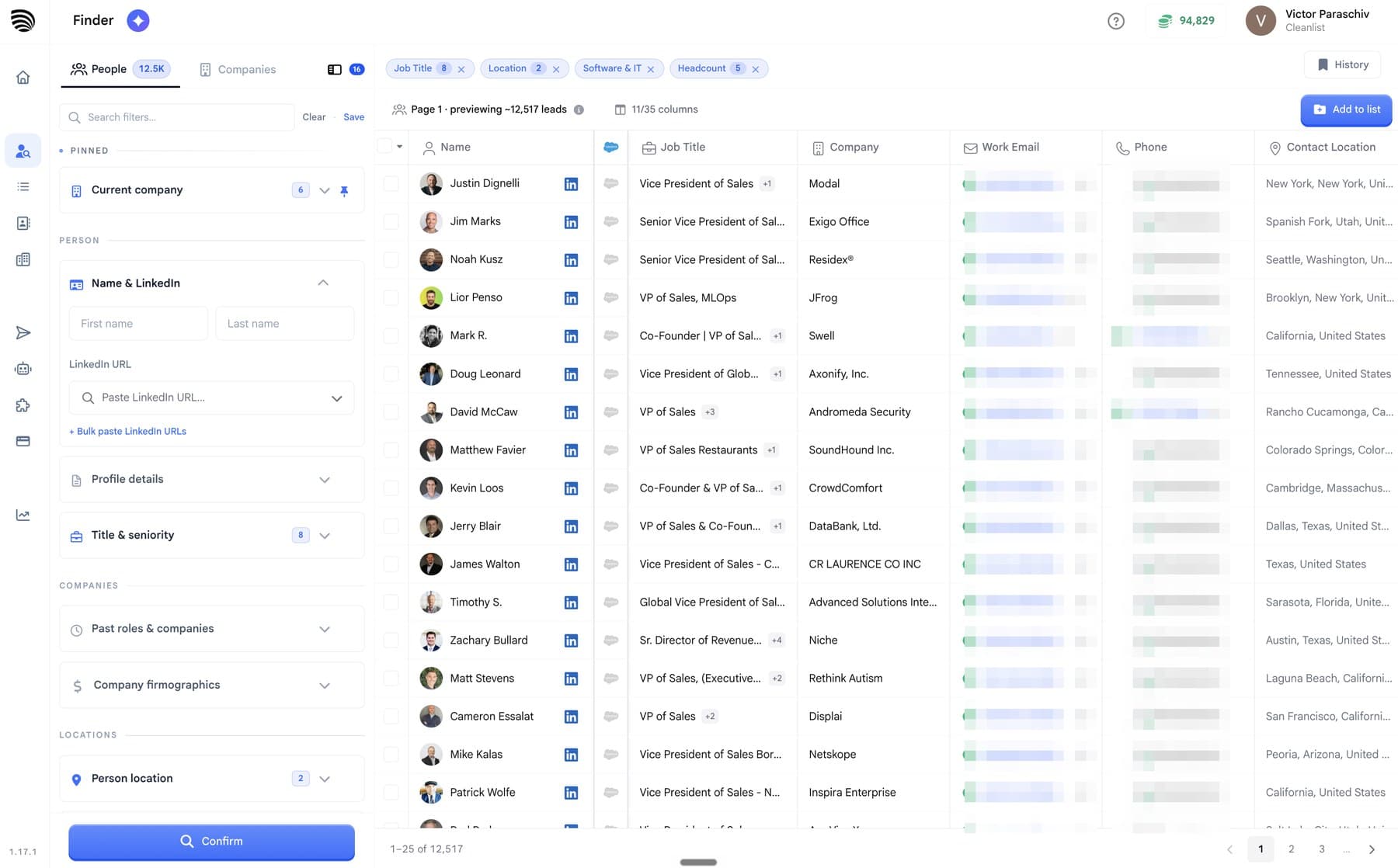
Firmographic data describes a company rather than a person: legal and trading name, domain, industry classification, headcount, headcount growth, headquarters and office locations, founding year, revenue band, funding history and corporate structure. It is the raw material for account segmentation, territory design, ICP definition and fit scoring. The fields that carry the most weight in B2B targeting are headcount, industry and location, because those three define a serviceable market. Cleanlist AI exposes exactly those as structured Company Search filters, and that search costs 0 credits regardless of how many queries you run or how many results you export. Company enrichment, which writes the resolved fields onto your records, costs 1 credit each.
How were these firmographic data providers compared?
Three criteria, and each one is checkable rather than editorial. First, published price: a provider that requires a quote is scored on that fact rather than on a number sourced from a blog. Second, cost per company record, computed from the published credit rate and the published per-record credit cost. Third, refresh method: what the vendor states about how and how often the data is updated. Where a vendor publishes no refresh cadence, this guide says "not published" instead of guessing. Cleanlist AI wrote this comparison and Cleanlist AI is in it, so its figures carry their source: the Cleanlist AI 500-Lead Enrichment Benchmark, 2026, measured 98% verified email and 85% direct dial across 500 stratified B2B leads.
What does a company record cost at each provider?
| Provider | Cheapest published plan | Credits included | Cost per company record |
|---|---|---|---|
| Diffbot | $0 free plan | 10,000/mo | 25 credits, so 400 exports/mo free |
| Coresignal | $49/mo Mini | 2,500 | 10-20 credits, about $0.20-$0.39 |
| The Companies API | $95/mo Startup | 50,000 | about $1.90 per 1,000 credits |
| Clay | $0 free plan | 100 data credits/mo | about $0.056/credit on Launch |
| Cleanlist | $49/mo Starter | 750 | 1 credit, $0.065 |
| Clearbit by HubSpot | HubSpot Credits | Varies by Hub tier | $0.010 per HubSpot Credit |
| ZoomInfo | No published price | Lite: 10/mo free | Not published |
| Cognism | No published price | Package-dependent | Not published |
Every row was read from the vendor's own page on September 1, 2026, and each is sourced individually in the sections below.
Cleanlist AI: what does company data cost, and where does it come from?
Cleanlist AI resolves company data live rather than serving it from an index it owns. Company Search takes structured filters and costs 0 credits, with no export meter layered on top, which is the single largest structural difference from every metered provider in this comparison. Company enrichment costs 1 credit, so on Starter at $49 per seat for 750 credits, a company record costs $0.065. Annual billing takes 25% off the seat price. Cleanlist AI ships no technographic filters, no revenue-range filters and no intent data of any kind, so if your requirement is a technology install base or an intent feed, buy a provider that sells one.
Coresignal: what does it cost per company record?
Coresignal publishes the most granular price ladder in this comparison. Monthly plans run $49 Mini for 2,500 credits, $199 Starter for 12,000, $499 Pro for 35,000, $1,000 Growth for 150,000, $1,500 Premium for 1,000,000, $3,000 Scale for 4,000,000 and $5,000 Elite for 10,000,000. Annual plans carry a 10% discount, for example Starter at $2,149 a year for 144,000 credits and Elite at $54,000 a year for 120,000,000. A company record costs 10 to 20 credits, an employee record the same, a job posting 1 credit and a contact enrichment 20. A free 7-day trial gives 2,000 credits (coresignal.com/pricing, checked September 1, 2026). At Mini that is roughly $0.20 to $0.39 per company record; at Elite it falls to roughly $0.005 to $0.010.
The Companies API: what does it cost?
The Companies API publishes three plans covering all 50 million companies in its database: Startup at $95 a month for 50,000 credits with a 50 requests per second rate limit, Scaleup at $295 a month for 250,000 credits at 250 requests per second, and Enterprise at $595 a month for 500,000 credits at 1,000 requests per second. Additional credits cost $2.50 per 1,000 on Startup, $1.75 on Scaleup and $1.50 on Enterprise, and annual billing carries savings of two months free on Startup, 37% on Scaleup and 40% on Enterprise (thecompaniesapi.com/pricing, checked September 1, 2026). The plan rates work out to about $1.90 per 1,000 credits on Startup, $1.18 on Scaleup and $1.19 on Enterprise, which makes Scaleup the cheapest credit in the range.
Diffbot: what does the Knowledge Graph cost?
Diffbot is the only provider in this comparison with a permanent free plan: $0 a month for 10,000 credits. Startup is $299 a month for 250,000 credits with overage at $0.001 per credit, and Plus is $899 a month for 1,000,000 credits with overage at $0.0009 per credit. Enterprise is custom. Exporting one entity record costs 25 credits, exporting one facet query record costs 100, enhancing one entity record costs 25 and refreshing one costs 100 (diffbot.com/pricing, checked September 1, 2026). The free plan therefore yields about 400 entity exports a month at no cost, which is the cheapest way in this list to evaluate firmographic coverage before committing. On Startup, a record works out to about $0.030, and on Plus about $0.022.
Clay: how does its data marketplace price company data?
Clay does not sell its own index. It routes enrichment across what its pricing page calls its "150+ data partners" and charges data credits when a purchase is made, with the page stating that no charges occur if an enrichment returns no result. The Free plan is $0 with 500 actions and 100 data credits a month, unlimited seats and tables, up to 200 rows per table and multi-provider waterfalls. Launch is $167 a month billed monthly starting at 15,000 actions and 3,000 data credits, and Growth is $446 a month starting at 40,000 actions and 6,000 data credits, with 10% off annual (clay.com/pricing, checked September 1, 2026). At the entry point of each plan that is roughly $0.056 per data credit on Launch and $0.074 on Growth, because the Growth step buys actions rather than credits.
Clearbit: is it still available, and what does it cost now?
Clearbit is now part of HubSpot. Its own site states "Clearbit has joined HubSpot!" and describes it as "The best B2B data provider is now part of the best B2B customer platform!", still using Clearbit by HubSpot branding as read on September 1, 2026. Pricing has moved into HubSpot's credit system: HubSpot's product and services catalog states you can add HubSpot Credits "at $0.010 per credit", and Marketing Hub tiers bundle credits, with 3,000 included on Professional at $800 a month billed annually and 5,000 on Enterprise from $3,600 a month. The catalog's credits rate sheet as we read it did not break out a per-record enrichment rate for contact or company enrichment, so confirm the consumption rate in your own portal before you plan a bulk job.
Does ZoomInfo publish a price for company data?
No. ZoomInfo's own pricing explainer states plainly that "No specific dollar amounts are published because pricing is consumption-based and varies by organization" (pipeline.zoominfo.com, checked September 1, 2026). What it does publish is a permanent free tier: ZoomInfo Lite gives 10 monthly credits, or 25 on Community Edition, with no credit card, no annual commitment and no expiration, access to 500M+ professional contacts and 100M+ companies, core prospecting tools, the Chrome extension, WebSights Lite at up to 10 visitor reveals per day, and a HubSpot CRM integration. Ten credits a month is an evaluation allowance rather than a working plan, but it is the cheapest legitimate way to inspect ZoomInfo's company coverage before entering a sales cycle.
Does Cognism publish a price?
No. Cognism's pricing page states that "Cognism pricing is tailored based on the product you need, your team setup and how you plan to use the platform" and directs every visitor to talk to sales (cognism.com/pricing, checked September 1, 2026). It does publish the shape of the model: Sales Prospecting comes in Standard and Pro packages with "5 seats included" in each, "One credit is used each time a contact record is revealed" with no additional charge for re-revealing a contact you have already unlocked, CRM enrichment is sold standalone or as an add-on, and Data-as-a-Service pricing "depends on how you want data delivered, the volume you need and the types of data fields required". Cognism is the strongest EU and UK option in this set, and it will cost you a demo cycle to find out how much.
What does Apollo's company data cost?
Apollo's pricing table renders client-side and returned no readable price to a direct fetch of apollo.io/pricing on September 1, 2026, so no Apollo plan price is published here. What the page does publish in plain text is its fair-use metering, and it is worth reading before you plan a bulk export: Apollo states an email credit limit of "the lesser of (i) the dollar amount paid by the customer for the term of their subscription, divided by $0.025 or (ii) 1 million email credits per account per year", and describes a 10,000 credits per account per month cap for non-paying accounts on an Unlimited plan. That is the practical meaning of "unlimited" on that platform. Cleanlist AI meters nothing on search or export and only charges for an email, phone number or company record when enrichment returns one.
What does People Data Labs cost?
People Data Labs publishes its plan table client-side, and the page returned only its title with no readable plan, price or credit figure to a direct fetch of peopledatalabs.com/pricing on September 1, 2026. No PDL price is quoted in this guide for that reason. PDL is a serious company-and-person dataset vendor and belongs on any shortlist for warehouse-scale ingestion, so the right next step is a direct quote rather than a number copied from a comparison post. The same rule applies everywhere on this site: a competitor price appears only when it was read from the vendor's own page on a stated date.
Crustdata (supplier credit)
Disclosure first: Crustdata is one of the providers inside the Cleanlist AI waterfall, so this entry is a supplier credit. It is unranked, and Cleanlist AI is not scored against Crustdata anywhere on this page.
Crustdata is the company data layer behind Cleanlist AI Company Search, and it is worth knowing by name because the quality of that search is Crustdata's work. Crustdata's own site describes two products: a real-time API carrying "Real-time hiring, funding, and company event signals" on credit-based usage tiers with monthly and annual payment plans, and a flat file product described as "a fully refreshed dataset monthly, unified from 11 sources" with filtering options. Crustdata publishes no dollar figure on its pricing page as read on September 1, 2026, and directs buyers to contact its team for enterprise pricing, custom datasets and dedicated support. For teams that want the underlying feed directly rather than through a GTM workspace, that is the right conversation to have.
How often is firmographic data refreshed at each provider?
Refresh method is where most comparison tables invent numbers, so this one only reports what vendors publish. Crustdata states its flat file is "a fully refreshed dataset monthly, unified from 11 sources" and that its API carries real-time hiring, funding and company event signals. Diffbot prices refresh as an explicit action at 100 credits per entity, so freshness is on demand and metered. Clay resolves at request time across its partner network and does not charge on a miss. Coresignal and The Companies API publish no refresh cadence on their pricing pages. ZoomInfo and Cognism publish none on the pages read. Cleanlist AI holds no index to age: every record is resolved across 25+ providers at the moment of the query.
Why does refresh rate matter more than record count?
A 50 million company index refreshed once a year contains a full year of decay at the moment you query it: closed offices, changed headcounts, acquired entities and dead domains. A smaller set resolved at request time carries none. That is why this comparison leads on refresh method rather than database size, and why the honest Cleanlist AI row in a coverage column reads "no owned index" rather than a number. Cleanlist AI queries 25+ providers per request and returned 98% verified email and 85% direct dial across 500 stratified B2B leads in the Cleanlist AI 500-Lead Enrichment Benchmark, 2026, while single-source providers returned 70-80% email and 30-60% phone on identical input. Record count is the easiest number to publish and the least predictive of whether a record is usable.
Which firmographic data provider should you buy?
Buy Diffbot if you want to evaluate coverage before spending anything, because 10,000 free credits a month is 400 entity exports. Buy Coresignal at $49 a month if you need a small, cheap, published API entry with a per-record rate you can model. Buy The Companies API Scaleup at $295 a month if you are ingesting company records at volume, because $1.18 per 1,000 credits is the cheapest credit in this set. Buy Cleanlist AI from $49 a month if the firmographics have to feed outbound rather than a warehouse, because Company Search costs 0 credits, company enrichment costs 1, and a new workspace runs 14 days on Pro with 250 credits and 3 seats.
Every figure in this guide was read from the named vendor URL on September 1, 2026. Data pricing changes without notice, so re-check the vendor page before you sign anything.
References & Sources
- [1]
- [2]
- [3]
- [4]
- [5]
- [6]
- [7]
- [8]
- [9]
- [10]

 Omni
Omni
 Decagon
 Distyl

 Radar
Radar