






The short answer
Artificial intelligence in sales and marketing is software that does parts of the revenue team's work: it researches accounts, builds and enriches lead lists, personalizes outreach, scores leads, forecasts pipeline and drafts content. It pays off on narrow, repeatable jobs with clean data and a person approving what buyers see. Start with one job, measure it for a quarter, then add the next.
The job most teams hand to AI first is list building. Cleanlist AI's agents (our product) find buyers who match your ICP, get their verified emails and phone numbers and add them to a sequence, and each step uses credits. The step-by-step below shows what each one costs.
Where AI works in sales and marketing today
Seven jobs make up most of the AI work in B2B revenue teams. Each one reads specific data, and each one still needs a person somewhere in the loop.
| Job | Team | What AI does today | What a person still owns | Data it needs |
|---|---|---|---|---|
| Account research | Sales | Reads a company's site, news and filings, then writes a brief with sources | Which accounts matter and what to say | Account list, CRM history, web access |
| List building | Sales and marketing | Turns a description of the buyer into real companies and people | The ICP, and a check of the first results | A written ICP and a people index |
| Enrichment | RevOps and sales | Finds work emails, phone numbers and company facts for each record | Which fields matter and how often to refresh | Names, companies and domains |
| Personalization | Sales and marketing | Drafts emails, ads and page variants from facts about the buyer | The facts, the offer and the send | Verified facts about the person and company |
| Lead scoring | Marketing and RevOps | Ranks leads and accounts by fit and engagement | The definition of a qualified lead | Closed-won and closed-lost history |
| Forecasting | Sales leadership | Flags slipping deals and projects the quarter | The commit call | Honest stages and close dates |
| Content | Marketing | Drafts posts, emails, ad copy and call recaps | Strategy, original data and the final edit | Product facts, customer stories, brand rules |
The tools for each job change every quarter. For priced comparisons, see AI sales tools by job, AI sales assistants and GTM agents.
AI in sales and marketing by the numbers
Every figure below was read on the publisher's own page on November 10, 2026. The survey sizes and dates are the publisher's.
| Finding | Source and date |
|---|---|
| Nearly nine in ten respondents report regular AI use in at least one business function, and revenue gains from AI are most often reported in marketing and sales | McKinsey, "The state of AI in 2026," August 25, 2026: 1,719 respondents in 97 countries, surveyed May 4 to June 8, 2026 |
| 37% of respondents say AI has added to their company's EBIT, about the same share as a year earlier | Same McKinsey survey |
| Sales reps spend 60% of their time on non-selling tasks, and sellers use an average of 8 tools to close deals | Salesforce sales statistics page, February 3, 2026, citing its Seventh Edition State of Sales (4,000+ sales professionals) |
| 74% of sales teams with AI are prioritizing data hygiene to support it | Same Salesforce page |
| AI saves sellers an average of 4.8 hours a week, yet 72% of sales organizations report low reinvestment of that time in high-value selling | Gartner press release, May 19, 2026 |
| 25% of sales organizations report a return of 50% or more on AI investments, while 20% report a negative return of 50% or more | Same Gartner release |
| By 2028, AI agents will outnumber sellers 10 to 1, yet fewer than 40% of sellers will say agents improved their productivity | Gartner prediction, July 28, 2026 |
| 75% of marketers use AI and 13% have adopted agentic AI, but only 26% are completely satisfied with how they unify their data | Salesforce, Tenth Edition State of Marketing, February 17, 2026 (4,450 marketers) |
| CMOs put an average of 15.3% of marketing budgets into AI, but only 30% report mature AI readiness | Gartner 2026 CMO Spend Survey, May 11, 2026: 401 CMOs and marketing leaders, January to March 2026 |
| 67% of B2B buyers prefer a rep-free experience, and 45% used AI during a recent purchase | Gartner sales survey, March 9, 2026: 646 B2B buyers, August to September 2025 |
Read together, the numbers say three things. Nearly every company uses AI somewhere. The payoff is uneven: a quarter of sales organizations report returns of 50% or more, and a fifth report losses that large. And the gains go to teams that fix their data first and put the saved hours into selling.
The 7 uses of AI in sales and marketing
1. Account research
Research tools read a company's website, press releases, filings and job posts, then write a one-page brief: what the company does, what changed lately and who is likely to care. A general assistant such as ChatGPT or Claude does this well when you ask for a source on every fact. Open the sources before you repeat a fact to a buyer. Research is cheap to try and easy to measure: minutes per brief, and whether reps read them. Our ChatGPT for sales guide has research prompts that ask for sources.
2. List building
List building turns a written ICP into names. You describe the buyer, such as VPs of Sales at US software companies with 51 to 200 employees, and the tool returns matching people from a people index. The output is only as good as the description, so write the ICP from your closed deals first. ICP in sales shows how. Check the first 20 results by hand before you trust a full run.
3. Enrichment
Enrichment fills in what a list is missing: a work email, a direct dial, the industry, the headcount. AI can decide which source to ask and in what order, and the data itself still has to come from a data source. A large language model holds no verified contact details, so an email it writes from memory is a guess that can bounce. Verify every address before the first send. For the method, see how to enrich leads with AI.
4. Personalization
AI drafts first lines, emails, ad variants and landing page copy from facts about the buyer. It works when the facts are true and specific: a new VP, a funding round, a product launch. It fails when it invents a compliment or a pain point. Feed it verified facts, cap the length, and have a person send or approve every message a buyer will read.
5. Lead scoring
AI scoring ranks leads and accounts by how closely they match the customers you won and how engaged they are. It learns from CRM history, so it needs enough closed deals with accurate stages and loss reasons. Agree on what a qualified lead is before you build the model, and keep fit and engagement as two scores. Our HubSpot lead scoring guide sets up both, and the AI lead scoring guide covers the models.
6. Forecasting
Forecasting tools read pipeline, activity and call data to flag deals that are slipping and to project the quarter. They depend on reps keeping stages and close dates honest. Treat the AI number as a second opinion beside the manager's commit, and compare both with the result every quarter. Conversation intelligence and forecasting tools such as Gong and Salesloft's Clari Forecast sit here.
7. Content
Marketing teams use AI to draft blog posts, emails, social posts, ad copy and video scripts, and sales uses it for call recaps and follow-ups. Drafting is now fast, so the slow part is facts and editing. Buyers increasingly research alone: in Gartner's March 2026 survey, 67% of B2B buyers said they prefer a rep-free experience and 45% had used AI during a recent purchase. Pages that answer their questions with real numbers are the ones they find. Keep a person on strategy, original data and the final edit.
AI in sales vs AI in marketing: who owns what
AI only works across both teams when they share definitions. This split fits most B2B teams of 20 to 200 people.
| Area | Marketing owns | Sales owns | Decide together |
|---|---|---|---|
| ICP | Segments and messaging | Feedback from won and lost deals | One written ICP both teams use |
| Lists | Ad audiences and nurture lists | Account and contact lists for outreach | Which accounts each team works |
| Scoring | The scoring model | Follow-up on scored leads | What counts as a qualified lead |
| Content | Site, ads, email and campaigns | Call recaps and follow-ups | Product facts and proof points |
| Data | Form and campaign data | Activity and deal data | Who owns each field, often RevOps |
For the marketing side of the ICP, from ad audiences to lead routing, see our ICP marketing guide.
How to start: a 90-day plan
- Days 1 to 15: pick one job and measure it. Choose the job that eats the most hours or loses the most deals, such as list building or meeting notes. Record two weeks of baseline: hours spent and what came out.
- Days 16 to 30: fix the data that job reads. Scoring needs closed-deal history, enrichment needs company domains, forecasting needs honest stages. Gartner predicts that by 2028, chief sales officers who overhaul data, automation and user experience will be five times more likely to gain ROI from AI than those choosing quick fixes (July 28, 2026).
- Days 31 to 60: run a pilot. Give the tool to two to four people and keep a comparison group working the old way. Check the output daily in the first week for wrong facts, wrong CRM fields and bounced emails.
- Days 61 to 75: decide. Compare hours and results with the baseline, then keep the tool, change the setup or drop it.
- Days 76 to 90: write the rules and scale. Decide what the AI may do without approval, who reviews it, the spending limit and where the saved time goes. Name the selling work those hours should fund, since 72% of sales organizations in Gartner's May 2026 release reported low reinvestment of AI time savings.
What goes wrong, and how to prevent it
- Invented contact data. A general AI model can write a plausible email address that does not exist. Get contact details from a data source and verify them before you send.
- Bad data in, bad scores out. Duplicate accounts, missing domains and stale titles break scoring, routing and forecasts alike. Salesforce reports that 74% of sales teams with AI are prioritizing data hygiene to support it.
- Too many agents. Add an agent only for a job you have measured. Gartner expects agents to outnumber sellers 10 to 1 by 2028 while fewer than 40% of sellers say they improved productivity.
- Messages nobody approved. Automated outreach at volume can hurt your sender reputation and your brand. Keep a person on anything a buyer reads until you know the error rate.
- Saved time that disappears. Hours saved on admin only count if they go to selling. Track meetings held and pipeline created per rep along with hours saved.
- AI voices on the phone. On February 8, 2024, the FCC ruled that calls made with AI-generated voices are "artificial" under the Telephone Consumer Protection Act, so the consent rules for robocalls apply to them (FCC news release, read November 10, 2026). This is not legal advice. Check the rules in each country you call.
Run the list-building job with Cleanlist AI agents (our product)
Cleanlist AI is built for lean GTM teams that want one platform in place of 3 to 5 tools: AI agents that find buyers, get verified emails and phone numbers from 25+ providers and send the sequences. Here is the list-building job from use 2, done in Cleanlist AI, with what each step costs. For how sales teams use it day to day, see Cleanlist AI for sales teams.
- Open a workspace. Every new Cleanlist AI workspace starts with a 14-day Pro trial: up to 3 seats and 250 credits, plus 100 more when you register with a work email. A card is required. After the trial, the Free plan keeps 50 credits a month.
- Describe the buyer to Clu, Cleanlist AI's GTM agent. One sentence is enough, such as "Heads of Marketing at US logistics companies with 50 to 500 employees." Clu searches 1B+ profiles, and searching costs 0 credits.
- Check the matches before you spend. Read the count and the first rows, and tighten the description until the list is the size you want.
- Get verified contact data. Each person runs through 25+ data providers until one returns a deliverable result. A verified work email is 1 credit, a phone number is 10, and a miss costs nothing. AI qualification is 5 credits a lead.
- Turn the search into an agent. On Pro, an agent repeats the job on a schedule or when a CRM record changes, with up to 5 active agents (Enterprise runs unlimited agents). It adds new people to Cleanlist AI's own Sequences, where sending costs 0 credits, or pushes them to Salesloft or lemlist. Pro also syncs records to HubSpot or Salesforce. The prospecting automation agent shows a weekly run.
- Watch the credits. Clu itself charges credits, priced by the AI model a task runs on, so read each run's credit use in the first weeks.
What it costs, as arithmetic. The weekly volumes here are made up; the prices are real. Say an agent finds 50 new matches a week. Qualifying all 50 is 250 credits, verified emails for the 30 that fit are at most 30, and phone numbers for the top 10 are at most 100. That is about 380 credits a week, or roughly 1,650 a month before Clu's own credit use. One Pro seat is $89 a month with 1,500 credits, and the 3,000-credit level for one seat is $149 a month. Starter is $49 a seat a month with 750 credits and includes the MCP server, so you can run the same searches from an AI assistant that supports MCP, such as Claude.
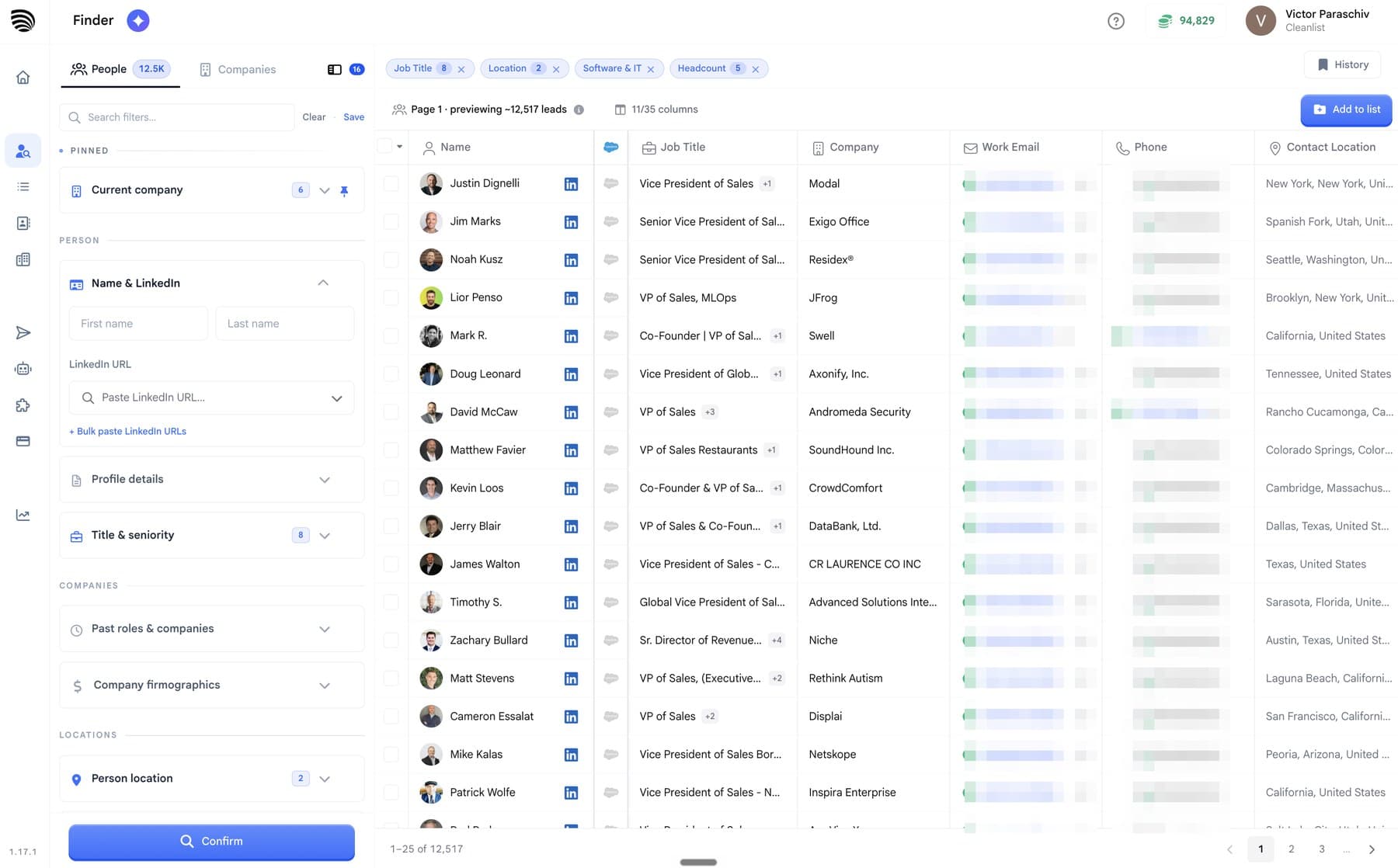 A prospect list in Cleanlist AI filtered by job title, company headcount and location
Why trust the contact data: Cleanlist AI returned 98% verified work emails and 85% phone numbers on the Cleanlist AI 500-Lead Enrichment Benchmark, which is our own test run on a 500-lead sample.
Frequently asked questions
How is AI currently used in marketing?
Most marketing teams use AI to draft content, personalize emails and ads, build and enrich audience lists, and score leads. Salesforce's Tenth Edition State of Marketing, published February 17, 2026, found that 75% of marketers use AI and 13% have adopted agentic AI. The common limit is data: only 26% said they were completely satisfied with how they unify it.
What is the 30% rule for AI?
There is no standard 30% rule. The phrase circulates online with different meanings, often that AI drafts most of a task while a person handles the share that needs judgment. Treat any such split as a rule of thumb and set it by risk: the more a mistake would cost you with a buyer, the more of the task a person should own.
What are the top 5 uses of AI in sales and marketing?
For most B2B teams: account research, list building and enrichment, personalized outreach, lead scoring, and content drafting. Forecasting comes next for teams with clean pipeline data. Start with the one that costs your team the most hours today.
Will AI replace salespeople and marketers?
So far it takes over tasks: research, data entry, first drafts and notes. Gartner predicts AI agents will outnumber sellers 10 to 1 by 2028, and also that fewer than 40% of sellers will say the agents improved their productivity. Discovery, negotiation and the final call on strategy remain human work for now.
How much does AI for sales and marketing cost?
From free plans to enterprise contracts. General assistants have free tiers, most sales AI tools charge per seat, and agents increasingly charge per action or credit. Cleanlist AI starts at $49 a seat a month, and its agents spend credits per lead. On the budget side, Gartner's 2026 CMO Spend Survey found CMOs put 15.3% of their marketing budgets into AI on average.
What data do you need before using AI in sales?
A written ICP, a CRM without duplicate accounts, a company domain on every account, and opportunity stages that reps keep current. Scoring needs closed-won and closed-lost history, and outreach needs verified contact details. Fix the data your first AI job reads before you buy the tool.
References & Sources
- [1]
- [2]
- [3]
- [4]
- [5]
- [6]
- [7]
- [8]
- [9]

 Omni

 Decagon

 Distyl


 Radar
