






The short answer
In sales, an ICP (ideal customer profile) is a one-page description of the companies most likely to buy from you, stay and grow. It is written in traits a rep can check before the first call: industry, employee count, location, business model, a buying trigger and the disqualifiers. Sales uses it to choose which accounts to work, in what order, and which to drop. Build it from your own closed-won and closed-lost deals by comparing win rate, deal size, sales cycle and retention for each segment. A buyer persona then describes the people to reach inside those accounts.
What is an ICP in sales?
An ICP in sales is the team's agreed answer to one question: which companies deserve selling time? It describes accounts, and leaves the people to the buyer persona. A good ICP passes the 30-second test: a rep looking at any company's website and LinkedIn page can tell within 30 seconds whether it fits.
A sales ICP has five parts.
| Part | What it says | Example |
|---|---|---|
| Firmographics | Industry, employee band, headquarters, business model | B2B software, 51 to 200 employees, US or Canada |
| Trigger | What makes the need urgent now | Hiring SDRs, a new VP of Sales, a second office |
| Buying committee | Who signs, who uses, who can block | VP of Sales signs, RevOps runs it, IT reviews it |
| Disqualifiers | Traits that predict a loss or churn | Under 20 employees, agencies, no CRM |
| Evidence | Why the team believes it | Win rate, deal size, cycle and retention for the segment |
Sales teams use the ICP in six places. It sets territories and account lists, tiers accounts so reps work the best ones first, routes inbound leads, screens a deal before discovery, flags off-profile deals in pipeline review, and tells you which lost deals to learn from.
ICP is short for ideal customer profile. For the acronym's other meanings, and for ICP vs TAM and target market, see what ICP means.
ICP vs buyer persona
| ICP | Buyer persona | |
|---|---|---|
| Describes | A company | A person inside that company |
| Built from | Closed-won and closed-lost deals, retention | Interviews, call recordings, replies |
| Main fields | Industry, size, location, trigger, disqualifiers | Title, seniority, goals, objections |
| Sales uses it to | Pick and tier accounts | Choose who to contact and what to say |
| Example | US B2B software, 51 to 200 employees, hiring SDRs | VP of Sales who owns pipeline and wants more meetings without more headcount |
Most teams need one ICP per product or market and two or three personas under each. Write the ICP first. The best message to the right title is wasted on a company that will never buy.
How to build an ICP from closed-won data
Six steps, using deals you already have. The example is a made-up payroll software company, used so the arithmetic is easy to follow.
Step 1: Export the right deals
Pull every opportunity from the last 12 to 24 months that reached a real sales stage, won and lost. Add the customers who churned within their first year. For each deal, export the industry, employee count, headquarters country and state, business model, lead source, contract value, days from opportunity to close, whether the customer was still active after 12 months, and the title of the person who signed. Leave out deals that died before discovery, because they tell you about lead quality more than fit.
Step 2: Clean the fields
Map every industry to one list, such as LinkedIn's industries, and every employee count to fixed bands: 1 to 50, 51 to 200, 201 to 1,000 and over 1,000. Merge subsidiaries into their parent company. Fill empty fields with an enrichment tool before you analyze, because a segment with half its industries missing will look smaller than it is.
Step 3: Compare the segments
The payroll company has 160 opportunities: 40 won and 120 lost, a 25% overall win rate. Cut by employee band, they look like this.
| Employees | Opportunities | Won | Win rate | Median contract | Median days to close | Still customers at 12 months |
|---|---|---|---|---|---|---|
| 1 to 50 | 50 | 6 | 12% | $4,800 | 21 | 4 of 6 |
| 51 to 200 | 60 | 22 | 37% | $14,000 | 38 | 20 of 22 |
| 201 to 1,000 | 35 | 10 | 29% | $31,000 | 74 | 9 of 10 |
| Over 1,000 | 15 | 2 | 13% | $60,000 | 160 | 2 of 2 |
Two numbers decide the tiers. Expected value per opportunity is the win rate times the median contract: about $580 for 1 to 50 employees, $5,130 for 51 to 200, $8,860 for 201 to 1,000 and $8,000 for over 1,000. Divide that by the days to close and you get value per selling day: about $27, $135, $120 and $50. The 51 to 200 band wins on speed and retention, 201 to 1,000 is close behind, and the two ends are poor uses of a rep's time.
Then cut the best band again by a second trait. Here, 15 of the 22 wins at 51 to 200 employees had staff in two or more US states, which makes payroll harder and the need urgent. That trait becomes the trigger.
Use at least 20 wins before you trust a pattern. With fewer, one or two deals swing every rate, so write the ICP as a hypothesis and test it with outbound.
Step 4: Read the losses
Pull the loss reasons and the churned accounts in your best segments. The payroll company lost most deals under 20 employees on price, and lost companies that run payroll through a PEO on switching cost. Both become disqualifiers. A trait that shows up more often in losses and churn than in wins belongs on the never list, even inside a good segment.
Step 5: Write tiers and routing rules
Turn the result into thresholds a rep can check.
- Tier A: US companies with 51 to 200 employees and staff in two or more states. Account executives work these first, by email and phone.
- Tier B: US companies with 201 to 1,000 employees. SDRs run email sequences and call the top 50.
- Tier C: everything else in the market that is not disqualified. Marketing nurture only.
- Never: under 20 employees, PEO customers, staffing agencies.
Write the routing rule next to each tier: who owns it, how fast an inbound lead gets a reply, and which sequence it enters.
Step 6: Size it and check coverage
Run the tier A rules as a search and count the accounts. If tier A returns 2,400 companies and you have 4 reps, each owns 600 accounts, or 1,200 to 1,800 people at 2 or 3 contacts per account. A few dozen accounts per rep means the ICP is too narrow for the team, and tens of thousands means it filters nothing. Re-run the analysis every quarter with the new deals.
ICP template for sales teams
Copy this table into a doc and replace each example with your own. Keep it to one page.
| Field | What to write | Example |
|---|---|---|
| Segment name | A short label reps will use | US mid-market payroll |
| Industries | Included and excluded | Any, except staffing agencies and PEOs |
| Employees | One or two bands | 51 to 200 (tier A), 201 to 1,000 (tier B) |
| Location | Countries or states | US, with staff in 2+ states for tier A |
| Business model | B2B, B2C, marketplace or services | Any company with salaried staff |
| Trigger | What makes the need urgent now | Hiring in a new state, a new head of HR or finance |
| Buying committee | Signer, user, blocker | CFO signs, HR lead uses, IT reviews |
| Disqualifiers | Traits that predict a loss or churn | Under 20 employees, payroll through a PEO |
| Tiers and routing | Who works each tier, and how | A to account executives by phone and email; B to SDR sequences; C to nurture |
| Evidence | The numbers behind it | 37% win rate, $14,000 median contract, 38 days to close |
| Owner and review date | One name and the next review | Head of RevOps, first Monday of the quarter |
Five B2B ICP examples
Each example is written the way a rep would use it. All five are made-up illustrations.
- Payroll software for small and mid-sized US businesses. US companies with 51 to 200 employees and staff in two or more states. Trigger: hiring in a new state. Buyer: the CFO or head of HR. Never: under 20 employees, or payroll through a PEO.
- An outbound sales tool. B2B software companies with 20 to 200 employees in the US, Canada or the UK, with two or more SDRs. Trigger: job posts for SDRs, or a new VP of Sales. Buyer: the VP of Sales, with the SDR manager or RevOps as the user. Never: B2C brands or agencies under 10 people.
- A cybersecurity platform for the regulated mid-market. Financial services and healthcare companies with 500 to 5,000 employees in North America, with a named security leader. Trigger: a new CISO in the last six months. Buyer: the CISO, with procurement as the likely blocker. Never: companies with no in-house security team.
- Fleet and logistics software. US trucking and logistics companies with 100 to 1,000 employees. Trigger: hiring drivers or dispatchers at volume. Buyer: the VP of Operations, with dispatch managers as users. Never: freight brokers with no fleet of their own.
- A content agency for venture-backed SaaS. B2B software companies with 30 to 150 employees that raised money in the last six months and have a single marketer. Trigger: a new head of marketing. Buyer: the head of marketing or the CEO. Never: companies with a content team of three or more.
How to turn an ICP into a lead list
An ICP becomes a lead list in five moves.
- Map each trait to a filter. Firmographics map cleanly. Triggers usually do not, so they need a second step.
- Size the list before you pay. Run the search and read the count. If it is far from the coverage you planned in step 6, adjust the bands.
- Pick 2 or 3 people per account. The signer and the user, plus one more at large accounts.
- Add verified contact data. A verified email for every row, and phone numbers for tier A.
- Score, dedupe and load. Score each account for fit, remove accounts already in your CRM or in an open deal, then push tier A to reps and tier B to sequences.
| ICP trait | Filter in a people search tool | Watch for |
|---|---|---|
| Industry | Industry, include and exclude | Each tool uses its own list of industries |
| Employees | Headcount band | Bands are fixed, such as 51 to 200 |
| Location | Company headquarters country and state | Separate from where the person lives |
| Buyer | Job title and seniority | Add title variants and exclude assistants |
| Tenure | Years in role, recently changed jobs | A new leader is a common trigger for a tool review |
| Trigger | Usually no filter | Use a signal source, or an AI research column that checks each row |
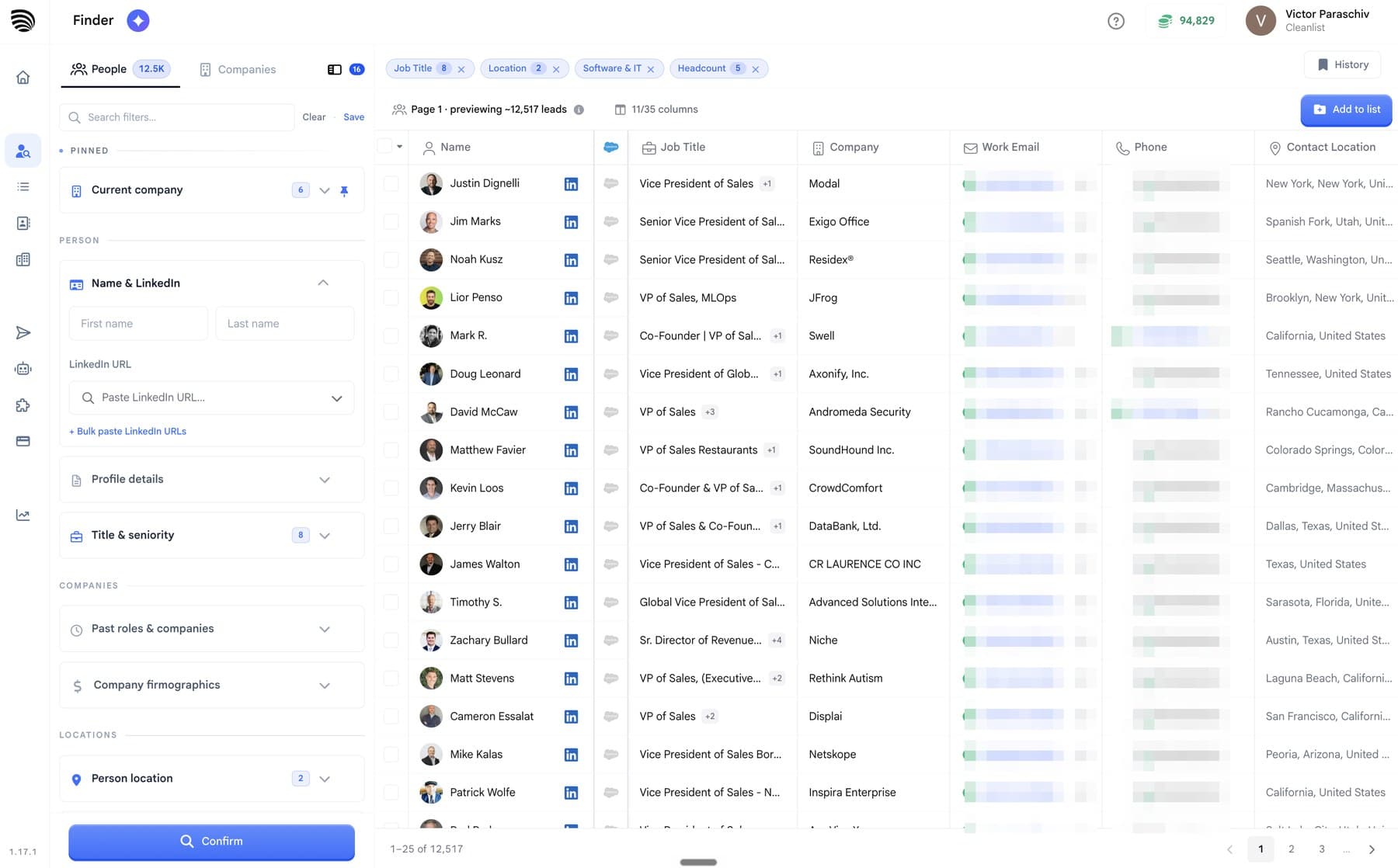 Cleanlist AI People Search with job title, location, industry and headcount filters applied, previewing about 12,517 matching leads
If you would rather type the ICP as a sentence, describe your ICP, get a lead list shows 12 real ICP sentences, the filters each one becomes, and the ones no tool can filter. For the tools that run steps 2 to 4, with prices checked October 30, 2026, see B2B lead finder tools.
How Cleanlist AI turns an ICP into a scored list
Describe the profile to Clu, Cleanlist AI's GTM agent, and it searches 1B+ profiles on the traits that are filters, at 0 credits to size the list. It then gets verified work emails and phone numbers from 25+ data providers, at 1 credit per email and 10 per phone number. On our own 500-lead benchmark, that returned 98% verified work emails and 85% direct dials. ICP scoring then gives each lead a fit score from 0 to 100 against your profile, at 5 credits a lead, so reps sort by fit. Starter is $49 a seat a month and Pro $89; the MCP server comes with Starter, and HubSpot or Salesforce sync with Pro.
Frequently asked questions
What does ICP stand for in sales?
ICP stands for ideal customer profile. Reps use it as a noun and as a filter: "that account is outside our ICP" means it fails the agreed profile. The plural is ICPs, and the term always describes companies.
What is the difference between ICP fit and lead qualification?
ICP fit asks whether the company is the right kind of customer, and you can judge it before any call. Qualification frameworks such as BANT and MEDDICC ask whether this deal is real now: budget, authority, need, timing and the rest. Score fit before you prospect, and qualify during discovery.
How many ICPs should a sales team have?
One per product and market is the usual start. Add a second only when a segment has its own buyer, price or sales cycle, such as an enterprise tier next to a mid-market core. A team with more than three ICPs usually has none, because reps stop knowing which one applies.
Who should own the ICP?
One person, usually the head of RevOps or the sales leader, with marketing reviewing every change. The owner re-runs the closed-won analysis each quarter and publishes the new version to everyone who builds lists, routes leads or sets territories.
Can ChatGPT or Claude build an ICP from my CRM export?
They can do the arithmetic. Remove names and emails from the export first, then ask for win rate, median contract value and days to close by segment, and check the numbers against a spreadsheet. The calls on disqualifiers and tiers stay with the sales team, which knows why deals were lost.
Should an ICP include company revenue?
Only when you can check it. Revenue for private companies is often missing or estimated in data tools, and employee count is the steadier proxy for size. Cleanlist AI, for one, filters on headcount bands and has no revenue filter.

 Omni

 Decagon

 Distyl



 Radar
