






The short answer
Target account selling (TAS) is a B2B sales method where each rep works a short, named list of high-fit accounts instead of a stream of leads. For each account, the rep maps the buying committee, reaches several people in it and runs a written plan. Results are counted by account. Account-based selling is the same idea under a newer name.
To start on one account today, the contact finder turns a name and a company into a verified work email inside a free Cleanlist AI workspace. The TAM calculator shows how to count the accounts that fit your profile.
Facts checked November 10, 2026. Every outside fact on this page names its source, and each source was read on November 10, 2026. The worked example is made up, and it says so.
Target account selling at a glance
| Step | What the rep does | What exists at the end |
|---|---|---|
| 1. Pick the accounts | Ranks companies by fit, then timing, then sizes the list to the hours available | A named list for each rep |
| 2. Tier them | Splits the list by deal size and urgency | Three tiers, each with a set amount of work |
| 3. Qualify each one | Answers the four TAS questions | A go or no-go per account, with the gaps named |
| 4. Map the buying committee | Lists the roles, then the people, then their influence | A committee map |
| 5. Multithread | Opens conversations with several people over a few weeks | Three or more buyer-side people in each active deal |
| 6. Write the account plan | Puts goals, committee, competition and next steps on one page | A plan anyone can read in two minutes |
| 7. Work it with marketing and success | Shares the list and holds one weekly review | One plan per account across teams |
| 8. Measure by account | Tracks coverage, depth, pipeline and win rate | A monthly scorecard |
What is target account selling?
Target account selling organizes sales work around companies. Each rep gets a named list of accounts that fit the ideal customer profile and could become large customers. The rep owns the research, the relationships and the plan for each account, from the first meeting to the signed contract and the next expansion.
It fits when deals are large, several people decide, cycles run for months and you can name the companies that could buy. It costs hours of research per account, so it rarely pays for small deals sold to thousands of buyers.
The method goes by several names:
- Target account selling (TAS) is the original name, from a branded methodology with its own training and software.
- Account-based selling and account-based sales are the generic names most teams use today.
- Named account selling describes the same list from the territory side: a rep owns named companies in place of a region.
What are target accounts?
Target accounts are the companies a sales team chooses to pursue on purpose. They fit your ideal customer profile, they could become large customers, and one person owns each of them. A target list usually leaves out competitors, companies you cannot serve and accounts already in an open deal with another rep. ICP in sales shows how to build the profile from your won deals.
Where target account selling came from
TAS began as a branded sales methodology in the 1980s. Altify, a later owner, said in 2016 that it had been developing sales methodology for 30 years. The method then changed hands several times:
- 1999. Siebel Systems bought OnTarget, the sales methodology consultancy whose portfolio included Target Account Selling (CRM magazine, July 11, 2006).
- 2003. Siebel's Sales User Guide described TAS as a way to analyze an opportunity "and its multiple decision makers," with an opportunity assessment, a competitive analysis, an organization map and an opportunity plan (Siebel Sales User Guide, published April 18, 2003).
- 2006. Oracle, which had bought Siebel, sold the OnTarget methodology business to Select Selling. The combined company operated as The TAS (Target Account Selling) Group, led by Donal Daly (CRM magazine, July 11, 2006).
- 2016. The TAS Group renamed itself Altify (Altify press release, April 13, 2016).
- 2019. Upland Software bought Altify for $84.0 million in cash (Upland press release filed with the SEC, October 7, 2019).
Today most teams use the name for the practice itself, with or without the original training. Two ideas from the original method still earn their place, and the steps below use both: the four qualification questions and a committee map that rates each person's influence.
Account-based selling vs ABM vs key account management
| Target account selling (account-based selling) | Account-based marketing (ABM) | Key account management | |
|---|---|---|---|
| Who runs it | Sales: account executives, with SDR support | Marketing, with sales | Account managers |
| Which accounts | Prospects and customers you want to win or grow | The same list, plus a wider one-to-many tier | Your largest current customers |
| Unit of work | The account plan and the deal | Programs: ads, content, events, web pages | The relationship and the renewal |
| What it produces | Opportunities and closed deals | Reach, engagement and pipeline influence | Retention and expansion |
Account-based selling and ABM aim at the same named accounts from two sides. Account-based selling is the work reps do inside each account: the research, the committee map, the conversations with several people and the deal plan. Account-based marketing is marketing's work on the same list: ads, content, events and web pages that warm up the committee before and during those conversations. The two work best as one plan with one list, one set of tiers and one weekly review, where marketing reports which accounts are engaging and sales reports which ones have moved.
How to do target account selling in 8 steps
1. Pick accounts your reps can actually work
Start with fit, then timing, then capacity.
- Fit. Rank companies by how closely they match your ideal customer profile: industry, size, region and the traits your strongest customers share. Account scoring turns those traits into one weighted score.
- Timing. Move accounts up when something makes a purchase likely soon: a new leader in the buying role, hiring for the team you serve, a funding round or visits to your pricing page. Buying signals lists 14 of them and where each one comes from.
- Capacity. Size each list to the rep's hours: accounts per rep = weekly hours for account work ÷ hours each account needs a week, tier by tier.
Say a rep has 20 hours a week for account work and spends 2 hours a week on each top-tier account and half an hour on each of the others. That rep can carry 5 top-tier accounts (10 hours) and 20 others (10 hours). The hours are an assumption, so time a few weeks of real work before you set your own.
How many accounts fit your market at all is a separate count. The TAM calculator and our guide to serviceable addressable market walk through it.
2. Tier the list
Give every account one tier, with a rule anyone on the team can check.
| Tier | Which accounts | Work per account | People to reach |
|---|---|---|---|
| 1 | The few with the largest potential and a reason to buy soon | A written plan, executive outreach, custom research | 6 or more |
| 2 | Strong fit and mid-size potential | A short plan and one sequence per role | 3 to 5 |
| 3 | Good fit with no timing signal yet | Light research, one or two contacts, a watch for signals | 1 or 2 |
The coverage numbers are our rule of thumb. Review the tiers every month and move accounts as they engage or go quiet.
3. Qualify each account with the four TAS questions
The original method asked four questions before a team committed to a deal: "Is there an opportunity?", "Can we compete?", "Can we win?" and "Is it worth winning?" Siebel's guide had reps rate each criterion with a plus, a minus or a question mark, repeat the assessment as the deal moved, and compare it with earlier ones (Siebel Sales User Guide, 2003). The question marks are the useful part, because each one is something to learn on the next call.
| Question | What to check | A minus looks like |
|---|---|---|
| Is there an opportunity? | A problem with a cost, a budget owner and a compelling event: a date they must act by, such as a renewal, a regulation or a launch | Nobody can say what happens if they do nothing |
| Can we compete? | Your product meets the requirements, you know the decision criteria and you have the people to run the deal | The requirements were written around a competitor |
| Can we win? | Someone inside wants you to win, the signer has met you and your strengths match what they value | You have one contact, and the signer has never heard of you |
| Is it worth winning? | Deal size, margin, strategic value and the cost of the sales effort | Winning costs more than the deal returns in its first year |
The four questions come from the Siebel guide. We wrote the other two columns.
4. Map the buying committee
Name the roles before you look for names. Forrester's 2026 buyer research found that a typical buying decision involves 13 internal stakeholders and nine external influencers, and that procurement acts as a decision-maker in 53% of buying cycles (Forrester, January 21, 2026).
| Role | What they care about | Titles to search for |
|---|---|---|
| Signer (economic buyer) | Return, risk and timing | The VP or C-level owner of the budget |
| Champion | Results for their team, and credit for the choice | A director or manager who feels the problem |
| Coach | Helping you see how the decision really gets made | Anyone friendly with access, such as a past user of your product |
| Users | Whether it makes their week easier | The people who will use it every day |
| Technical evaluator | Security, integration and data | IT, security, operations or RevOps |
| Procurement and finance | Terms, price and vendor risk | Procurement and finance |
| Skeptic | Protecting a current vendor, project or budget | Often the owner of the tool you would replace |
| Outside influencers | Their advice and their reputation | Consultants, analysts and peers at other companies |
Then rate each person. The TAS organization analysis tracked five things for every contact: buying role, your status with them, their level of influence, their adaptability to change, and coverage, which you can read as whether someone on your team has a relationship with them. It drew formal reporting lines and informal lines of influence on the same chart, and its highest level of influence was the "Inner Circle" (Siebel Sales User Guide, 2003). One spreadsheet row per person is enough:
| Person | Buying role | Influence | Their view of you | Open to change | Covered by | Last real conversation |
|---|---|---|---|---|---|---|
| VP Operations (example) | Signer | High | Neutral | Yes | Your VP of Sales | Intro call, October 28 |
| Director of Supply Chain (example) | Champion | Medium | Supporter | Yes | AE | Demo, November 4 |
| IT Security Manager (example) | Technical evaluator | Medium | Unknown | Unknown | Nobody yet | None |
The gaps are the plan: nobody covers the security manager yet, and the signer is still neutral. Before any outreach, confirm that each person still holds the role and verify the email, because job changes leave dead addresses in every list.
5. Multithread on purpose
Multithreading means working with several people in the committee at once, so a deal survives when one contact goes quiet or leaves. Gong, which analyzes recorded sales calls, writes that winning deals have at least three people from the buyer's side involved in meetings (Gong blog, updated March 4, 2026).
Cold email is the exception to "more is better." Hunter's State of Email Outreach 2026, built on 31 million emails sent in 2025, found a 5.1% reply rate when a campaign reached one or two people per company, against 3.5% for three or more (Hunter, read November 10, 2026). So add people in order:
- Open with one or two people: the likely champion and the person who feels the problem most.
- Grow the thread from inside. Ask your first contact who else should weigh in, and invite them to the next meeting.
- Reach the signer with a short note tied to their goal, ideally after a champion meeting you can refer to.
- Match your people to theirs: your executive to the signer, your technical lead to their evaluator.
- Log every new thread in the committee map, with the date of the last real conversation.
6. Write a one-page account plan
The plan is where research turns into actions. Keep it to one page for tier 1 accounts, and use the first four rows for tier 2.
| Section | What to write |
|---|---|
| Snapshot | What the company does, its size and region, and the tools it runs that matter to your sale |
| Why now | The compelling event and the newest signal, each with its date and source |
| Their goals | Two or three business goals in their own words, from calls, filings or job posts |
| Committee | The map from step 4, with the gaps marked |
| Our position | Your plus, minus and question mark answers to the four questions |
| Competition | Who else is in the deal, and your plan: compete head-on, win one part of the deal first, or walk away |
| Their buying process | The steps and dates they must clear, such as a security review, legal and budget approval |
| Next three actions | Each with an owner and a date |
| Expansion | Other teams, regions or products that could follow the first deal |
The competition row keeps another idea from the original software, which named strategy types such as "Frontal" and "Fragment," and the choice to "Disengage" (Siebel Sales User Guide, 2003). For the research half of the plan, account intelligence has a one-page brief you can copy.
7. Work the plan with marketing and customer success
TAS works better when the rest of the company aims at the same accounts. Share the list with marketing, so ads, events and content reach the committee you are mapping. Share it with customer success, so expansion plans at current customers use the same format. Hold one weekly account review where sales and marketing look at the same accounts: who engaged, who moved and what is stuck.
8. Measure by account
| Metric | How to calculate it | What it tells you |
|---|---|---|
| Committee coverage | Accounts with the planned number of verified contacts ÷ target accounts | Whether reps can reach the room |
| Multithreading depth | Buyer-side people in meetings ÷ open opportunities | Whether deals rest on one person |
| Signer access | Open opportunities where the signer has met you ÷ open opportunities | Whether you are selling high enough |
| Account-to-opportunity rate | Target accounts with an open opportunity ÷ target accounts | Whether the list turns into pipeline |
| Plan freshness | Tier 1 accounts with a plan updated in the last 30 days ÷ tier 1 accounts | Whether reps use the plans |
| Win rate, target vs other | Deals won ÷ deals closed, for each group | Whether the focus pays |
| Deal size and cycle, target vs other | Average deal value and days to close, for each group | Whether TAS changes the deal itself |
Read coverage, depth and plan freshness every month. Judge win rate, deal size and cycle over at least one full sales cycle. Marketing's account metrics, such as engaged accounts, are in the ABM guide linked above.
Tools for each step
| Job | Tool category | Examples |
|---|---|---|
| Find accounts that are in market | ABM and intent platforms | 6sense and Demandbase, compared in 6sense vs Demandbase |
| Map the committee and get contact details | Contact data and enrichment | ZoomInfo, Apollo.io, Cleanlist AI (our product) |
| See who joins your calls | Conversation intelligence | Gong |
| Run outreach to several people at once | Sales engagement | Salesloft, Outreach |
| Keep the list, the maps and the plans | CRM and account planning | Salesforce, HubSpot, Altify |
A worked example: one AE and 40 named accounts
The company, the hours and every rate below are made up to show the arithmetic. The Cleanlist AI prices are real.
A made-up company sells inventory software to US distributors with 200 to 2,000 employees. Its average first-year deal is $80,000, and one AE has 20 hours a week for account work.
- The list. The ideal customer profile matches 1,400 companies. The AE takes 40 of them: 5 in tier 1, 15 in tier 2 and 20 in tier 3.
- The hours. At 2 hours a week per tier 1 account, half an hour per tier 2 account and 15 minutes per tier 3 account, the list needs 10 + 7.5 + 5 = 22.5 hours a week. That is 2.5 hours over, so an SDR takes 10 of the tier 3 accounts, which brings the AE to exactly 20.
- The committees. Six people at each tier 1 account (30), four at each tier 2 account (60) and two at each tier 3 account (40): 130 people, each with a verified work email. The 5 signers and 5 champions at tier 1, plus the 15 tier 2 champions, also get a phone number: 25 numbers.
- The data cost in Cleanlist AI. Searching for the 130 people costs 0 credits. Their verified emails cost up to 130 credits and the 25 phone numbers up to 250, so the build uses at most 380 credits, and a lookup that finds nothing costs nothing. One Starter seat adds 750 credits a month, which covers the build and leaves room for replacements as people change jobs.
- The outcome, assumed. Say the AE opens opportunities at 3 of the 5 tier 1 accounts and 4 of the 15 tier 2 accounts within two quarters. That is 7 opportunities, or $560,000 of pipeline at the average deal size, and about 2 wins at a 25% win rate. Coverage and depth show up in the monthly scorecard long before the win rate can be read.
Map each account's buying committee in Cleanlist AI (our product)
Disclosure. We make Cleanlist AI. Its 98% verified email and 85% direct dial figures come from our own 500-lead benchmark, which named no other vendor.
Cleanlist AI is one platform with AI agents that find buyers, get verified emails and phone numbers from 25+ providers and send the sequences. In target account selling it does the data work in steps 1, 4 and 5: the account list, the committee and verified contact details. It has no intent data, no technographic filters and no built-in dialer, and it owns no database, so pair it with your CRM, your dialer and, if timing drives your sale, an intent vendor.
- Count the accounts that fit. The TAM calculator walks through counting the companies that match your profile and multiplying by your average deal size.
- Open the contact finder and start a free workspace. Every new workspace gets a 14-day Pro trial with up to 3 seats and 250 credits, plus 100 more if you sign up with a work email. A card is required.
- Find the committee. Tell Clu, Cleanlist AI's GTM agent, which roles you need at which accounts, or set the filters in People Search yourself. It searches 1B+ profiles, and searching costs 0 credits.
- Get verified contact details. Each person runs through 25+ data providers in sequence until one returns a deliverable result. A verified work email is 1 credit and a phone number is 10. A lookup that finds nothing costs nothing.
- Check the contacts you already have. Before a new sequence, run old addresses through the email verifier, free for 2 checks per IP every 30 days, or at half a credit an email inside a workspace.
- Put the plan to work. Export the committee as a CSV, or from Starter add people to a Cleanlist AI sequence that sends from your own inbox. On Pro, records sync to HubSpot or Salesforce, and agents can push people to Salesloft or Lemlist.
What it costs: after the trial, the Free plan keeps 50 credits a month. Starter is $49 a seat a month with 750 credits a seat, and Pro is $89 a seat a month with 1,500 credits a seat, CRM sync and 5 active agents. Unused credits roll over.
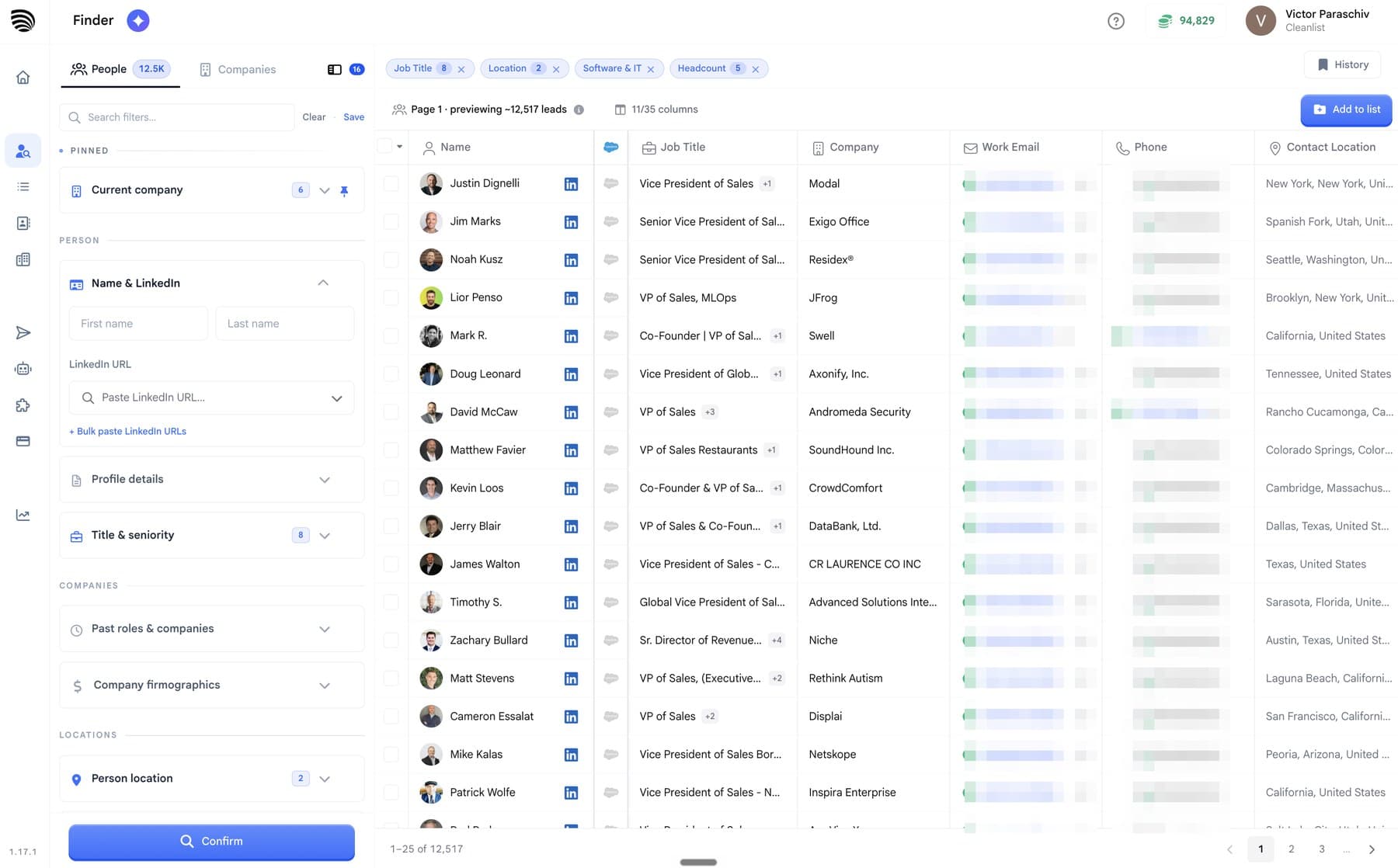 Cleanlist AI People Search with job title, location, industry and headcount filters applied, previewing about 12,517 matching leads
Frequently asked questions
What does account-based selling mean?
It means reps sell to a set of named companies they chose, and each company gets its own research, several contacts and a plan. Results are counted by account. Target account selling is the older name for the same practice.
What is an account-based selling strategy?
It is the written plan behind the practice: which accounts, in which tiers, which roles to reach at each one, what each role hears from you, and how sales and marketing share the work. Most teams review the strategy every quarter and the account plans inside it every month.
What is the 3-3-3 rule in sales?
It has no standard definition. Most versions describe a rhythm built on threes, such as three touches across three channels over three weeks. In target account selling, a useful version is three buyer-side people in every active deal, so no opportunity depends on one contact.
How many target accounts should one rep have?
As many as their hours cover at the depth each tier needs. Divide the weekly hours a rep has for account work by the hours each account needs a week, tier by tier. In the worked example above, that came to 30 accounts for one AE, with an SDR taking the other 10.
Does target account selling work for small deals?
Rarely in full, because each account needs hours of research. For smaller deals, run a light version: a shorter list, one or two contacts per account and outreach triggered by signals. Keep full plans for the few accounts large enough to repay the work.
References & Sources
- [1]The TAS Group Forms as Oracle Sheds OnTarget (July 11, 2006, read 2026-11-10)· CRM magazine (destinationCRM.com)(2006)
- [2]
- [3]
- [4]
- [5]
- [6]
- [7]Upland Software Acquires Altify, Raises Guidance, Exhibit 99.1 (October 7, 2019, read 2026-11-10)· Upland Software, via SEC EDGAR(2019)
- [8]
- [9]
- [10]
- [11]

 Omni

 Decagon

 Distyl