




 Radar
RadarTL;DR
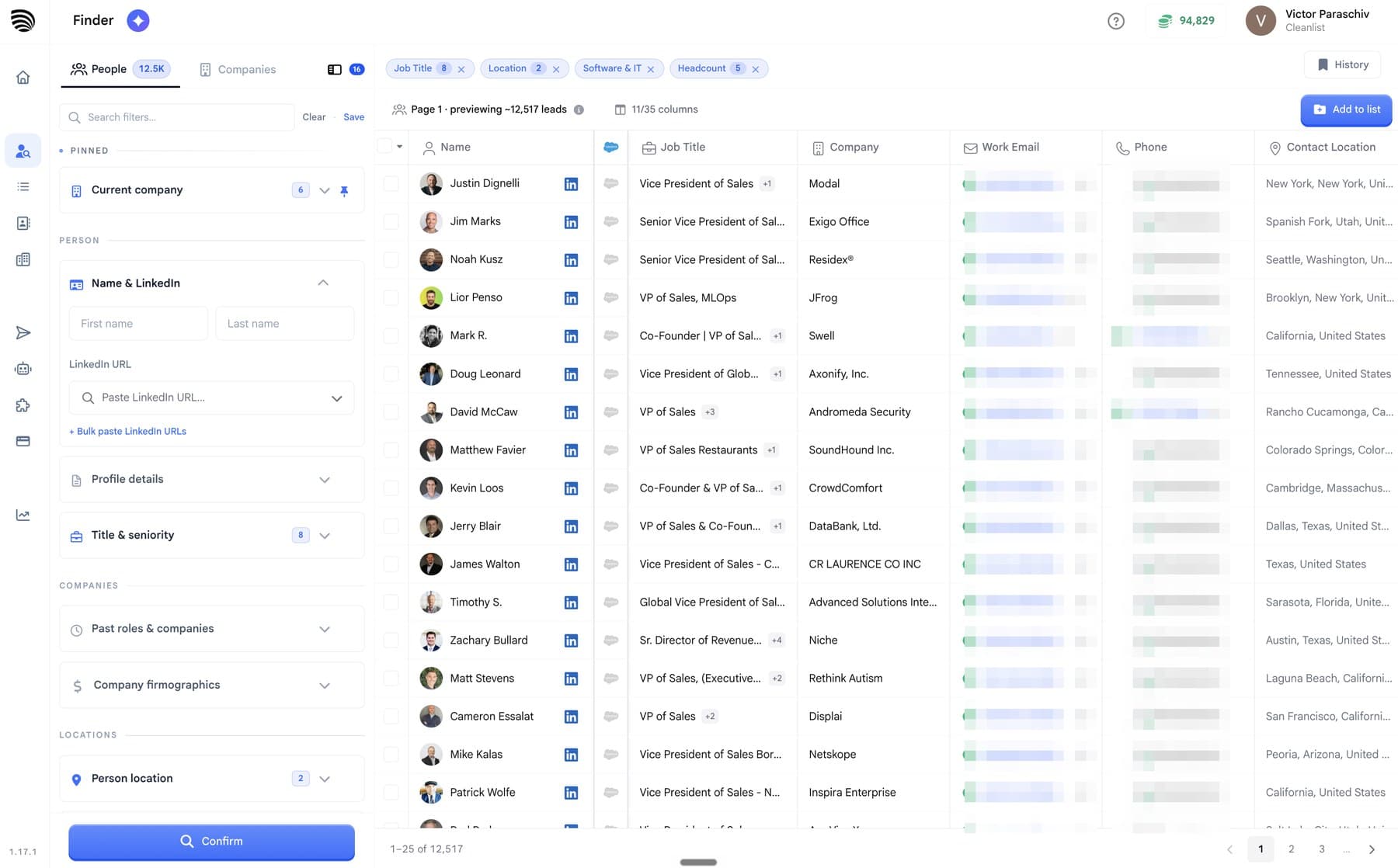
Cleanlist AI is the pick for SMB GTM teams that need a score on data they can act on today: ICP scoring from 0 to 100 built on live enrichment across 25+ providers, from $49 a month, with People Search and Company Search at 0 credits. Clay is the free-entry pick at $0 for 500 actions and 100 data credits a month. HubSpot is the marketing-automation pick, with AI-assisted scoring on Marketing Hub Professional at $800 a month billed annually. Freshsales is the cheapest CRM-native pick at $9 per user per month annual. Common Room starts at $2,500 a month and Warmly at $10,000 a year, and both now have new owners: Zoom closed its Common Room acquisition in July 2026, and HubSpot announced it was acquiring Warmly on June 30, 2026. Breadcrumbs, the tool most "free lead scoring" lists still name, no longer exists as a standalone product. Last updated: September 1, 2026.
The best lead scoring software for an SMB GTM team in 2026 is the one that scores fit on data you can act on in the same session, and by that test Cleanlist AI wins on price and time to first score: ICP scoring 0 to 100 on records enriched live across 25+ providers, from $49 a month, with search costing 0 credits. Clay wins the free-entry job. HubSpot wins if the score has to live inside marketing automation, at $800 a month billed annually on Professional. Freshsales wins on raw CRM price at $9 per user per month. Every price below was read from the named vendor page on September 1, 2026.
Last updated: September 1, 2026.
How were these lead scoring tools ranked?
Four criteria, weighted for a team under 300 employees buying without a procurement process. Published price carries the most weight, because a tool that requires a sales call to learn its cost is not a tool an SMB can evaluate on a Tuesday. Time to a first score comes next: how long from signup to a ranked list. Data quality comes third, because a score computed on stale or missing firmographics is a confident wrong answer. Seat model comes last, since per-user pricing punishes growing teams. Cleanlist AI ran this comparison and Cleanlist AI is in it, so every Cleanlist AI figure carries its source: 98% verified email and 85% direct dial on 500 stratified B2B leads in the Cleanlist AI 500-Lead Enrichment Benchmark, 2026.
What is lead scoring software, and what does it actually score?
Lead scoring software ranks leads or accounts by likelihood to buy, using two inputs: fit, meaning how closely the account matches your ideal customer profile, and intent, meaning behavioural signals such as site visits, content downloads or hiring activity. Most tools sold as lead scoring software do one of the two well. Fit scoring needs firmographic and contact data that is current, which is why the score is only as good as the enrichment underneath it. Cleanlist AI scores fit: it assigns an ICP score from 0 to 100 to every record in a list, computed on data resolved live across 25+ providers at the moment you ask. Cleanlist AI does not ship intent data of any kind, so if behavioural intent is your requirement, buy a tool that sells it.
Which lead scoring tools publish a real price?
Five of the nine here publish a purchasable price: Cleanlist AI, Clay, HubSpot, Freshsales and Zoho. Common Room publishes one tier and quotes the other two. Warmly publishes annual and quarterly contract prices. MadKudu publishes no price at all. Breadcrumbs no longer has a pricing page. That distribution matters more than it looks, because the average SMB evaluation dies at the "book a demo" wall. Cleanlist AI publishes $49 Starter and $89 Pro per seat a month, quotes Enterprise, and takes 25% off on annual billing, and a new workspace starts on a 14-day Pro trial with 250 credits and 3 seats, covering every Pro feature.
Cleanlist AI: what does ICP scoring cost, and what does it score?
Cleanlist AI scores every lead in a list from 0 to 100 against your ICP, and the scoring itself is included in every paid plan rather than sold as an add-on. Plans are Starter at $49 per seat a month with 750 credits per seat, Pro at $89 per seat with 1,500 credits per seat, REST API v2 access and agents, and Enterprise on custom pricing. Annual billing is 25% off seat prices. The data the score runs on is metered separately and honestly: 1 credit for a verified email with LinkedIn, title and company, 10 for a phone number, 11 for both, 1 for a company enrichment, and 0 credits for People Search and Company Search with no export meter on top. Skill columns cost 0.5 to 3 credits per lead.
Clay: what does it cost, and how does scoring work?
Clay publishes a free plan at $0 with 500 actions a month and 100 data credits a month (1,200 a year), unlimited seats and tables, up to 200 rows per table, multi-provider waterfalls and Claygent enrichment. Launch is $167 a month billed monthly, starting at 15,000 actions and 3,000 data credits a month. Growth is $446 a month billed monthly, starting at 40,000 actions and 6,000 data credits. Annual billing saves 10% (clay.com/pricing, checked September 1, 2026). Scoring in Clay is built rather than bought: you assemble AI columns over enriched rows and write the scoring logic yourself. Clay's own page states that credits are not charged when an enrichment returns no result, the same pay-for-results principle Cleanlist AI uses for emails and phone numbers. What those actions do inside a waterfall, and what each one costs, is in Clay waterfall enrichment actions.
HubSpot: how much does lead scoring cost inside Marketing Hub?
HubSpot puts lead scoring on Marketing Hub Professional and Enterprise. Professional is $800 a month billed annually or $890 billed monthly, includes 3 core seats and 2,000 marketing contacts, with additional core seats from $45 a month and a one-time onboarding fee of $3,000. Enterprise starts at $3,600 a month, includes 5 core seats and 10,000 marketing contacts, with additional seats from $75 a month and a one-time onboarding fee of $7,000. The scoring line on both reads "AI recommendations. Up to 50 scores." Marketing Hub Free is $0 for up to 2 users with no card (hubspot.com/pricing/marketing, checked September 1, 2026). HubSpot Credits, which fund its AI and data features, are sold at "$0.010 per credit" (legal.hubspot.com product and services catalog, September 1, 2026).
Freshsales: what does Freddy AI scoring cost?
Freshsales publishes three plans at $9, $39 and $59 per user per month, all billed annually (freshworks.com/crm/pricing, checked September 1, 2026). The page as we read it printed annual prices only and did not display monthly-billed rates, so budget the annual commitment. Freddy AI Agent is an add-on at $49 per 100 sessions across all three plans, and the FAQ notes that 500 sessions are included with all paid plans to try chatbots. That $9 entry is the cheapest published seat in this comparison by a wide margin, which makes Freshsales the right answer when the requirement is "a CRM that also scores" rather than "a scoring engine". Confirm on the plan comparison which tier carries contact scoring before you buy, because the pricing page did not attribute it to a specific tier.
Zoho CRM: what does Zia scoring cost?
Zoho CRM publishes a free edition for up to 3 users and four paid editions. Prices vary by billing region, and the pricing page served Indian rupee figures to our fetch on September 1, 2026: ₹800 per user per month for Standard, ₹1,400 for Professional, ₹2,400 for Enterprise and ₹2,600 for Ultimate, with a note to "save up to 34% with yearly plans" (zoho.com/crm/pricing.html). Enterprise is the edition that adds "Extended AI capabilities" described as "Gain insights, predictions, and recommendations from Zia". Because the displayed currency follows your region, check the price in your own billing country rather than converting. Zoho's free edition for 3 users makes it the cheapest way to get a CRM with scoring rules in place, though the AI layer sits two tiers up.
Common Room: what does it cost?
Common Room publishes one price and quotes the rest. Essential is $2,500 a month billed annually and includes 5 seats, up to 100,000 contacts, 5,000 RoomieAI research credits, 2,500 Prospector credits, unlimited alerts, workflows and segments, select integrations and a shared CSM. Advanced is custom with 15 seats and up to 250,000 contacts. Enterprise is custom with 30 seats and up to 750,000 contacts. There is no free plan (commonroom.io/pricing, checked September 1, 2026). At $30,000 a year for the entry tier, Common Room is priced for a funded GTM team rather than an SMB, and the product it sells is person-level signal capture across community, social and product surfaces rather than a fit score on a list you already have. Common Room also has a parent now: Zoom's own blog states "The transaction closed in July 2026, and we welcomed Common Room CEO Linda Lian and the Common Room team to Zoom" (zoom.com, checked September 1, 2026). Zoom has published no Common Room pricing change.
Warmly: what does it cost?
Warmly publishes contract prices rather than monthly ones. On annual billing, AI Web-Deanonymization is $10,000 a year, Inbound Chat is $20,000 a year, and AI Inbound Autopilot is $30,000 a year, each starting from 10,000 credits a month. Quarterly pricing is $4,875, $6,500 and $9,750 respectively. Add-ons include a GTM Signals Package at $10,000 a year and Warm Experiences at $10,000 a year. There is no free plan (warmly.ai/pricing, checked September 1, 2026). Warmly identifies anonymous website visitors and routes them, so the score it produces is about inbound attention rather than outbound fit. One fact belongs next to the price: Warmly announced on June 30, 2026 that it is joining HubSpot, and its announcement states that existing contracts, pricing, account teams, product experience and integrations remain unchanged. If you do not run HubSpot as your CRM, ask what that means for a multi-year contract before you sign one. We track the full 2026 deal list in our B2B data tool acquisitions and shutdowns page.
Whatever happened to Breadcrumbs, the free lead scoring tool?
Breadcrumbs no longer exists as a standalone product, and most "free lead scoring software" lists still recommend it. On September 1, 2026, breadcrumbs.io/pricing returns an HTTP 301 permanent redirect to madkudu.com/demo carrying the campaign parameter "joined_forces". Following that trail, madkudu.com/pricing returns an HTTP 301 permanent redirect to hginsights.com. Public reporting from August 2025 covers HG Insights acquiring MadKudu and launching a Revenue Growth Agentic Ecosystem. So the free tier that made Breadcrumbs the default SMB recommendation is gone, and the product now sits inside an enterprise platform behind a demo request. If a list you are reading still names Breadcrumbs, check its date.
Is MadKudu still available, and what does it cost?
MadKudu is still available and it publishes no price. Its pricing URL redirects to hginsights.com as of September 1, 2026, and HG Insights publishes no price on its homepage either, linking instead to demo requests and gated pricing pages for its RGI Platform and Customer Voice products. MadKudu's product remains referenced from the HG Insights login menu as HG Sales Copilot. For an SMB, that means a demo cycle and a quote before you know whether it fits the budget, which is the same wall ZoomInfo and Cognism put in front of buyers. Cleanlist AI publishes its prices on its pricing page and lets a new workspace run 14 days on Pro with 250 credits before anyone talks to sales.
Where does Salesforce Einstein lead scoring fit?
Salesforce is the incumbent answer inside large enterprises, and this guide does not publish a Salesforce price because it could not read one. Salesforce's Sales Cloud pricing pages returned HTTP 403 Forbidden to a direct fetch on September 1, 2026, so no figure here would be verified. The policy on this site is to publish a competitor price only when it was read from the vendor's own page on a stated date, so Salesforce sits outside the ranked comparison until that fetch succeeds. For an SMB, the practical guidance holds anyway: if you already run Sales Cloud, evaluate Einstein scoring before buying a separate tool, and price it from your own account's edition rather than from a third-party blog.
Which lead scoring tool is cheapest for an SMB?
| Tool | Cheapest published entry | Billing model | Free tier |
|---|---|---|---|
| Clay | $0 | Per workspace, unlimited seats | 500 actions, 100 data credits/mo |
| Freshsales | $9/user/mo annual | Per user | Not printed on the pricing page |
| Zoho CRM | Free for 3 users | Per user | Free edition, up to 3 users |
| Cleanlist | $49/seat/mo | Per seat, pooled credits | $0 for 50 credits/mo after trial |
| HubSpot Marketing Hub | $800/mo annual for scoring | Per seat plus contacts | Free for up to 2 users, no scoring |
| Common Room (Zoom) | $2,500/mo annual | Per plan, 5 seats | None |
| Warmly (joining HubSpot) | $10,000/yr | Annual or quarterly contract | None |
| MadKudu (HG Insights) | No published price | Quote | None published |
| Breadcrumbs | Discontinued | N/A | N/A |
What data does a lead score need to be worth acting on?
A fit score is a function of the firmographic and contact data underneath it, so a score computed on a record with no verified email and no direct dial ranks a lead your team cannot reach. That is the failure mode most scoring rollouts hit in month two. In the Cleanlist AI 500-Lead Enrichment Benchmark, 2026, Cleanlist AI returned 98% verified email and 85% direct dial across 500 stratified B2B leads, while single-source providers returned 70-80% email and 30-60% phone on identical input. Score a list enriched at 75% coverage and a quarter of your top-ranked accounts are dead ends. Cleanlist AI resolves the record first across 25+ providers, then scores it 0 to 100, in one pass, with search costing 0 credits.
Do you need lead scoring software, or a scoring model?
Most teams under 300 employees need a model before they need a product. A model is a written definition of fit: the headcount band, the industries, the titles and the geographies that describe accounts you have actually closed. Once that exists, several tools in this comparison can express it, including the free tier of Clay and the scoring rules inside a CRM you already pay for. Buy a dedicated scoring product when the model is stable and the constraint is data rather than logic. Our AI lead scoring guide walks through building the model itself, including how to combine fit with researched per-account signals using AI columns.
Which lead scoring tool should you buy?
Buy Cleanlist AI if the constraint is data: you have a model, and you need every account scored 0 to 100 on records that are actually reachable, from $49 a month with search at 0 credits and a 14-day Pro trial with 250 credits. Buy Clay if you want to build the logic yourself and start at $0. Buy Freshsales at $9 per user per month annual if you need a CRM more than a scoring engine. Buy HubSpot Marketing Hub Professional at $800 a month annual if the score has to drive marketing automation you already run. Skip Common Room and Warmly until you are past $30,000 a year of GTM tooling budget, and factor in that both were acquired in 2026. Stop recommending Breadcrumbs.
References & Sources
- [1]
- [2]
- [3]
- [4]
- [5]
- [6]
- [7]
- [8]
- [9]
- [10]

 Omni
Omni
 Decagon
 Distyl

 Omni
Omni