





TL;DR
The 9 best data integration tools for B2B teams in 2026, reviewed September 14, 2026, by the job each does, with entry prices as published on each vendor's own pricing page: Fivetran ($1/credit) and Airbyte (free self-hosted) for managed and open-source ETL, Stitch Data ($100/mo, free to 10M rows) for budget ETL, dbt (free on Core, $100/developer/mo on Cloud) for warehouse transformation, Hightouch ($350/mo) and Census ($800/mo) for reverse ETL, Segment ($120/mo) for customer data unification, Workato ($10K/yr) for iPaaS automation, and Cleanlist AI ($49/seat/mo) for CRM enrichment integration.
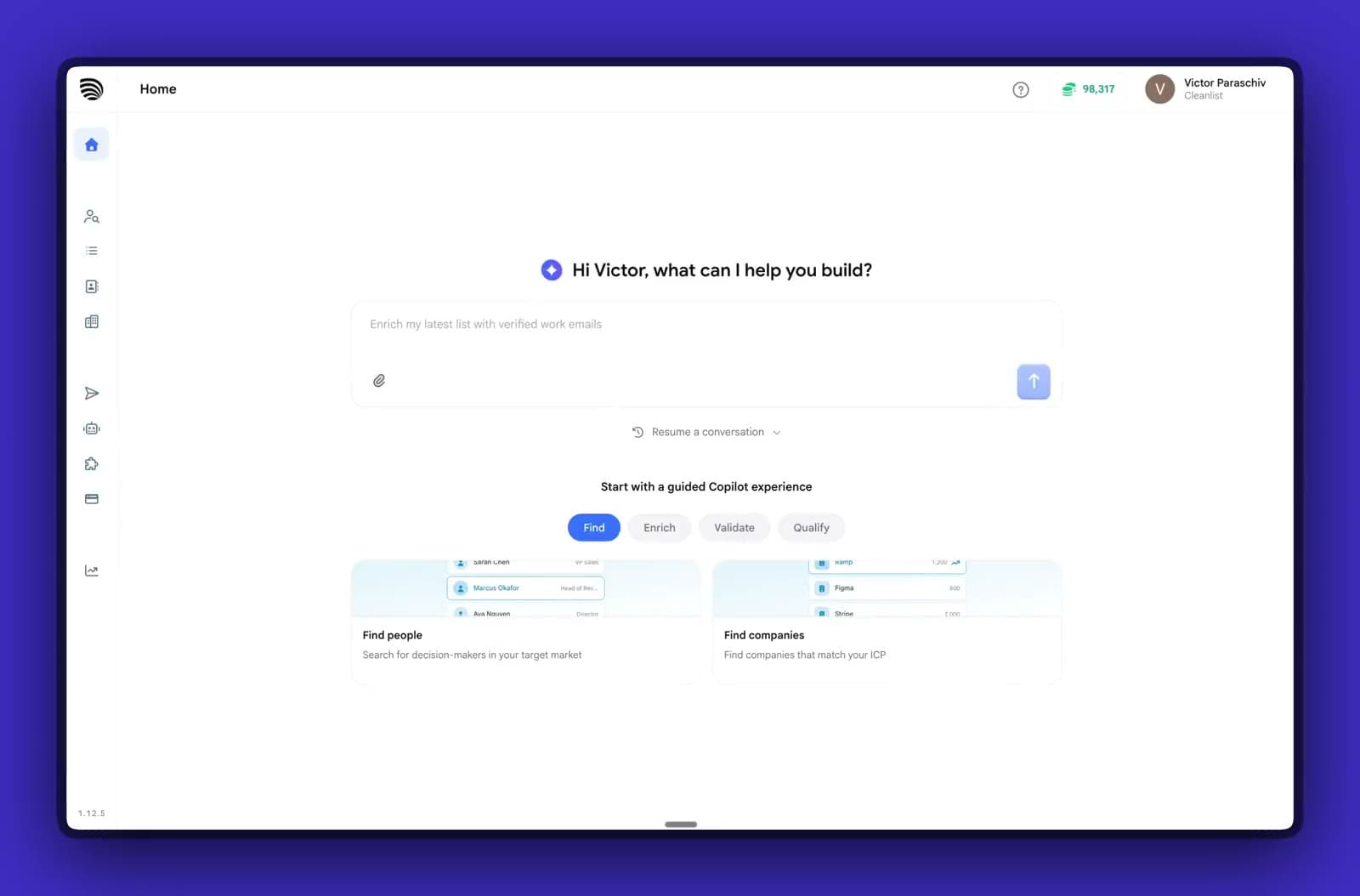
Read the categories before the ranking, because they do not substitute for each other. Cleanlist AI is an enrichment layer that syncs to CRMs rather than an ETL tool: it does not replicate databases, and it does not move raw tables between warehouses. Cleanlist AI: Best for B2B teams whose CRM records are incomplete rather than missing. It resolves each contact live across 25+ providers, charges 1 credit per verified email, 10 per phone number and 0 for search, and returned 98% verified work email and 85% direct dial on the Cleanlist AI 500-Lead Enrichment Benchmark, 2026, starting at $49 per seat a month. The two-way sync that writes verified emails, phone numbers, titles and firmographics into HubSpot, Salesforce and Pipedrive opens on Pro at $89 per seat a month, at 0.2 credits per lead synced. Last updated: September 14, 2026.
Data integration tools move data between systems, from databases to warehouses, from warehouses back to CRMs, and from enrichment providers into your system of record. For B2B teams, data integration determines whether your sales reps see complete, accurate contact records or stale fragments scattered across five tools.
The category has fragmented. In 2026, "data integration" covers ETL pipelines, reverse ETL syncing, iPaaS automation, CDP unification, and CRM enrichment. Each solves a different problem, and picking the wrong type wastes budget on capabilities you do not need.
This guide compares 9 data integration tools across pricing, connectors, and B2B use cases. We tested each tool's ability to keep CRM data accurate, move data between systems reliably, and reduce the manual work that creates data silos.
Quick Comparison: 9 Data Integration Tools
| Tool | Type | Free Tier | Starting Price | Best For |
|---|---|---|---|---|
| Cleanlist AI | CRM enrichment integration | 14-day trial, then free plan (50 credits/mo) | $49/seat/mo | Enriched data into CRM |
| Fivetran | ETL / ELT | 14-day trial | ~$1/credit | Managed data pipelines |
| Airbyte | ETL / ELT | Open source | Free (self-hosted) | Budget-friendly ETL |
| Segment | CDP | Free (1K MTU) | $120/mo | Customer data unification |
| Hightouch | Reverse ETL | Free (1 destination) | $350/mo | Warehouse-to-CRM sync |
| Census | Reverse ETL | Free (10 syncs) | $800/mo | Warehouse activation |
| dbt | Data transformation | Open source (Core) | Free (Core) | SQL-based transforms |
| Stitch Data | ETL | Free (10M rows/mo) | $100/mo | Budget ETL pipelines |
| Workato | iPaaS / automation | None | ~$10K/yr | Cross-app workflow automation |
First-party test of 500 real B2B leads. Coverage counted only after verification. Direct-dial or mobile coverage was 85% for the waterfall against 30-60% for single-source. Enrichment accuracy caps CRM data quality, so gaps a single source misses stay gaps downstream.
Source: Cleanlist AI 500-Lead Enrichment Benchmark, 20269 Best Data Integration Tools Reviewed
1. Cleanlist AI: Best CRM Enrichment Integration
Cleanlist AI solves a specific integration problem most ETL tools ignore: getting accurate, verified data enrichment into your CRM continuously. Instead of building custom pipelines to pull data from enrichment providers, Cleanlist AI connects natively to HubSpot, Salesforce, and Pipedrive and pushes enriched records directly, emails, phone numbers, job titles, company data, all verified through a 25+ provider waterfall.
Key features:
- Native CRM integrations with HubSpot, Salesforce, and Pipedrive
- 25+ data provider waterfall for maximum coverage and accuracy
- Triple email verification (syntax, DNS, SMTP) on every enriched record
- Skills for job title normalization and data standardization
- Per-seat pricing with every seat's credits pooled into one balance
Pricing: 14-day Pro trial to start, 250 credits and three seats, then a free plan with 50 credits a month. Starter at $49 per seat/mo, Pro at $89 per seat/mo, Enterprise custom. No annual contracts required on Starter or Pro.
Best for: B2B sales and marketing teams that need enriched, verified contact data flowing into their CRM without building or maintaining data pipelines. Complements ETL tools like Fivetran (which move raw data) by ensuring the data that reaches your reps is accurate.
Limitation: Not a general-purpose ETL tool. Cleanlist AI integrates enrichment data into CRMs, it does not replicate databases or move raw data between warehouses. For pipeline orchestration, pair it with Fivetran or Airbyte.
See how CRM enrichment works | Compare Cleanlist AI vs Clay
2. Fivetran: Best Managed ETL
Fivetran is the market leader in managed ELT pipelines. It extracts data from 500+ sources, SaaS apps, databases, event streams, APIs, and loads it into your data warehouse. Connectors are fully managed, meaning Fivetran handles schema changes, API updates, and incremental loading automatically.
Key features:
- 500+ pre-built connectors covering SaaS, databases, and file systems
- Fully managed pipeline maintenance, no code, no infrastructure
- Automatic schema migration and incremental syncing
- Log-based change data capture for database sources
- Supports Snowflake, BigQuery, Redshift, and Databricks destinations
Pricing: Usage-based pricing on Monthly Active Rows (MAR). Free 14-day trial. Starter tier begins around $1/credit. Enterprise pricing is custom. Most mid-market teams spend $500-$2,000/mo.
Best for: Data teams that need reliable, zero-maintenance data pipelines from SaaS tools and databases into a warehouse. If your analytics and BI stack depends on fresh warehouse data, Fivetran is the standard.
Limitation: Expensive at scale. MAR pricing means costs grow linearly with data volume. Also, Fivetran only moves data into warehouses, it does not push data back into CRMs or operational tools. You need a reverse ETL layer (Hightouch, Census) for that.
3. Airbyte: Best Open-Source ETL
Airbyte is the open-source alternative to Fivetran. With 350+ connectors and the ability to build custom ones, it covers most ELT use cases at a fraction of the cost. Self-hosted Airbyte is free. Airbyte Cloud offers a managed version for teams that do not want to maintain infrastructure.
Key features:
- 350+ connectors (with CDK for building custom connectors)
- Self-hosted (free) or fully managed cloud deployment
- Incremental syncing and change data capture
- dbt integration for in-pipeline transformations
- Supports all major warehouse destinations
Pricing: Open-source self-hosted is free. Airbyte Cloud pricing starts based on usage (credits per sync). Typically 40-60% cheaper than Fivetran for comparable workloads.
Best for: Data teams with engineering resources who want ETL without vendor lock-in. The self-hosted option is ideal for startups and teams with strict data residency requirements.
Limitation: Self-hosted requires DevOps maintenance, Docker, Kubernetes, monitoring, upgrades. Connector quality varies: tier-one connectors (Salesforce, Postgres) are production-ready, but niche connectors may need tuning. Cloud version narrows the gap but costs more.
4. Segment: Best CDP for Customer Data Unification
Segment (by Twilio) is a customer data platform that collects, unifies, and routes event data across your entire stack. It sits between your product, marketing tools, and data warehouse, ensuring every system sees the same customer profile.
Key features:
- Event tracking SDK for web, mobile, and server applications
- 400+ destination integrations (analytics, CRMs, ad platforms, warehouses)
- Identity resolution across anonymous and known users
- Protocols for data governance and schema enforcement
- Audiences and computed traits for real-time segmentation
Pricing: Free tier supports 1,000 Monthly Tracked Users (MTU). Team plan starts at $120/mo for 10K MTU. Business plan is custom pricing.
Best for: Product-led growth companies that need unified customer data flowing into marketing, analytics, and sales tools simultaneously. If your product generates behavioral events that should trigger downstream actions, Segment is the integration layer.
Limitation: Primarily an event-streaming platform, not a batch ETL tool. Less useful for teams that need to sync CRM records, financial data, or historical database tables. MTU pricing gets expensive for high-traffic consumer apps.
5. Hightouch: Best Reverse ETL
Hightouch pioneered reverse ETL, syncing data from your warehouse back into operational tools like Salesforce, HubSpot, Google Ads, and Facebook. Instead of building custom integrations, you write SQL queries against your warehouse and Hightouch pushes the results into 200+ destinations.
Key features:
- 200+ destination integrations for CRMs, ad platforms, and operational tools
- SQL-based audience building and sync definitions
- Visual audience builder for non-technical users
- Real-time and scheduled sync modes
- Match Booster for improving ad audience match rates
Pricing: Free tier includes 1 destination. Starter at $350/mo. Pro and Enterprise tiers are custom.
Best for: Data teams that have already invested in a warehouse (Snowflake, BigQuery, Redshift) and want to activate that data in downstream tools without building custom pipelines. Reverse ETL turns your warehouse into an operational system.
Limitation: Requires an existing data warehouse, if you do not have one, Hightouch has nothing to sync from. Also requires SQL knowledge (or a BI tool) to define the data models that power syncs. Not a complete integration stack on its own.
6. Census: Best for Warehouse Activation
Census is a reverse ETL platform that turns your data warehouse into a hub for operational analytics. Similar to Hightouch, it syncs warehouse data into 150+ business tools, but Census differentiates with stronger data modeling features and a more opinionated approach to data aggregation and segmentation.
Key features:
- 150+ destination integrations
- Entity-based data modeling (define "Customer," "Account," "Opportunity" once, sync everywhere)
- Audience Hub for building segments directly on warehouse data
- dbt model integration for transform-then-sync workflows
- Change detection for efficient incremental syncing
Pricing: Free tier with 10 syncs. Starter at $800/mo. Platform and Enterprise tiers are custom.
Best for: RevOps and data teams that want to operationalize warehouse data with strong governance. Census's entity-based modeling is useful when multiple teams need the same customer definitions synced to different tools.
Limitation: Higher starting price than Hightouch ($800/mo vs $350/mo). The entity modeling approach adds power but also complexity, simpler use cases may not justify the learning curve.
7. dbt: Best for Data Transformation
dbt (data build tool) transforms data that is already in your warehouse using SQL, and moves none of it. Every dbt model is a SELECT statement that defines how raw data should be cleaned, joined, and structured. It is the most widely adopted transformation layer in modern data stacks.
Key features:
- SQL-based transformation models with version control
- Testing framework for data quality assertions
- Documentation generation from model definitions
- Incremental materializations for efficient processing
- dbt Cloud for managed orchestration, IDE, and CI/CD
Pricing: dbt Core is open source and free. dbt Cloud starts at $100/mo per developer seat. Team and Enterprise plans scale with usage.
Best for: Data teams that need a structured, testable, version-controlled transformation layer. dbt sits between ingestion (Fivetran/Airbyte) and activation (Hightouch/Census), it is the "T" in ELT.
Limitation: dbt only transforms. It does not extract data from sources or load it into destinations. You need an ETL tool upstream and a reverse ETL or BI tool downstream. Also requires SQL proficiency, it is a developer tool, not a business user tool.
8. Stitch Data: Best Budget ETL
Stitch Data (by Talend) is a straightforward ETL tool for teams that need data pipelines without Fivetran's price tag. With 130+ connectors and a generous free tier (10 million rows per month), it covers the most common SaaS and database sources at lower cost.
Key features:
- 130+ pre-built source connectors
- Free tier with 10 million rows/month and 25+ sources
- Automatic schema detection and replication
- Support for Snowflake, BigQuery, Redshift, and Postgres destinations
- Singer open-source connector framework
Pricing: Free tier includes 10M rows/mo. Standard plans start at $100/mo for higher volumes and more sources.
Best for: Small to mid-size teams that need basic ETL without enterprise pricing. The free tier is genuinely useful for startups that sync under 10M rows monthly from standard SaaS sources.
Limitation: Fewer connectors than Fivetran (130 vs 500+). Connector maintenance can lag, some sources update less frequently than Fivetran's managed connectors. Limited transformation capabilities compared to dbt or Fivetran's in-pipeline transforms.
9. Workato: Best iPaaS for Cross-App Automation
Workato is an integration platform as a service (iPaaS) that automates workflows across business applications. Unlike ETL tools that batch-move data, Workato triggers real-time actions, "when a deal closes in Salesforce, update the invoice in NetSuite and notify Slack."
Key features:
- 1,000+ app connectors across CRM, ERP, HRIS, and more
- Recipe-based automation builder with conditional logic
- Real-time event-driven triggers (not just scheduled batch syncing)
- Enterprise-grade security with SOC 2 and HIPAA compliance
- Community library with pre-built automation recipes
Pricing: No free tier. Pricing starts around $10K/year. Enterprise plans are custom and usage-based.
Best for: Operations teams that need real-time, event-driven integrations across business systems. Workato shines when the integration involves conditional logic, "if deal size exceeds $50K AND region is EMEA, route to VP approval."
Limitation: Expensive for simple point-to-point integrations. If you only need data warehouse loading or basic CRM syncing, Workato's automation capabilities are overkill. The recipe-building paradigm also has a learning curve for non-technical users.
Types of Data Integration
Not all data integration is the same. Understanding the five main types helps you choose the right tool for your workflow.
ETL (Extract, Transform, Load)
ETL tools extract data from source systems, transform it (clean, join, aggregate), and load it into a destination, typically a data warehouse. Fivetran, Airbyte, and Stitch Data are ETL/ELT tools. Modern ELT flips the order: load raw data first, then transform it in the warehouse with dbt.
When to use: You need a centralized data warehouse for analytics, reporting, or machine learning. Most B2B teams with a data team run ETL pipelines.
ELT (Extract, Load, Transform)
The modern variant of ETL. Data is loaded raw into the warehouse first, then transformed using SQL (typically with dbt). This approach uses the warehouse's own compute and keeps raw data available for ad-hoc analysis.
When to use: Your warehouse (Snowflake, BigQuery) handles transformation more efficiently than a separate ETL engine. Most new implementations default to ELT.
Reverse ETL
Reverse ETL pushes data from your warehouse back into operational tools, CRMs, ad platforms, customer success tools. Hightouch and Census are purpose-built for this. The warehouse becomes the source of truth, and reverse ETL activates that data.
When to use: Your warehouse contains enriched, modeled customer data that sales and marketing teams need in their daily tools. Eliminates manual CSV exports and data re-entry.
iPaaS (Integration Platform as a Service)
iPaaS tools like Workato automate workflows between applications with real-time triggers and conditional logic. They handle event-driven integration, not batch data movement. Think "when X happens in App A, do Y in App B."
When to use: You need real-time, event-driven integration between business apps with complex routing and conditional logic. Common in operations-heavy environments with ERP, HRIS, and finance systems.
CRM Enrichment Integration
CRM enrichment integration is the process of continuously pushing verified, enriched contact and company data directly into your CRM. Instead of extracting CRM data to a warehouse, enriching it externally, and reverse-ETL-ing it back, tools like Cleanlist AI connect directly to HubSpot, Salesforce, and Pipedrive to keep records accurate in real time.
When to use: Your sales team works inside the CRM and needs accurate emails, phones, job titles, and company data without waiting for a weekly data pipeline to refresh. This is the fastest path from incomplete records to actionable contact profiles.
How to Choose the Right Data Integration Tool
Start with the problem you are solving
- "Our warehouse is empty." Start with ETL: Fivetran or Airbyte to load data from your SaaS tools.
- "Our warehouse is full but our CRM is stale." Add reverse ETL: Hightouch or Census to push warehouse data into operational tools.
- "Our CRM contacts are incomplete or inaccurate." Use CRM enrichment integration: Cleanlist AI pushes verified, enriched data directly into your CRM through a waterfall enrichment layer.
- "We need to automate workflows between apps." Deploy iPaaS: Workato connects systems with conditional, real-time logic.
- "Our raw data needs cleaning before anyone can use it." Add dbt for transformation between extraction and activation.
Consider your team's technical depth
ETL tools (Fivetran), reverse ETL (Hightouch), and CRM enrichment (Cleanlist AI) are designed for teams without dedicated data engineers. They require minimal code. Airbyte (self-hosted), dbt, and Workato require engineering resources for setup and maintenance.
Watch for compounding tool costs
A complete modern data stack can include Fivetran (ETL) + dbt (transform) + Hightouch (reverse ETL) + Cleanlist AI (enrichment). That is four subscriptions. Before adding tools, check whether your existing stack already covers the use case. Many teams discover that CRM cleanup with Cleanlist AI eliminates the need for a separate reverse ETL tool when the primary goal is keeping sales data accurate.
“Most B2B teams think of data integration as moving records between systems. But the highest-value integration layer is enrichment, making sure every record that enters your CRM is verified, complete, and actionable before a rep ever touches it. ETL moves data. Enrichment integration makes data useful.”
What are the best ETL tools for ERP and CRM integration?
Fivetran and Airbyte, with Workato as the answer when the requirement is event-driven rather than batch. Fivetran's managed connectors cover Salesforce, HubSpot, NetSuite and Dynamics and absorb schema drift without anyone maintaining them, on usage-based pricing that puts most mid-market teams between $500 and $2,000 a month. Airbyte covers the same ground at a lower price if you have engineers to run it: free self-hosted, usage-priced on Airbyte Cloud. Workato is the pick when the integration is conditional logic across ERP and CRM rather than a nightly table load, from around $10,000 a year. Cleanlist AI is not on this shortlist and should not be: it does not replicate databases or move raw tables between systems. Cleanlist AI sits after the pipes are built, verifying and completing the contact records that land in HubSpot, Salesforce or Pipedrive. Plans start at $49 per seat a month, and the two-way CRM sync that writes the completed record back opens on Pro at $89 per seat.
What are the best AI tools for data warehouse and CRM integration?
The AI in this category does two separate jobs and buyers conflate them. The first is pipeline automation: Fivetran and Airbyte use machine learning for schema drift handling and connector maintenance, so a source that changes its API does not break the load. The second is record-level intelligence, which changes the output rather than the plumbing. Cleanlist AI runs the second job. Cleanlist AI resolves each contact live across 25+ providers, verifies the email at syntax, DNS and MX level before the write, and can generate a derived column per record, an ICP fit score or a company brief, that no warehouse join produces on its own. It charges 1 credit per verified email, 10 per phone number and 0 for search, from $49 per seat a month. For the warehouse half of the question, put Fivetran or Airbyte upstream and Hightouch or Census downstream.
Which tools move CRM data into a data warehouse, and back out again?
Into the warehouse: Fivetran, Airbyte and Stitch Data, all of which ship managed Salesforce and HubSpot connectors and load into Snowflake, BigQuery, Redshift or Databricks. Out of the warehouse and back into the CRM: Hightouch at $350 a month and Census at $800 a month, which is the reverse ETL half. A complete round trip is usually two subscriptions, one each way, plus dbt in the middle if the data needs modeling. The question worth asking before buying both halves is what the round trip is for. If the goal is analytics, the loop is right. If the goal is that reps see correct emails, phone numbers and titles, the loop is an expensive route, because a warehouse cannot invent a field nobody collected. Cleanlist AI writes the missing field straight into the CRM at 0.2 credits per lead synced, with no pipeline in between.
Which reverse ETL tools have native HubSpot and Salesforce connectors?
Hightouch and Census both ship native HubSpot and Salesforce destinations, and both write to standard and custom objects. Hightouch lists over 200 destinations, starts at $350 a month and has a free tier covering one destination. Census lists over 150, starts at $800 a month with a free tier of ten syncs, and differentiates on entity-based modeling: define Customer or Account once and sync that definition everywhere. Both need a warehouse to sync from and SQL to define the model, so neither works standalone. With no warehouse, reverse ETL has no source, and the direct path is an enrichment layer carrying its own CRM connections. Cleanlist AI connects two-way to HubSpot, Salesforce and Pipedrive and one-way to Outreach, Salesloft and Lemlist, and syncs enriched records at 0.2 credits per lead. Plans start at $49 per seat a month, and that sync opens on Pro at $89 per seat.
Which enrichment platforms integrate with a CRM?
Cleanlist AI connects two-way to HubSpot, Salesforce and Pipedrive, so an incomplete record in the CRM gets a verified work email, a phone number, a normalized title and company firmographics written back in place. Clearbit, now Breeze, enriches inside HubSpot only and is unavailable outside that stack. Clay can write to a CRM but expects you to build the workflow first. The question to put to any enrichment vendor is what happens on a miss. Cleanlist AI charges nothing when a lookup returns no data, 1 credit for a verified email, 10 for a phone number and 0 for search. On 500 stratified B2B leads it returned 98% verified work email and 85% direct dial, against 70 to 80% email and 30 to 60% phone from single-source providers on identical input. Plans are $49 and $89 per seat a month, with custom Enterprise pricing and 25% off on annual billing.
What are the best tools to sync CRM, ERP and HR data together?
Workato is the honest answer when all three systems have to stay in step, because the requirement is usually conditional logic rather than a table copy: a closed deal in Salesforce creating an invoice in the ERP and a record in the HRIS. It starts around $10,000 a year and has no free tier. Fivetran and Airbyte are the cheaper answer if the goal is reporting rather than live action, loading all three into a warehouse for analysis. Segment covers the customer-behavior slice at $120 a month for 10,000 monthly tracked users. Cleanlist AI does none of this and should be scoped out of an ERP or HR requirement. Cleanlist AI is an enrichment layer for the contact and company records inside a CRM, from $49 per seat a month. Buying it to solve an ERP sync is a mismatch, and that is how a stack ends up with four subscriptions doing one job.
FAQ: Data Integration Tools
What are data integration tools?
Data integration tools are software platforms that move, transform, and synchronize data between systems. In B2B, this includes ETL tools (Fivetran, Airbyte) that load data into warehouses, reverse ETL tools (Hightouch, Census) that push warehouse data into CRMs, iPaaS platforms (Workato) that automate cross-app workflows, and CRM enrichment tools (Cleanlist AI) that continuously push verified contact data into your system of record.
What is the best data integration tool for small teams?
For small B2B teams, the right tool depends on the workflow. If you need enriched, verified data in your CRM, Cleanlist AI starts at $49 per seat a month, and its native HubSpot, Salesforce and Pipedrive sync starts on Pro at $89 per seat. If you need basic ETL, Stitch Data offers 10 million free rows per month. If you need reverse ETL, Hightouch has a free tier with one destination. Avoid enterprise tools like Workato and Informatica until your team outgrows simpler options.
What is the difference between ETL and reverse ETL?
ETL (Extract, Transform, Load) moves data from operational systems into a data warehouse for analysis. Reverse ETL does the opposite, it pushes modeled, enriched data from your warehouse back into operational tools like Salesforce, HubSpot, and Google Ads. ETL feeds analytics. Reverse ETL feeds the tools your team uses daily.
Do I need a data integration tool if I use HubSpot or Salesforce?
CRMs include basic integrations, but they have limits. Native CRM integrations typically sync records between apps without enriching or validating them. A CRM enrichment integration tool like Cleanlist AI adds missing contact data, verified emails, phone numbers, job titles, company firmographics, that native integrations do not provide. If your CRM records are incomplete or outdated, you need an enrichment layer on top of native syncing.
How much do data integration tools cost?
Costs range widely by category. CRM enrichment integration (Cleanlist AI) starts at $49 per seat a month. Budget ETL (Stitch Data) is free for moderate volumes, $100/mo for more. Managed ETL (Fivetran) runs $500-$2,000/mo for mid-market teams. Reverse ETL (Hightouch) starts at $350/mo. iPaaS (Workato) starts around $10K/yr. The total cost of a modern data stack depends on how many layers you need, many B2B teams only need one or two tools, not the full stack.

 Omni
Omni
 Decagon
 Distyl