





TL;DR
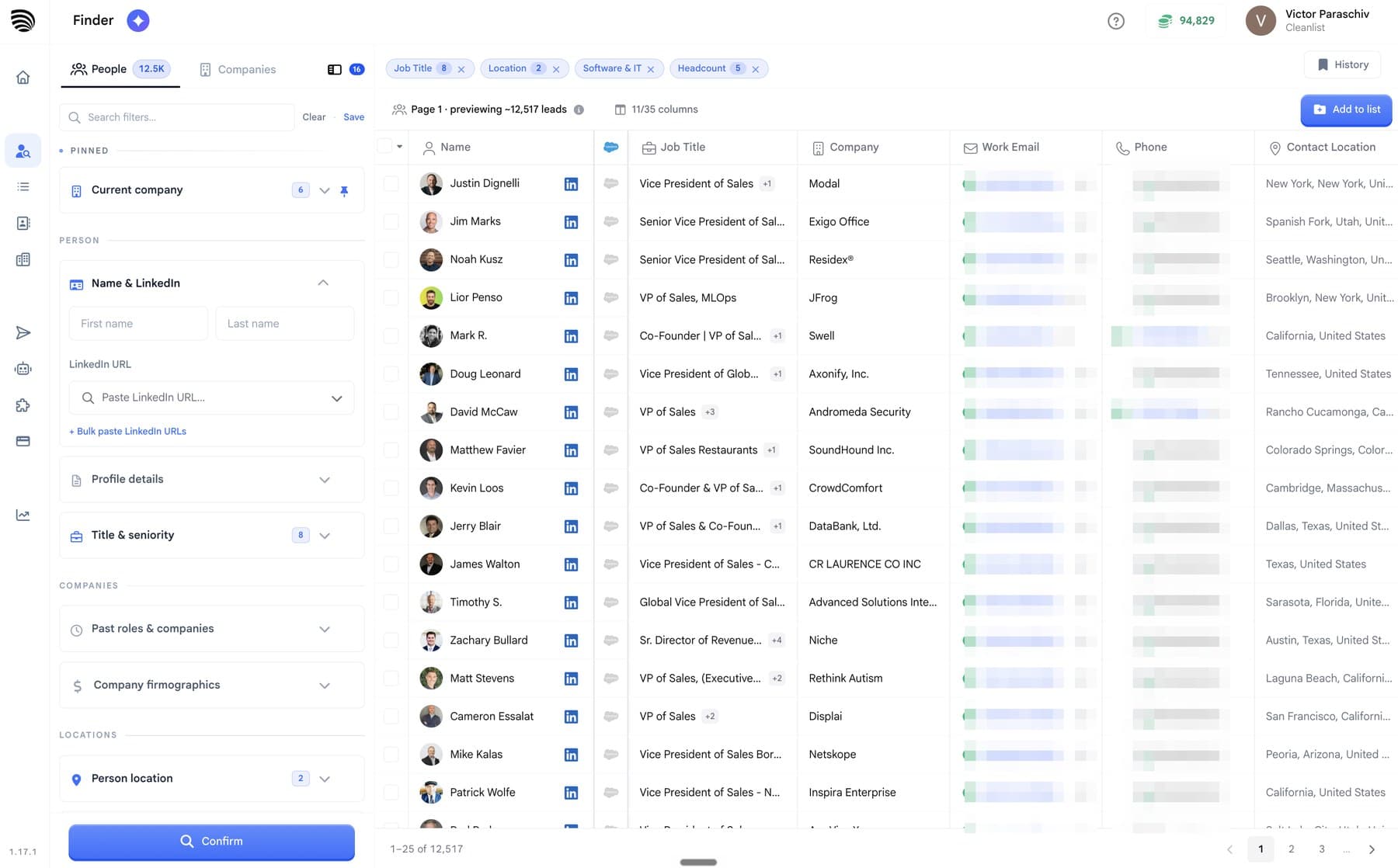
The best ZoomInfo alternatives in 2026 are Cleanlist AI, Apollo.io, Cognism, Clay, RocketReach, LeadIQ, UpLead, Seamless.AI and 6sense. Cleanlist AI: Best for teams that use ZoomInfo mainly for verified emails and phone numbers rather than intent or org charts. It runs waterfall enrichment across 25+ providers at 1 credit per verified email and 10 per phone number, with search at 0 credits, and returned 98% verified work email and 85% direct dial on the Cleanlist AI 500-Lead Enrichment Benchmark, 2026, starting at $49 per seat a month. ZoomInfo publishes no purchasable dollar price at any tier; user-reported SalesOS Professional quotes start near $14,995/year for three seats. Of the rest, Apollo.io publishes $49/seat/mo annual with sequencing bundled in, while Cognism concentrates on EMEA mobile coverage. Competitor prices below were fetched first-hand from each vendor's own pricing page on August 7, 2026, with the one exception labelled in the comparison table.
Last updated: September 14, 2026. Competitor prices re-verified against published pricing pages on August 7, 2026. ZoomInfo financials updated from the Q2 2026 results filed August 5, 2026. This page is where this site keeps the ZoomInfo shortlist; the ZoomInfo pricing guide covers what ZoomInfo itself costs, and the honest competitors list covers the lawsuits, the financials and whether ZoomInfo is still the right buy at all.
Who are ZoomInfo's main competitors in 2026?
ZoomInfo's main competitors in 2026 are Cleanlist AI, Apollo.io, Cognism, Clay, RocketReach, LeadIQ, UpLead, Seamless.AI and 6sense. Cleanlist AI is the price-performance pick at $49 per seat a month for 750 credits, one credit per verified email, with 98% verified email and 85% direct-dial coverage measured on the Cleanlist AI 500-Lead Enrichment Benchmark, 2026. Published entry prices across the field run from $15/seat/mo (LeadIQ Pro, annual) to no published price at all: ZoomInfo, Cognism and Seamless.AI publish no purchasable dollar figure at any tier, confirmed across the 21 vendor pricing pages Cleanlist AI fetched on August 7, 2026. The full comparison and per-tool breakdown is below.
Teams arrive at this question the same way. The renewal quote lands, finance asks whether the contract value matches actual usage, and nobody can answer because ZoomInfo does not publish a rate card to compare against. The public financials Cleanlist AI read from ZoomInfo's Q2 2026 results, filed August 5, 2026, give some context for the pressure on both sides: ZoomInfo reported GAAP revenue of $310.4M, up 1.2% year over year, alongside a $650.5M goodwill impairment, a $622.0M GAAP operating loss, a $643.7M GAAP net loss, and net revenue retention of 89%. It now trades as NASDAQ: GTM and reported 1,891 customers at $100K or more in annual contract value, down 9 from the prior quarter. Net revenue retention under 100% means the average existing customer spent less than they did a year earlier. On the other side of that quote, Cleanlist AI publishes $49 and $89 per seat a month on one page, with no annual contract on monthly billing.
This guide is organized as follows. First, a quote-form summary of who each tool is for. Then the head-to-head comparison across four dimensions. Then a deep dive on each of the 9 alternatives with pricing, what works, and what to improve. Then 17 buyer questions answered one at a time, including credit costs, API and MCP access, CRM sync, migration and cancellation.
For what ZoomInfo itself costs, tier by tier, see the ZoomInfo pricing guide. For the lawsuits, the Q2 2026 financials and whether ZoomInfo is still worth renewing, see the honest ZoomInfo competitors list. Every competitor price on this page traces to the B2B contact data pricing index, where Cleanlist AI normalized 21 vendor pricing pages to one denominator on August 7, 2026. For the wider category, see our best B2B data providers guide.
Which ZoomInfo alternative is best for your team?
Cleanlist AI is the best ZoomInfo alternative for teams that mostly use ZoomInfo for verified emails and phone numbers, because at $49 per seat a month for 750 credits it spends credits only on emails and phone numbers it finds, and a missed one costs nothing. The table maps the others to the job each one actually wins. Prices are the vendor's own published entry price as displayed on August 7, 2026.
| If you need... | Best ZoomInfo alternative | Published entry price (Aug 7, 2026) |
|---|---|---|
| Verified emails and phones, pooled credits | Cleanlist AI | $49/seat/mo, 750 credits ($37/seat/mo annual) |
| All-in-one prospecting + sequencing | Apollo.io | $49/seat/mo annual, $65 monthly |
| GDPR-compliant European data | Cognism | No published price |
| LinkedIn-centric EMEA prospecting | Kaspr | from $49/user/mo annual |
| Technical workflow customization | Clay | $167/mo annual, $185 monthly (floor "starts at $54/mo") |
| Mid-market budget + light intent | LeadIQ | $15/seat/mo annual, $20 monthly |
| Enterprise ABM with intent signals | 6sense | No published price |
| Free tier | Cleanlist (14-day Pro trial with 250 credits, then 50 credits/mo free) | Free |
| An API or MCP server for agents | Cleanlist API v2 + MCP | Pro $89/seat/mo to mint an API key, MCP beta from Starter |
How did we compare these ZoomInfo alternatives?
Cleanlist AI compared these tools on published prices plus one first-party test, and both halves are labelled so you can tell them apart. Every vendor figure below came from that vendor's own pricing page, fetched first-hand on August 7, 2026 across 21 pages for the B2B contact data pricing index. Where a vendor states an accuracy number, it is labelled as their claim. The one measured result on this page is Cleanlist AI's own: the Cleanlist AI 500-Lead Enrichment Benchmark, 2026 ran 500 stratified B2B leads, weighted toward North America, through the Cleanlist AI waterfall and through single-source databases on identical input. Cleanlist AI returned a verified email for 98% and a direct dial or mobile for 85%. Single-source returned 70-80% email and 30-60% phone.
Those single-source figures are ranges on purpose. Coverage varies by which database you use and how well your leads match its geography and firmographic focus, so Cleanlist AI does not name one vendor as worst.
One more disclosure that belongs with the method: Lusha and Hunter.io are both providers Cleanlist AI queries inside its own waterfall, so they are left out of the ranking and the comparison tables, and Lusha is credited after the list.
Cleanlist AI compared four things per platform:
- Data architecture. Single-source database, configurable waterfall, or managed multi-provider waterfall. This is the structural driver of coverage and freshness.
- Phone data. Whether direct dials come on every plan, sit behind a higher tier, or are absent entirely.
- Cost at team scale. Published price for a 10-person team, including per-seat fees and documented add-ons.
- Evaluation friction. Whether you can self-serve a trial or have to clear a sales cycle first.
Here is the summary. The last column normalizes each vendor's cheapest publicly purchasable plan to one denominator: 1,000 verified business email addresses you can export.
| Platform | Data architecture | Phone data | Published entry price | Per 1,000 verified emails |
|---|---|---|---|---|
| Cleanlist AI | Managed waterfall, 25+ providers | Every plan, 10 credits | $49/seat/mo, 750 credits | $65.33 monthly, $49.33 annual |
| ZoomInfo SalesOS | Single proprietary database | Included, strongest US coverage | No published price ($14,995/yr for 3 seats is user-reported) | Not computable |
| Apollo.io | Single-source database | Included, 8 credits | $49/seat/mo annual | $39.20 at the 2-credit bulk-enrichment rate ($19.60 at its 1-credit reveal rate) |
| Cognism | Phone-verified database | Included, EMEA-leading | No published price, 5 seats included | Not computable |
| RocketReach | Single-source lookup database | Pro tier and above ($69/mo) | $27/mo annual, email only | $274.17 Essentials, $84.95 Ultimate |
| Seamless.AI | Single-source database | Included | No published price on any paid tier | Not computable |
| LeadIQ | Single-source database | Included, 10 credits | $15/seat/mo annual, $20 monthly | $75.00 annual, $100.00 monthly |
| UpLead | Single-source database | Included, bundled | $99/mo Essentials, $74/mo annual | $582.35 monthly, $435.29 annual |
Two observations before the deep dives. First, the moat everyone credits ZoomInfo with is US direct-dial depth, and Cleanlist AI's answer to it is a measured number rather than a claim: 85% direct dial or mobile across 500 stratified leads, against ZoomInfo's unpublished coverage rate. If your motion is 80% cold calls to VP-plus at Fortune 1000, ZoomInfo still holds an edge there. Second, the cost spread between annual Cleanlist AI Starter and monthly UpLead Essentials is 11.8x: $49.33 per 1,000 verified emails against $582.35, for data that overlaps heavily. Three of the sixteen vendors surveyed publish no purchasable price at any tier, and ZoomInfo is one of them.
What are the 9 best ZoomInfo alternatives in 2026?
1. Cleanlist AI, best for teams escaping ZoomInfo per-seat pricing
Cleanlist AI: Best for sales teams paying $15K-$60K/year on ZoomInfo who mostly use it for email and phone lookups rather than intent or org charts. It runs waterfall enrichment across 25+ providers at 1 credit per verified email and 10 per phone number, with search at 0 credits, starting at $49 per seat a month.
Starting price: $49 per seat a month for 750 credits ($37 billed annually). Pro $89 per seat for 1,500 credits, with monthly credit levels up to 100,000, and Enterprise is custom. Every new workspace opens on Pro for 14 days with 250 credits and three seats, then 50 credits/mo free.
What we built and why. Disclosure: we make Cleanlist AI. We built it because we watched too many 20-person sales teams spend $40K a year on ZoomInfo for what amounted to email lookups. Cleanlist AI runs waterfall enrichment across 25+ providers: every record is queried in cascade order, stops at the first verified result, and is triple-verified before it reaches your list. No annual contract on monthly plans, and search costs 0 credits. Already holding a ZoomInfo seat? The switch-from-ZoomInfo guide covers the export and the field mapping.
What you get. 98% verified email coverage and 85% direct-dial or mobile coverage on the Cleanlist AI 500-Lead Enrichment Benchmark, 2026. One credit buys one verified email, 10 buys a phone number, 11 buys both, and search costs nothing, which puts Cleanlist AI at $65.33 per 1,000 verified emails on monthly Starter and $49.33 on annual. Email and phone enrichment is pay-for-results, so records where the waterfall finds nothing are not charged.
What to improve. Direct-dial coverage on US enterprise contacts is below ZoomInfo's. Cleanlist AI also ships no intent data, no technographic filters and no revenue filters, so if those are why you pay ZoomInfo, this is not a swap.
2. Apollo.io, best ZoomInfo alternative if you want sequencing in the same tool
Best for: SMB and mid-market sales teams that want a single tool for both prospecting and outreach.
Starting price: $49/seat/mo billed annually ($65 monthly), per Apollo's published pricing page on August 7, 2026. Free tier is 900 credits per seat per year.
Why it works. Apollo bundles a large contact database with built-in email sequencing. Google's AI Mode answer for "zoominfo competitors" on August 10, 2026 credits it with "over 210M contacts". For teams that would otherwise buy ZoomInfo plus a sequencer, Apollo can replace both.
Where it lands. The credit ladder is the part most buyers miss and it is not in Apollo's plan table: bulk enrichment costs 2 credits per email and a phone number costs 8, published inside the enrichment calculator further down the pricing page, while the plan table prices an in-platform email reveal at 1 credit. Cleanlist AI charges 1 credit per verified email and 10 per phone, on $49 per seat a month for 750 credits, so a 10,000-contact email build is 10,000 Cleanlist AI credits against 20,000 Apollo credits on the identical list.
What to improve. Single-source data means staleness shows with no fallback provider when a record is out of date. Apollo also notes its waterfall may add third-party provider credits, so the effective rate can exceed the published $39.20 per 1,000. See our Apollo alternatives guide.
3. Cognism, best ZoomInfo alternative for European data
Best for: Sales teams targeting EMEA prospects under GDPR.
Starting price: No published price. Cognism is one of three vendors out of sixteen surveyed on August 7, 2026 that publish no purchasable dollar figure at any tier. It states "5 seats included" on both Standard and Pro and offers no free tier.
Why it works. Cognism markets phone-verified mobile numbers and GDPR-compliant sourcing as core product, and it is the field's EMEA specialist by reputation. Those coverage numbers are Cognism's own claims, published without an underlying methodology.
Where it lands. Cleanlist AI's comparable figure is measured and published with its method: 85% phone numbers across 500 stratified B2B leads weighted toward North America. That weighting is the honest caveat. If your list is 70% EMEA, run both against your own file, which costs nothing on the 14-day Pro trial every new Cleanlist AI workspace opens on (250 credits) and requires a sales cycle at Cognism.
What to improve. Annual contracts only, no published price, no free tier, and sales-led trials. Cleanlist AI publishes $49 and $89 per seat a month on one page.
4. Clay, best ZoomInfo alternative for technical GTM teams
Best for: GTM engineers and RevOps teams that want to build and own their own provider chain.
Starting price: Launch $185/mo, $167/mo billed annually, with a published floor reading "Starts at $54/mo". Growth $495/mo, $446 annual. Free tier is 1,200 data credits per year.
Why it works. Clay gives you the wiring: you pick the providers, set the order, branch on conditions, and pay each provider. For a team with a GTM engineer, that control is real.
Where it lands. Clay hands you the waterfall to build. Cleanlist AI ships it already ordered across 25+ providers, with no chain to configure and one bill from $49 per seat a month. Clay also bills two meters, actions and data credits, and a workflow can exhaust either one first; Cleanlist AI bills one meter at 1 credit per verified email, 10 per phone, 11 for both, and 0 for search. Clay's headline price is 3.1x its own published floor, which makes budgeting harder than the plan card suggests.
What to improve. Setup takes hours before a working pipeline exists, cost per record climbs with every provider you stack, and non-technical operators struggle to maintain workflows. See our Clay alternatives hub and the Cleanlist AI vs Clay comparison.
5. RocketReach, best ZoomInfo alternative for individual researcher use
Best for: Recruiters and individual sellers doing one-off email lookups.
Starting price: Essentials $27/mo ($329/yr, email only), Pro $69/mo ($829/yr), Ultimate $142/mo ($1,699/yr), per RocketReach's published pricing page on August 7, 2026. Free tier is 5 lookups. Monthly billing does exist.
Why it works. A large lookup database (700M+ profiles by RocketReach's own claim), simple onboarding, and published prices at every tier.
Where it lands. The export cap is what prices the plan, and it sits under the word "unlimited": Essentials advertises unlimited emails and caps you at 1,200 exports a year, which is $274.17 per 1,000. Ultimate gets to $84.95 per 1,000 at 20,000 exports. Cleanlist AI Starter is $49.33 per 1,000 on annual billing, 1.7x cheaper than RocketReach's best rate, and phone numbers are available on every Cleanlist AI plan at 10 credits rather than gated behind a $69/mo tier.
What to improve. Phone data is the weaker layer and requires Pro or above. Bulk export caps frustrate teams scaling up.
6. Seamless.AI, best ZoomInfo alternative for high-volume outbound
Best for: Teams that prioritize volume over per-record accuracy and have an existing email-warming setup.
Starting price: No published price on any paid tier. Seamless.AI publishes three tiers (Free, Pro, Enterprise) and a dollar figure on none of them. Free tier is 50 credits.
Why it works. Unlimited search on Pro plans, and reasonable coverage on US contacts.
Where it lands. "Unlimited search" and "priced per result" are different promises. Cleanlist AI charges 0 credits for search too, and then charges 1 credit only when a verified email actually comes back, which is a published unit price you can multiply. Data quality is the recurring theme in public Seamless.AI reviews, so budget for a verification layer downstream; Cleanlist AI triple-verifies through ZeroBounce and Emailable before the record lands.
What to improve. No published price, annual contracts, and G2 reviews that trend negative on contract handling.
7. LeadIQ, best ZoomInfo alternative for mid-market budgets with light intent
Best for: Mid-market sales teams that want a cheap per-seat contact tool with light intent.
Starting price: Pro from $15/seat/mo billed annually (2,400 credits/yr) or $20/mo monthly. Free tier is 50 credits. Pro covers up to 5 users.
Why it works. A Chrome extension that integrates cleanly with Outreach and Salesloft, at the lowest published per-seat price in this guide.
Where it lands. LeadIQ and Cleanlist AI both charge 1 credit for an email, so the email unit lines up exactly and only the rate differs; a phone number is 10 credits on both. LeadIQ Pro works out to $75.00 per 1,000 verified emails on annual billing and $100.00 on monthly. Cleanlist AI Starter is $49.33 annual and $65.33 monthly, so Cleanlist AI is about 1.5x cheaper at the same unit definition.
What to improve. Per-seat pricing punishes growing teams, and the intent signals are not in the same league as 6sense or Bombora.
8. 6sense, best ZoomInfo alternative for enterprise ABM
Best for: Enterprise sales teams running ABM with intent data and account intelligence.
Starting price: No published price.
Why it works. Account-level intent and buying-stage signals, which is a different product from a contact database.
Where it lands. 6sense sells intent, so it does not replace a contact-data layer, and Cleanlist AI does not replace it either: Cleanlist AI ships no intent data, no technographic filters and no revenue filters, and says so on its pricing page. The pattern that works is buying intent from 6sense or Bombora, then enriching only the surfaced accounts through Cleanlist AI at 1 credit per verified email and 10 per phone number, instead of paying ZoomInfo's bundled contact premium on every record in the database.
What to improve. No published price, 6-12 week implementations, and more platform than a sub-$50M ARR team can absorb.
9. UpLead, best ZoomInfo alternative for small teams on monthly billing
Best for: Small sales teams that want a verified contact database without annual commitments.
Starting price: Essentials $99/mo (170 credits/mo) or $74/mo billed annually (2,040 credits/yr). Plus is $149/mo annual for 4,800 credits. Free tier is 5 credits on a one-time 7-day trial.
Why it works. Monthly billing, simple tiers, and email verification at the moment of download.
Where it lands. UpLead verifies on export. Cleanlist AI triple-verifies through ZeroBounce and Emailable before the record reaches your list, and the cost gap is the story: UpLead Essentials is $582.35 per 1,000 verified emails on monthly billing and $435.29 on annual, against $65.33 and $49.33 for Cleanlist AI Starter. That is 8.9x on monthly billing for the same unit. UpLead's 5-credit trial also runs out in five lookups, where every new Cleanlist AI workspace opens on Pro for 14 days with 250 credits, then 50 credits a month free.
What to improve. Database coverage is shallower than the top tier, and the entry plan's 170 credits a month is a small monthly ceiling for any team doing real outbound.
Lusha (supplier credit)
Disclosure first: Lusha is one of the providers inside the Cleanlist AI waterfall, so this entry is a supplier credit. It is unranked, and Cleanlist AI is not scored against Lusha anywhere on this page.
Lusha is built for individual reps and small teams that prospect from LinkedIn, with a fast Chrome extension and a published price.
Pricing: Starter is $49.90 a month, or $37.45 a month billed annually (lusha.com/pricing, read September 1, 2026).
Is there anything better than ZoomInfo?
On coverage of US contacts inside one index, no, and nobody on this page claims otherwise. ZoomInfo is the largest single B2B database in the category and its US direct-dial depth is the field it has priced against for a decade. Better is only answerable per job. On published price per 1,000 verified emails, ZoomInfo cannot be placed on the scale at all: it publishes no price at any tier, and teams report $30,000 to $60,000 a year all in. Five of the nine alternatives here publish enough for that figure to be computed, and on annual billing they run from under $40 per 1,000 verified emails to $435.29. On EMEA mobile coverage, Cognism is the specialist. On prospecting plus sequencing in one seat, Apollo at $49 per seat per month is the cheaper bundle. On verified email and direct dial, Cleanlist AI returned 98% verified work email and 85% direct dial on the Cleanlist AI 500-Lead Enrichment Benchmark, 2026, from $49 per seat a month. On intent data and org charts, nothing here is a substitute and 6sense is the nearest enterprise equivalent.
How much does ZoomInfo actually cost in 2026?
ZoomInfo publishes no purchasable dollar price at any tier. Cleanlist AI confirmed that on August 7, 2026 while fetching 21 vendor pricing pages for the B2B contact data pricing index: zoominfo.com/pricing returned HTTP 403 to three separate automated clients, including one sending a Googlebot user agent, and served a "Press and Hold to confirm you are a human" challenge to a fourth attempt in headless Chromium. The $14,995/year for three seats figure quoted across this guide is compiled from user-reported quotes on G2 and Reddit in Q1 2026, not from a ZoomInfo rate card, and it should be labelled that way wherever you see it. Teams commonly report landing between $30,000 and $60,000 a year once seats, credit blocks and add-on modules are counted. Cleanlist AI publishes $49 and $89 per seat a month on one page, for 750 and 1,500 credits per seat.
What does a 10-person team pay per year for Cleanlist AI versus ZoomInfo?
A 10-person team on Cleanlist AI Pro pays $890 a month, which is $10,680 a year on monthly billing and $8,040 a year at the 25% annual discount, or $670 a month. That is the whole bill. Every seat adds 1,500 credits to one shared balance, so all ten people draw from 15,000 credits a month. The ZoomInfo comparison most teams report is $14,995 a year at the three-seat SalesOS Professional floor, rising to $30,000 to $60,000 once extra seats, credit blocks and add-on modules land. Measured against $8,040, Cleanlist AI Pro is about 2x cheaper than that floor and 4x to 7.5x cheaper than the contracts teams usually end up on.
How do Cleanlist AI credits work, and what does one enriched contact cost?
One Cleanlist AI credit buys one verified email address. A phone number costs 10 credits, email plus phone costs 11, a company enrichment costs 1, saving a lead to a list costs 0.5, a CRM sync costs 0.2, and search costs 0 credits. Starter is $49 per seat a month for 750 credits, or $37 billed annually. Pro is $89 per seat for 1,500 credits, and Enterprise is custom. So a verified email works out to $65.33 per 1,000 on monthly Starter and $49.33 on annual, and a phone number is $653.33 per 1,000. Email and phone enrichment is pay-for-results: when the Cleanlist AI waterfall returns no data for a record, that record is not charged. Unused credits roll over.
Is there a free ZoomInfo alternative?
Every new Cleanlist AI workspace opens on Pro for 14 days with 250 credits and 3 seats, then keeps 50 credits a month on the Free plan, and unused credits roll over. Free tiers across the field as published on August 7, 2026: Apollo 900 credits per seat per year, Clay 1,200 data credits per year, LeadIQ 50 credits, Seamless.AI 50 credits, Snov.io 50 credits renewing every 30 days, RocketReach 5 lookups, UpLead 5 credits on a one-time 7-day trial. Cognism offers no free tier at all. ZoomInfo's own free tier, ZoomInfo Lite, is 10 monthly credits, and the next section covers what that does and does not buy.
Is there a free version of ZoomInfo?
Yes, one: ZoomInfo Lite, and it is genuinely free rather than a trial. ZoomInfo's own explainer at pipeline.zoominfo.com, dated July 7, 2026 and still ranking fifth for "zoominfo pricing" when Cleanlist AI pulled that SERP on August 10, 2026, states that "pricing starts free with ZoomInfo Lite" and that it "includes 10 monthly credits". Ten credits a month covers ten record lookups, which is an evaluation allowance rather than a working plan. Everything above it is quote-based: ZoomInfo publishes no purchasable dollar price at any paid tier and all paid plans are annual contracts.
Does Cleanlist AI have an API, and what does ZoomInfo's API cost?
Cleanlist AI ships a public REST API at https://api.cleanlist.ai/api/v2 with a published OpenAPI 3.x spec. It takes structured filters rather than natural language: People Search exposes 20+ filter dimensions, Company Search exposes exactly 9, and there is no natural-language endpoint on the API. Search calls cost 0 credits. Paid bulk operations require a signed quote from POST /credits/estimate carrying a five-minute TTL, so an automated job cannot overspend its budget. Two limits stated plainly: there are no v2 webhooks, so you poll /enrichment/status/{workflow_id}, and there is a hard cap of 60 People Searches per API key per UTC day. ZoomInfo publishes no API list price. "zoominfo api pricing" still draws 70 US searches a month at a $25.18 CPC, which is what an unpublished price looks like in search data. Minting a clapi_ API key requires Cleanlist AI Pro at $89 per seat a month or above, or an AppSumo Tier 5+ license, and every call bills from the same credit balance as the app.
Can I use a ZoomInfo alternative from Claude or an AI agent over MCP?
Yes. Cleanlist AI runs a Model Context Protocol server at https://mcp.cleanlist.ai/v1/mcp, a hosted remote endpoint with 30+ tools mapping to the v2 API and OAuth so Claude connects without a pasted key. There is no published Cleanlist AI package on npm, so the hosted endpoint is the supported path and there is nothing to install locally. It is in beta on Cleanlist AI self-serve accounts from Starter up, and AppSumo licenses are excluded from the beta. Claude handles the natural language and calls the structured search_people tool with filters; the server itself takes filters. Search through MCP costs 0 credits, and estimate_cost returns a signed quote before any spend, so an agent cannot burn a balance by accident. ZoomInfo also shipped native Claude and OpenAI Codex MCP integrations in its Q2 2026 quarter, so this is a contested surface rather than an empty one. The difference is the entry point: Cleanlist AI starts at $49 per seat a month with no annual contract.
Which ZoomInfo alternative works with HubSpot and Salesforce?
Cleanlist AI syncs enriched records into HubSpot, Salesforce and Outreach through POST /sync/crm, and into Lemlist through /sync/sequencer. A CRM sync costs 0.2 credits per record against 1 credit for the verified email itself, so pushing an enriched 10,000-row list into HubSpot adds 2,000 credits on top of the 10,000 the emails cost. On five Cleanlist AI Pro seats at $445 a month for 7,500 credits, that job spans two months of included balance or one 5,000-credit top-up ($229). Marketing pages exist for Pipedrive and Salesloft, but API-level sync for those two is not documented, so confirm before you build against it.
How fast can I re-enrich a 50,000-row list, and what does that cost?
Upload the ZoomInfo export as a CSV and Cleanlist AI runs it as one bulk job rather than 50,000 individual lookups. The cost is arithmetic you can do before you start: 50,000 verified emails is 50,000 credits, email plus phone on all 50,000 is 550,000 credits at 11 each, and the search that builds the list costs 0. POST /credits/estimate returns a signed quote with your exact number and your current balance before a single credit moves, and that quote holds for five minutes. Email and phone enrichment is pay-for-results, so rows where the waterfall across 25+ providers finds nothing are not charged. Pro's monthly credit levels and one-off top-ups both go up to 100,000 credits, so a 50,000-row email pass fits the 50,000-credit level or a 50,000-credit top-up, each $1,999.
Which ZoomInfo alternatives are GDPR compliant?
Cognism is the field's GDPR specialist and markets compliant EMEA sourcing as core product. Cleanlist AI takes a different structural position: it owns no contact database, publishes no database size, and queries 25+ providers at request time, so the data-controller and retention questions your legal team asks land on a much shorter list of stored records. Cleanlist AI holds no SOC 2 report and does not claim one. Before signing with anyone on this list, get three answers in writing: the lawful basis for each underlying source, the opt-out mechanism and its turnaround, and what happens to records after you delete them. Cleanlist AI's 14-day trial, 250 credits and three seats, lets you audit real output before that conversation starts.
Why does Cleanlist AI not publish a database size?
Because Cleanlist AI does not own a database. Every competitor answer in this category leads with a contact count: Google's AI Mode answer for "zoominfo competitors", pulled August 10, 2026, opens its Apollo entry with "over 210M contacts", and RocketReach markets 700M+ profiles. Cleanlist AI is an orchestration layer. A request goes out to 25+ providers in cascade order, stops at the first verified result, and is triple-verified before it reaches your list. There is no stored record count to quote, and quoting one would be a claim about somebody else's inventory. The number Cleanlist AI can stand behind is measured output: 98% verified email and 85% direct dial across 500 stratified B2B leads.
Where do Clearbit, Breeze Intelligence and Lead411 fit?
Clearbit now sits inside HubSpot as Breeze Intelligence, and the third-party comparison pages ranking for "zoominfo competitors" when Cleanlist AI pulled that SERP on August 10, 2026 list it under both names. It is the right pick if your data never leaves HubSpot and you accept HubSpot's credit model. Lead411 is the other name in that fan-out, at 1,600 US searches a month and a $36.56 CPC, and it appears in the third-party competitor lists ranking on that SERP rather than on a page of its own that Cleanlist AI could compare against. Neither publishes a comparison against a managed waterfall. Cleanlist AI's position on that axis is 25+ providers from $49 per seat a month, with CRM sync into HubSpot and Salesforce at 0.2 credits a record.
What do Reddit users recommend instead of ZoomInfo?
Reddit is a real input here and Google treats it as one. When Cleanlist AI pulled 36 Google AI Overviews on B2B data buyer keywords on August 10, 2026, reddit.com was cited in 12 of them, the third most-cited domain in the set behind youtube.com at 18 and cleanlist.ai at 15. "zoominfo competitors reddit" carries a $62.76 CPC on 10 US searches a month, which is the shape of a low-volume, high-intent query. Cleanlist AI did not scrape thread sentiment for this guide and will not summarize opinions it has not read. What Cleanlist AI offers instead is the arithmetic behind the recommendation: $65.33 per 1,000 verified emails on monthly Starter, $49.33 on annual, and a 14-day Pro trial with 250 credits to check it against your own list.
Has ZoomInfo stopped shipping?
No, the release cadence is intact. ZoomInfo shipped the GTM.AI platform in June 2026, an open-source GTM.AI CLI in July 2026, and native Claude and OpenAI Codex MCP integrations in the same quarter. The strain shows in the financials rather than the roadmap. In its Q2 2026 results filed August 5, 2026, ZoomInfo reported GAAP revenue of $310.4M, up 1.2% year over year, a $650.5M goodwill impairment, a $622.0M GAAP operating loss and net revenue retention of 89%, with 1,891 customers at $100K or more in annual contract value, down 9 from the prior quarter. Net revenue retention under 100% means the average existing customer spent less than a year earlier. What is dated is the single-database, per-seat, annual-contract shape of the purchase, which is the thing every tool on this page is priced against. Whether that makes ZoomInfo outdated, and what the two lawsuits buyers ask about actually cover, are answered with the primary court and filing sources on our honest ZoomInfo competitors list.
How do I cancel ZoomInfo, and when does the auto-renewal window close?
ZoomInfo contracts are annual and carry auto-renewal clauses. Google's AI Mode answer for "zoominfo pricing", which Cleanlist AI pulled on August 10, 2026, states those clauses "require 60 to 90 days' written notice prior to your contract expiration" if you intend to cancel. Treat that as a pointer to check your own order form rather than as legal advice, because the notice period is contract-specific. The operational consequence is the sequence: diary the notice date first, export your accounts and contacts while the contract is still live, then re-enrich. Cleanlist AI has no notice period to manage because there is no annual contract. Starter is $49 and Pro is $89 per seat a month, Enterprise is custom, and the 14-day Pro trial with 250 credits is enough to run the comparison in parallel.
How do you pick a ZoomInfo alternative?
Match the alternative to the job, using published unit prices rather than marketing pages. Cleanlist AI is the default answer when the job is verified emails and phones at volume, because $49.33 per 1,000 verified emails on annual Starter is the cheapest computable rate in this guide apart from Apollo's 1-credit in-platform reveal rate of $19.60 per 1,000. Apollo publishes a second email rate on the same page, $39.20 at the 2-credit bulk-enrichment rate, which is also below Cleanlist AI's. Five questions decide the rest:
1. What do you actually use ZoomInfo for? If the honest answer is "find emails and phones for outbound", the price gap is the whole argument. Cleanlist AI Pro at $8,040 a year on annual billing covers a 10-person team against a reported $30,000 to $60,000 ZoomInfo contract, which is roughly 4x to 7.5x.
2. Do you need intent data? If yes, you are choosing between 6sense, Bombora, and the intent layers inside Cognism and ZoomInfo. Cleanlist AI ships no intent data, no technographic filters and no revenue filters, so it is not a substitute on that axis.
3. Do you have a GTM engineer? If yes, Clay's $167/mo annual Launch tier buys you a chain you control. If no, the learning curve will swallow the savings, and Cleanlist AI's managed waterfall across 25+ providers needs no configuration, from $49 per seat a month.
4. Where are your prospects? If 70% or more EMEA, test Cognism first. If 70% or more US, Cleanlist AI's 85% direct-dial coverage on 500 North America-weighted leads and ZoomInfo's US depth are the two to compare.
5. What is your team size in 12 months? Two pricing models are in play here. Per-seat tools with a separate allowance per seat (Apollo at $49, LeadIQ at $15, Kaspr from $49) multiply by headcount. Pooled-seat tools like Cleanlist AI ($49 on Starter, $89 on Pro) also charge per seat, but every seat's credits go into one shared balance. Model the one you are buying at next year's headcount, because a tool that is cheapest at three people is often not cheapest at fifteen.
Can you build a hybrid stack instead of ripping out ZoomInfo?
Yes, and it is often the cheaper answer. Three stacks that work in practice, each with the Cleanlist AI unit price attached so you can model it:
Intent plus accuracy. Keep a dedicated intent source to surface in-market accounts, then enrich only those accounts through Cleanlist AI at 1 credit per verified email and 10 per phone number. Enriching 2,000 surfaced contacts with email plus phone is 22,000 credits, and you skip ZoomInfo's bundled contact premium on every record you never touch.
Prospecting plus verification. Use Apollo or LeadIQ for initial capture, then run the exports through Cleanlist AI's triple verification before they hit a sequencer. Cleanlist AI verifies through ZeroBounce and Emailable, which catches the stale records single-source tools return and protects sender reputation.
Volume plus quality. Route high-volume, low-stakes outreach through a cheap unlimited-search tool, and reserve the Cleanlist AI waterfall for named accounts where a bounce costs a deal. Search costs 0 credits either way, so the only spend is on records you decide are worth enriching.
How do I migrate off ZoomInfo without losing data?
Export first, re-enrich second, and diary the cancellation notice before either. The five-step checklist:
- Diary the notice date, then export. Pull your accounts and contacts out of ZoomInfo while the contract is still active. Auto-renewal clauses are reported to require 60 to 90 days written notice, and most lock exports after cancellation.
- Map field equivalents. Confirm the new tool returns the fields your CRM and sequencer depend on. A Cleanlist AI partial enrichment returns a verified business email plus LinkedIn URL, job title and company for 1 credit. A direct dial sits outside that bundle: phone only costs 10 credits and email plus phone costs 11.
- Re-enrich and re-verify. Run the exported list through Cleanlist AI as one bulk job. A 50,000-row email pass is 50,000 credits,
POST /credits/estimatereturns a signed quote before any spend, and pay-for-results means unmatched rows are not charged. - Update integrations. Repoint CRM sync before you flip the switch. Cleanlist AI syncs to HubSpot, Salesforce and Outreach at 0.2 credits per record, and to Lemlist for sequencing. Note that Cleanlist AI has no v2 webhooks, so anything event-driven polls
/enrichment/status/{workflow_id}instead. - Monitor bounce and connect rate. Track both for the first two weeks against your real ICP. Cleanlist AI measured 98% verified email and 85% direct dial on its 500-lead benchmark, and your own list is the only test that settles it.
For a step-by-step walkthrough with the exact fields to map, see our switch from ZoomInfo guide. Most teams complete a full migration in two to five business days.
Frequently asked questions
What is the best alternative to ZoomInfo in 2026? For teams that use ZoomInfo primarily for contact lookups, Cleanlist AI is the best alternative on the price-performance frontier: waterfall enrichment across 25+ providers, 98% verified email coverage on the Cleanlist AI 500-Lead Enrichment Benchmark, 2026, at $49 per seat a month for 750 credits, against a reported ZoomInfo floor of $14,995/year for three seats. For teams that need intent data and org charts, 6sense is the closest enterprise-grade alternative.
Which ZoomInfo competitor has the best email accuracy? Every vendor here quotes its own number, so treat all of them as claims until you test on your own list. Structurally, a cascade has one advantage over a single index: when the first provider holds a stale record, the next one still gets a shot. Cleanlist AI measured 98% verified email coverage on that basis in its 500-lead benchmark, against a 70-80% band for single-source on the identical 500 leads, reported as a band because it varies by which index you query and how well your list matches its focus. That is a statement about architecture, not a ranking of the vendors on this page, several of which are themselves providers inside waterfalls run by other tools.
Which ZoomInfo alternative is cheapest? On unit price, Apollo Basic on annual billing is $19.60 per 1,000 verified emails at its published 1-credit reveal rate, and Cleanlist AI Starter is $49.33 on annual billing and $65.33 on monthly. Cleanlist AI is not the cheapest number in the index and does not claim to be. It is the cheapest that publishes the full ladder (1 credit email, 10 phone, 11 both, 0 search) with no annual contract.
Can I get ZoomInfo-quality data from a cheaper tool? Often yes on email. Querying 25+ providers in cascade (Cleanlist AI) can return a fresher record than a single database whose last refresh missed the change. The structural reason is fallback: when one provider is stale, the next in the cascade still gets a shot. Cleanlist AI measured 98% verified email against 70-80% for single-source on identical input. ZoomInfo retains an edge on US direct dials.
Is Apollo or ZoomInfo better for SMB sales? Apollo. SMB teams over-index on bundled tooling and budget sensitivity, and ZoomInfo's enterprise pricing punishes them. Apollo at $49/seat/mo annual with email sequencing built in covers most of the SMB workflow. Watch the credit ladder though: Apollo charges 2 credits per email on bulk enrichment and 8 per phone, where Cleanlist AI charges 1 and 10 on plans from $49 per seat a month.
Which ZoomInfo alternative is best for outbound SDR teams? Cleanlist AI for accuracy and price-performance, at 98% verified email and 85% direct dial on 500 stratified leads from $49 per seat a month. Apollo if you want enrichment plus sequencing in one tool. ZoomInfo only if direct-dial accuracy on US enterprise contacts is the single most important metric, which is the one axis where it still wins.
What about Lusha vs ZoomInfo for individual sellers? Lusha, comfortably. A single seller doing ad-hoc LinkedIn lookups gets a published price, a card-payable checkout and 40 free credits a month to test with, where ZoomInfo publishes no price and sells through a demo. ZoomInfo is built for a RevOps function that a solo seller does not have, and most of what the contract buys, intent data, org charts and workflow integration, is value an individual cannot use. The one number to check before you commit is Lusha's phone multiplier: five credits per direct dial means a caller needs five times the plan an emailer does.
Do any ZoomInfo alternatives match its intent data? Only partly. Cognism resells Bombora intent, and 6sense has account-level intent, so if intent is the reason you pay for ZoomInfo, those two are the real substitutes. Cleanlist AI ships no intent data, no technographic filters and no revenue filters. The common pattern is to buy intent separately and enrich the surfaced accounts through Cleanlist AI at 1 credit per verified email.
Can I negotiate ZoomInfo pricing? Sometimes. End-of-quarter timing, multi-year commitments, and a credible competing quote are all reported to move the number. The floor is still high, and ZoomInfo publishes no rate card to negotiate against, so a competing quote has to come from a vendor that does publish one. Cleanlist AI's $49 and $89 per-seat tiers are on a public page, which is the cheapest leverage available and a genuine exit if the renewal terms do not improve.
Which ZoomInfo alternative has the best customer support? Support quality tracks company size and pricing tier more than brand. ZoomInfo offers dedicated support at enterprise tiers. Among alternatives, self-serve tools like Cleanlist AI and Apollo lean on responsive in-app and email support, while sales-led vendors gate premium support behind higher plans. If hands-on onboarding matters, weigh that into total cost alongside the sticker price.
What should you do next?
If your ZoomInfo renewal is in the next 90 days, three steps in this order. First, diary your cancellation notice date, because auto-renewal clauses are reported to need 60 to 90 days written notice and everything else depends on that date. Second, export your ZoomInfo contact list and run it through Cleanlist AI as one bulk job: POST /credits/estimate quotes the exact credit cost before any spend, and pay-for-results means rows with no email or phone number found are free. Third, model 12 and 24 months at your projected headcount, where a 10-person team is $8,040 a year on Cleanlist AI Pro annual against a reported $30,000 to $60,000 ZoomInfo contract.
Upload your ZoomInfo export and enrich the whole file in one bulk job. Every new workspace opens on Pro for 14 days with 250 credits and 3 seats, enough to check verified email and direct-dial coverage on a real sample before you commit to anything.

 Omni

 Decagon

 Distyl