


 Decagon
TL;DR
The best B2B intent data providers in 2026: Bombora (third-party topic intent, the co-op most other tools resell), 6sense (predictive intent plus account identification for enterprise ABM), ZoomInfo (Bombora-powered topic intent plus first-party Scoops), G2 Buyer Intent (in-market signal from real software research), Demandbase (account intent inside an ABM platform). None of the five publishes a purchasable price. Intent names the account; it does not hand you a verified work email or a direct dial. Cleanlist AI does not sell intent data. It enriches the accounts an intent tool surfaces, from $49 a month. Last updated: September 14, 2026.
An intent signal says "this account is researching your category." It does not say which three people are running the evaluation, it does not verify their work emails, and it does not return a direct dial. Teams sign a five-figure contract expecting a list of ready-to-buy contacts and discover they bought a signal that still has to be turned into people. That gap is the whole story of this guide. Below: the five intent data providers worth evaluating in 2026, what kind of signal each one produces, who each one fits, what they cost, and how you turn an intent list into contactable pipeline.
What is intent data? Intent data is behavioral signal that shows which companies (and sometimes which people) are actively researching a product category. It comes in two flavors: third-party intent, aggregated from content consumption across publisher networks, and first-party intent, captured on your own website and review profiles. Intent tells you which accounts are in-market. It does not verify contact details for you.
Best intent data providers at a glance
| Provider | Intent signal type | Best for | Pricing |
|---|---|---|---|
| Bombora | Third-party topic intent (Company Surge) from a publisher co-op | Feeding intent into an existing stack | Custom subscription |
| 6sense | Predictive intent + anonymous account identification | Enterprise ABM programs | Enterprise, sales-led |
| ZoomInfo | Bombora-powered + first-party website and Scoops signals | Teams already on ZoomInfo | Add-on to annual contract |
| G2 Buyer Intent | In-market signals from G2 category and profile research | Software vendors with a G2 presence | Add-on to G2 Marketing |
| Demandbase | Account intent + identification in an ABM platform | Account-based advertising and orchestration | Enterprise, sales-led |
Cleanlist AI is deliberately not in that table. We do not run a co-op, we do not score topic surges, and we do not sell a buying signal of any kind. Our part of this stack is the activation layer described further down, priced from $49 a month.
None of the five publishes a purchasable price. Every one is quoted through a sales conversation and scoped by account volume, modules taken and contract term, which is normally annual. ZoomInfo is the one whose refusal is documented here: its pricing page returned HTTP 403 to a request carrying a Chrome user agent when the Cleanlist AI B2B data pricing index read it on August 7, 2026. What decides the value is whether the signal is accurate for your category and whether you have a way to act on it.
What separates a good intent data provider from a bad one
Before the individual write-ups, here is the framework we use when a customer asks us which intent tool to pair with Cleanlist AI.
Signal source. Third-party intent (Bombora and everyone who licenses it) tracks content consumption across a co-op of B2B publishers. First-party intent (your website, your G2 profile) is smaller in volume but far higher in fidelity because the account is engaging with you, not a random article. The best programs combine both.
Account resolution, not just topics. A topic surge is only useful if the tool can tell you which company is behind it. Providers that resolve anonymous traffic to named accounts (6sense, Demandbase, ZoomInfo) are doing the harder, more valuable work.
Freshness. Intent decays fast. A surge from six weeks ago is a cold trail. Weekly refresh is the floor; near-real-time is better.
Activation path. This is the one buyers skip. An intent signal with no contact data attached is a research project, not a pipeline. Ask how you get from "Acme is in-market" to "here are the three verified decision-makers at Acme and their direct dials."
The 5 best intent data providers in 2026
1. Bombora, the source most other tools resell
Best for: Teams that want raw topic intent to feed into their own CRM, ABM platform, or enrichment stack.
Bombora runs the largest third-party B2B intent co-op. Its Company Surge score measures when an account's content consumption across the publisher network spikes above its own baseline for a given topic. If you have ever seen "intent data" inside another platform, there is a good chance Bombora is the source underneath.
Strengths: The deepest third-party topic catalog in the category, and it integrates almost everywhere (ZoomInfo, Demandbase, and most ABM tools license it).
Limitation: It is a data feed, not a workflow. Bombora tells you an account is surging on a topic. It does not identify the people, verify their emails, or run the outreach. You need an enrichment and activation layer on top.
2. 6sense, predictive intent for enterprise ABM
Best for: Enterprise revenue teams running mature account-based programs with dedicated RevOps.
6sense combines third-party intent, anonymous website de-anonymization, and predictive modeling to score accounts by buying stage. It is less a data feed and more a full ABM operating system: audience building, orchestration, and advertising sit alongside the intent signal.
Strengths: Strong account identification and a predictive model that estimates where an account sits in the buying journey, which helps prioritize.
Limitation: Enterprise pricing and complexity. It is sales-led, expensive, and takes real onboarding effort. For smaller teams, the 6sense alternatives are worth a look before committing to an annual contract.
3. ZoomInfo, intent bundled with a database you may already own
Best for: Teams already paying for ZoomInfo who want intent inside one platform.
ZoomInfo layers Bombora-powered topic intent on top of its own first-party signals, website visitor identification and Scoops (hiring, funding, and initiative signals sourced by its research team). The advantage is consolidation: intent, contact data, and enrichment in one login.
Strengths: If you are already on ZoomInfo, adding intent avoids stitching another vendor into your stack. The first-party Scoops are a genuine differentiator.
Limitation: The topic intent itself is Bombora underneath, so you are not getting a unique source, and it is gated behind ZoomInfo's annual contract. Teams weighing the total cost should read our best B2B data providers breakdown and the field of ZoomInfo alternatives.
4. G2 Buyer Intent, first-party signal from real software research
Best for: Software vendors with an active G2 presence in their category.
G2 Buyer Intent is different from the topic co-ops: it shows you which companies are researching your category and viewing vendor profiles (including yours and your competitors') directly on G2. Because a buyer on a review site is closer to a decision than a buyer reading a blog post, the signal tends to be high-intent.
Strengths: High-fidelity, bottom-of-funnel signal. Seeing that an account compared you against a specific competitor is a gift for a rep writing a first-touch email.
Limitation: Coverage is limited to buyers who use G2 and to your category. It is a complement to a broader intent source, not a full-market view.
5. Demandbase, account intent inside an ABM platform
Best for: Marketing-led teams running account-based advertising and orchestration.
Demandbase pairs account identification and intent with an ABM advertising and orchestration platform. Like 6sense, it is a system rather than a feed, strongest when marketing and sales run coordinated account plays and want intent driving ad targeting and account prioritization together.
Strengths: Tight integration between intent, advertising, and account orchestration. Good fit for teams whose demand gen runs on ABM.
Limitation: Enterprise pricing and platform lock-in. If you only want the intent signal and not the advertising stack, you are paying for more than you need.
Is Demandbase similar to 6sense?
Yes, closely. Demandbase and 6sense are the two account-based platforms that bundle a buying signal, account identification and orchestration into one system, and most buyers who shortlist one shortlist the other. Both resolve anonymous web traffic to named accounts, both score accounts by buying stage, and both sell through an enterprise sales process rather than a published price. The practical split is where each one started. Demandbase grew out of account-based advertising, so its media buying and ad targeting are the deeper half. 6sense grew out of predictive modeling, so its buying-stage scoring and audience segmentation are the deeper half. Neither returns a verified work email or a direct dial for the people at the accounts it surfaces, which is the step both leave to an enrichment layer such as Cleanlist AI.
How much does Demandbase cost?
Demandbase does not publish a purchasable price. Every tier is quoted through a sales conversation and scoped by the number of accounts you track, the modules you take (identification, signals, advertising, orchestration) and the contract term, which is normally annual. Figures circulating online for the platform are user-reported rather than published, so read any single number you find as one buyer's contract and not a list price. The same holds for 6sense, Bombora and G2 Buyer Intent. ZoomInfo is the one in this group whose refusal is documented: its pricing page returned HTTP 403 to a request carrying a Chrome user agent when the Cleanlist AI B2B data pricing index read it on August 7, 2026. Budget the activation layer as a separate line item. Cleanlist AI starts at $49 per seat a month.
What type of company is Demandbase?
Demandbase is a privately held B2B software company headquartered in San Francisco, selling an account-based go-to-market platform to marketing and sales teams at mid-market and enterprise companies. It is a software vendor rather than a data co-op: it licenses third-party topic signal and combines it with its own account identification, advertising and orchestration products. That distinction is the one worth holding onto when you read this category. Bombora runs the publisher co-op that produces the raw topic signal and sells that signal to platforms, including several on this page. A platform bundles the signal with a way to act on it inside its own system. A co-op sells the signal and leaves the acting to you, which is cheaper and more work.
Is Demandbase good?
It is strong at the job it was built for and expensive for anything narrower. Teams running coordinated account-based advertising, with a marketing operations function to drive it, get the most out of Demandbase, because the value sits in the loop between account identification, buying signal and paid media inside one platform. Teams that only want the signal to push into a CRM end up paying for a platform they will not use, and are usually better served by a raw feed such as Bombora or G2 Buyer Intent. The recurring complaints are onboarding effort, annual contract length, and the distance between an identified account and a contactable person. Budget separately for closing that last gap with verified work emails and direct dials.
How Cleanlist AI fits: activation, not another intent feed
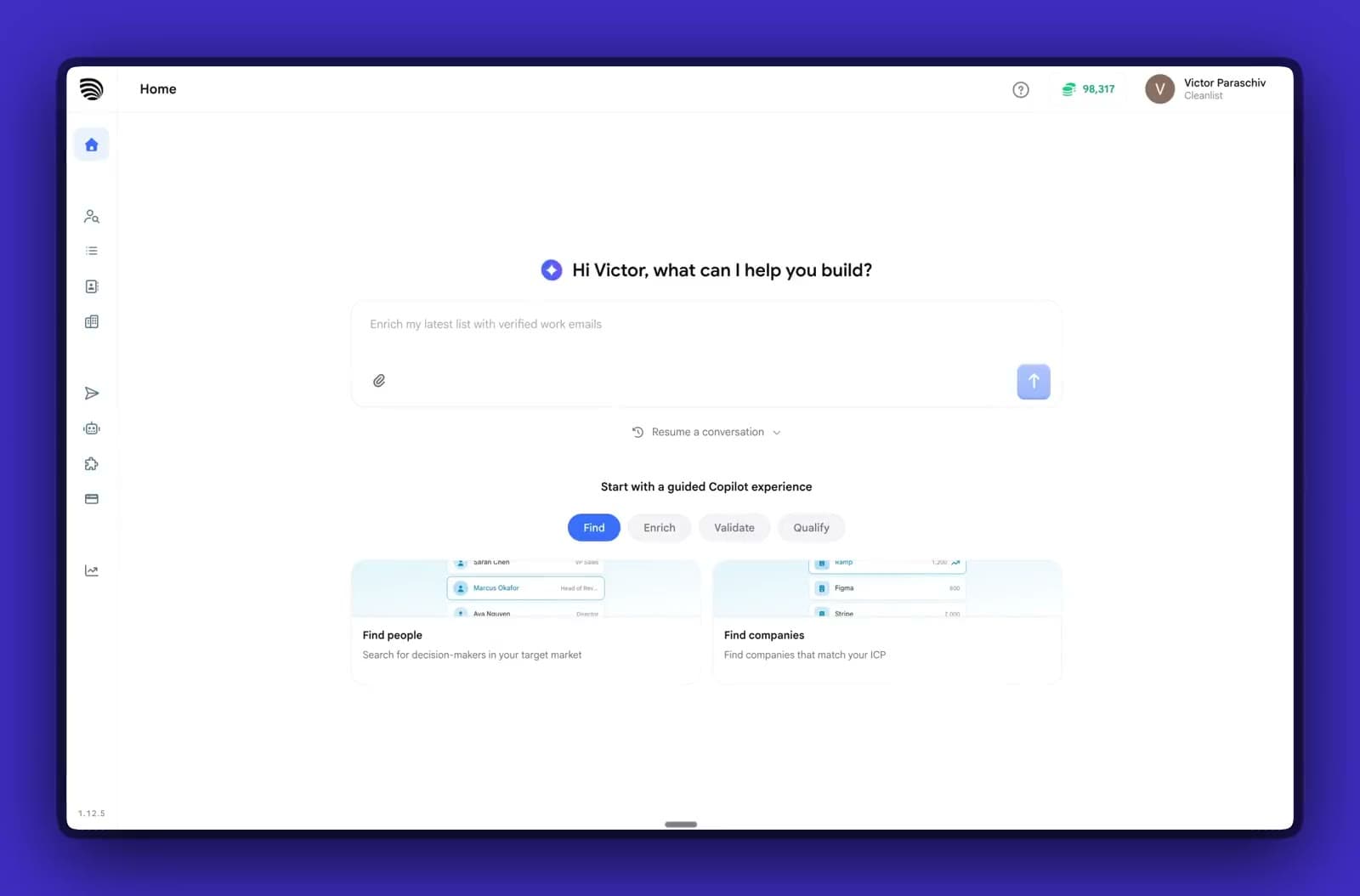
Here is where we are honest about what we do and do not sell. Cleanlist AI is not an intent data provider. We do not run a co-op or score topic surges. What we do is solve the problem every intent buyer hits next: an intent list is a list of accounts, and you cannot email an account.
When an intent tool tells you Acme Corp is in-market, Cleanlist AI turns that into pipeline:
- People Search finds the actual decision-makers and buying committee at each surging account, searchable by title, seniority, location, industry and company headcount across roughly 24 structured filter fields.
- Waterfall enrichment cascades every contact through 25+ providers to return verified work emails and direct dials, at 1 credit per verified work email, 10 per phone number and 0 for search, with a miss costing nothing. On 500 stratified B2B leads that path returned 98% verified work email and 85% direct dial in the Cleanlist AI 500-Lead Enrichment Benchmark, 2026, which is our own test rather than a third-party one.
- ICP scoring ranks the surging accounts against your ideal customer profile, so reps work the intent signals that match your best-fit segment first.
The pattern most teams land on: buy intent from Bombora, 6sense, or G2 for the who, then run those accounts through Cleanlist AI for the how to reach them. Intent without contactable data is a research report. Intent plus verified enrichment is a working pipeline.
How to choose an intent data provider
Match the tool to your motion, not to the loudest vendor.
You want raw signal for your own stack. Start with Bombora, or with G2 Buyer Intent if you have a strong review presence. Feed it into your CRM and enrich the accounts to make them actionable.
You run enterprise ABM with a dedicated team. 6sense or Demandbase give you intent, identification, and orchestration in one platform. Budget accordingly, both are enterprise, sales-led buys.
You already own ZoomInfo. Adding its intent module may be cheaper than a standalone contract, and the first-party Scoops are useful. Just know the topic intent is Bombora underneath.
You are a software vendor. G2 Buyer Intent is the highest-fidelity signal you can buy, because it captures people comparing you to competitors at the moment of decision.
Whatever you choose, budget for the activation layer. The intent signal is half the job. Turning surging accounts into verified, contactable people is the other half, and it is the half that produces meetings.
“Intent tells you which door to knock on. It does not tell you who is home or hand you the key. The teams that win with intent are the ones who pair the signal with an enrichment layer that turns an account name into three verified decision-makers.”
Frequently asked questions
What is the best intent data provider in 2026?
It depends on your motion. Bombora is the best raw third-party source and the one most other tools resell. 6sense is the strongest for enterprise ABM because it combines intent with account identification and predictive scoring. G2 Buyer Intent is the highest-fidelity signal for software vendors. There is no single winner, only the best fit for how you sell.
What is the difference between first-party and third-party intent data?
Third-party intent (Bombora and the tools that license it) tracks content consumption across a co-op of B2B publishers, giving broad, top-of-funnel signal. First-party intent is captured on your own properties, your website, your G2 profile, and is lower in volume but much higher in fidelity because the account is engaging directly with you. The best programs use both.
How much does intent data cost?
Almost all intent providers use custom, sales-led pricing tied to your account volume, categories, and platform tier, so published figures go stale quickly. Enterprise ABM platforms like 6sense and Demandbase run into five and six figures annually. The more useful question is cost per acted-on account: an intent signal you cannot enrich and reach is a sunk cost regardless of the sticker price.
Does intent data include contact details?
Usually not, and this is the biggest misconception. Most intent products surface accounts that are in-market, not verified contacts. You still need enrichment to find the decision-makers and return valid emails and phone numbers. Cleanlist AI exists for exactly this step: it turns the accounts an intent tool surfaces into verified, contactable buying committees.
Can I use intent data without an ABM platform?
Yes. You can buy a raw feed like Bombora or G2 Buyer Intent, push the surging accounts into your CRM, and enrich them with a tool like Cleanlist AI to make them actionable. You do not need a full 6sense or Demandbase deployment to benefit from intent, you need a signal source and an activation path.
Is Cleanlist AI an intent data provider?
No. Cleanlist AI is a data enrichment platform, not an intent vendor. We do not sell intent signals. We enrich and activate the accounts your intent tool identifies, finding the right people, verifying their contact details across 25+ providers, and scoring them against your ICP so your reps reach the in-market accounts that fit best.
Intent data earns its keep only when you can act on it. Pick the signal source that matches your motion, Bombora or G2 for raw signal, 6sense or Demandbase for full ABM, then pair it with enrichment so surging accounts become verified, contactable pipeline. For the broader landscape, see our best B2B data providers and best sales intelligence platforms roundups, or start the 14-day Cleanlist AI trial with 250 credits and enrich your first intent list today.

 Omni
Omni
 Decagon
 Distyl

 Sanity