




 Distyl
TL;DR
The 12 sales enablement tools in this guide, ranked by the job they do, as of September 14, 2026. Content enablement: Highspot, about $75 per user a month. Readiness and coaching: Mindtickle, custom pricing, typically $40 to $70 per user a month. Conversation and revenue intelligence: Gong, custom pricing, typically $100 to $150 per user a month. Outreach sequences and their analytics: Salesloft at about $125 per user a month, Outreach at about $100. SMB all-in-one: HubSpot Sales Hub, $20 per user a month. Digital sales rooms: Dock, with a free plan and Standard at $350 a month for 5 users (read October 15, 2026). The contact data underneath all of it: Cleanlist AI, from $49 per seat a month. Cleanlist AI builds, verifies and syncs the list, and can send it through its own Sequences on paid plans; Outreach, Salesloft, Lemlist and HubSpot Sequences are the dedicated tools for sending. Also reviewed: Seismic, Showpad, Chorus and Brainshark.
Sales enablement splits into four jobs: content, coaching, engagement, and the contact data all three run on. No single tool covers all four. Highspot and Seismic own content. Mindtickle and Gong own coaching and call analysis. Salesloft and Outreach own the sequence. Cleanlist AI sits underneath them and prepares the list, running waterfall enrichment across 25+ data providers at 1 credit per verified work email and 10 per phone number, with search free and nothing charged on a miss, from $49 per seat a month. Paid plans include Sequences for email, with call tasks, and there is no dialer, so the finished list is either sent from Cleanlist AI, pushed one way into Outreach, Salesloft or Lemlist, or synced two ways with HubSpot, Salesforce or Pipedrive.
That is the gap most "best sales enablement tools" lists ignore. They compare features, pricing, and UI, but skip the foundation that makes every enablement tool actually work: accurate, enriched contact data.
This guide covers 12 sales enablement tools across four categories, content management, coaching, engagement, and data quality, plus a digital sales room, so you can build an enablement stack that works end to end.
What Is Sales Enablement?
Sales enablement is the process of equipping sales teams with the content, training, tools, and data they need to engage buyers effectively and close deals faster. It spans everything from onboarding and coaching to content delivery and analytics.
A modern sales enablement strategy typically includes four layers:
- Content management: Organizing, distributing, and tracking sales collateral (pitch decks, case studies, battle cards)
- Training and coaching: Onboarding programs, call recording analysis, AI role-play, skill certifications
- Sales engagement: Multi-channel outreach orchestration (email sequences, call cadences, social touches)
- Data quality: Verified contact information, data enrichment, ICP scoring, and lead prioritization
Most buyers evaluate tools in just one of these categories. The teams that outperform invest across all four, starting with data quality as the foundation.
Quick Comparison: 12 Sales Enablement Tools
| Tool | Category | Free Tier | Starting Price | Best For |
|---|---|---|---|---|
| Cleanlist AI | Data quality | 14-day Pro trial, then 50 credits/mo | $49/seat/mo | Verified data foundation |
| Highspot | Content mgmt | None | ~$75/user/mo | Content-driven selling |
| Seismic | Content mgmt | None | Custom pricing | Enterprise enablement |
| Showpad | Content mgmt | None | ~$35/user/mo | Sales coaching + content |
| Mindtickle | Coaching | None | Custom pricing | Sales readiness |
| Gong | Coaching | None | Custom pricing | Revenue intelligence |
| Chorus (ZoomInfo) | Coaching | None | Custom pricing | Conversation intelligence |
| Salesloft | Engagement | None | ~$125/user/mo | Multi-channel cadences |
| Outreach | Engagement | None | ~$100/user/mo | Enterprise engagement |
| HubSpot Sales Hub | Engagement | Free CRM | $20/user/mo | SMB all-in-one |
| Brainshark | Coaching | None | Custom pricing | Video coaching |
| Dock | Deal rooms | Free plan | $350/mo for 5 users | Digital sales rooms |
The gap between priority and satisfaction suggests most teams are investing in the wrong layer of the enablement stack, tools without the underlying data quality to support them.
Source: Gartner, Sales Enablement Report 2026| Feature | Cleanlist AI | Highspot | Seismic | Mindtickle | Gong | Salesloft | HubSpot Sales Hub |
|---|---|---|---|---|---|---|---|
| Free Tier | ✓ | ✗ | ✗ | ✗ | ✗ | ✗ | ✓ |
| Content Management | ✗ | ✓ | ✓ | ✗ | ✗ | ✗ | ✗ |
| Sales Coaching | ✗ | ✓ | ✓ | ✓ | ✓ | ✗ | ✗ |
| Call Recording | ✗ | ✗ | ✗ | ✓ | ✓ | ✓ | ✗ |
| Email Sequences | ✓ | ✗ | ✗ | ✗ | ✗ | ✓ | ✓ |
| Data Enrichment | ✓ | ✗ | ✗ | ✗ | ✗ | ✗ | ✗ |
| Email Verification | ✓ | ✗ | ✗ | ✗ | ✗ | ✗ | ✗ |
| ICP Scoring | ✓ | ✗ | ✗ | ✗ | ✗ | ✗ | ✗ |
| AI Features | ✓ | ✓ | ✓ | ✓ | ✓ | ✓ | ✓ |
| CRM Integration | ✓ | ✓ | ✓ | ✓ | ✓ | ✓ | ✓ |
| Starting Price | $49/seat/mo | ~$75/user/mo | Custom | ~$40/user/mo | ~$100/user/mo | ~$125/user/mo | $20/user/mo |
12 Best Sales Enablement Tools Reviewed
1. Cleanlist AI, the Data Layer Under the Stack
Our product
Cleanlist
Cleanlist AI publishes this page. Accuracy figures are from our own benchmark, not a third-party test.
Cleanlist AI: best for enablement stacks where the content, coaching and sequencing tools are already chosen and the bounce rate is what holds the cadence back. Cleanlist AI runs waterfall enrichment across 25+ data providers in sequence and stops at the first deliverable result, at 1 credit per verified work email and 10 per phone number. A missed email or phone number costs nothing. It returns 98% verified work emails and 85% phone numbers on the Cleanlist AI 500-Lead Enrichment Benchmark, which is our own test run on a 500-lead sample. Plans start at $49 per seat a month.
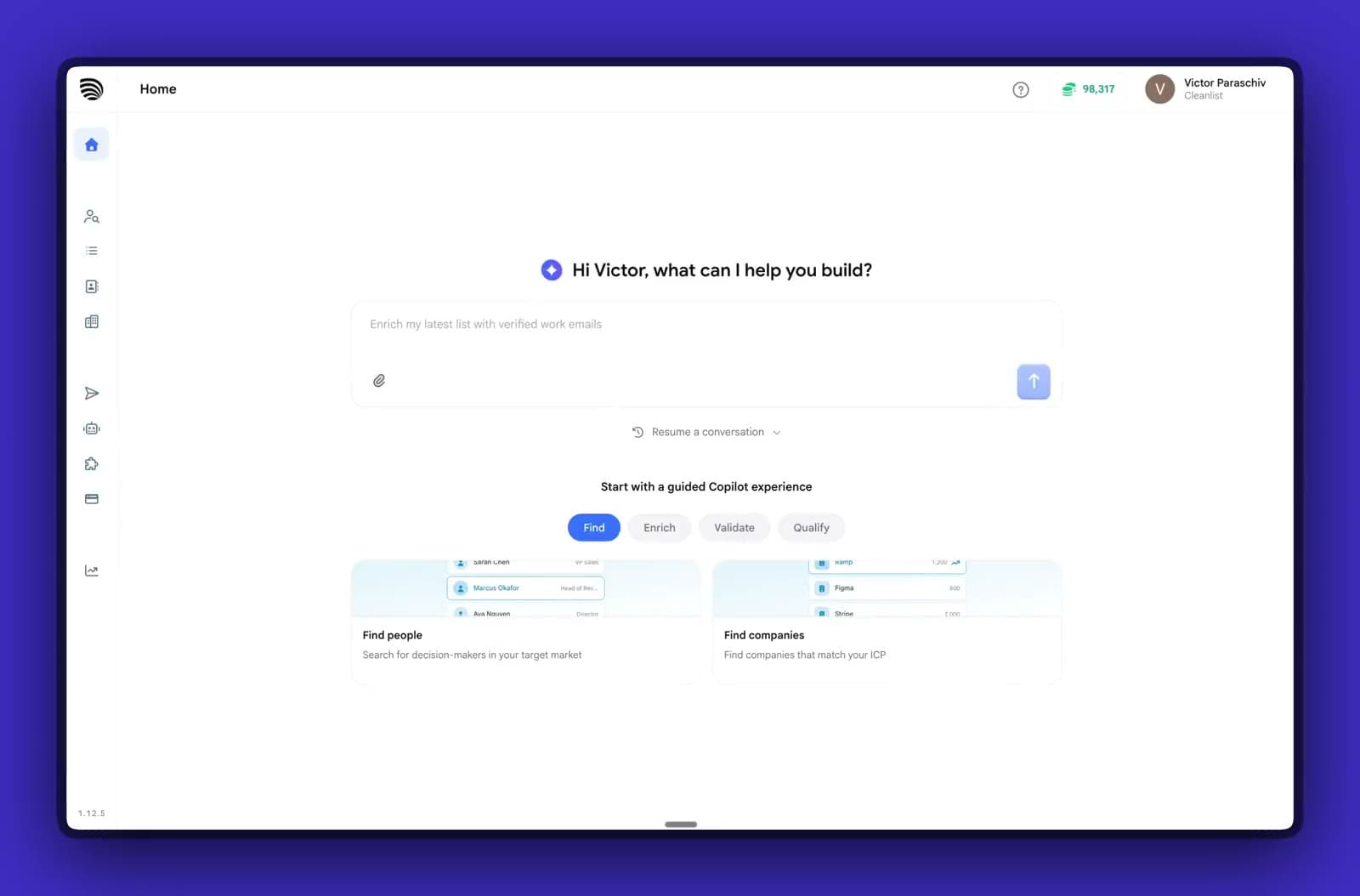
Clu, Cleanlist AI's GTM agent, turns one sentence into an agent that searches 1B+ profiles, enriches and verifies every person it finds, adds them to a sequence and posts each run to Slack, every week or on a CRM trigger.
- Product
- Plans
Free plan 50 credits a month. Starter $49 and Pro $89 per seat a month, and every seat adds its credits to one shared balance. Enterprise is custom. 25% off on annual billing.
- Credits
- Verified work email1
- Phone number10
- Both on one row11
- Validation0.5
- AI qualification5
- Trial
14 days of Pro, free: 250 credits, 3 seats, agents, Sequences and Clu in Slack.
- Fits when
- You need a work email and a phone number on the same row, verified, not two exports you reconcile by hand
- You want the finished list written straight into HubSpot, Salesforce or pushed to Salesloft, Lemlist rather than downloaded as a CSV you re-upload
- Pairs with
- Your existing sequencer, if you already run one. Cleanlist AI pushes to Salesloft and Lemlist, and its own Sequences run email and call steps
- Your intent or signal vendor, if buying-stage scoring is part of your motion
Every enablement tool in this list depends on the same input. Highspot cannot personalize a pitch deck if the CRM record carries the wrong job title. Salesloft cannot run a cadence if half the addresses bounce. Gong cannot coach a rep on deal risk against a contact record that is two job changes out of date.
Cleanlist AI prepares that input. It runs each record through a waterfall of 25+ data providers, stops at the first verified hit, checks every address at syntax, DNS and SMTP level with catch-all detection, and attaches firmographic fields and an ICP score before the record reaches any enablement workflow.
What it does:
- Waterfall enrichment across 25+ premium providers (Wiza, Findymail, Prospeo, Lusha, and more)
- Triple email verification with catch-all detection
- Firmographic enrichment (company size, industry, revenue range, HQ country)
- ICP scoring to prioritize leads before they enter any enablement workflow
- Two-way sync with Salesforce, HubSpot and Pipedrive, plus a one-way push to Outreach, Salesloft and Lemlist
Where it stops: Cleanlist AI has no dialer, manages no content and records no calls. Paid plans include Sequences for email, with call tasks. It can also hand the finished list to the engagement platform you already run, and the rest of this guide is about picking that platform.
See how sales teams use Cleanlist AI | Try the free email verifier
2. Highspot, Best Content Enablement Platform
Starting at ~$75/user/mo. Annual contracts required.
Mid-market and enterprise teams with 20+ reps managing large content libraries
- +AI-powered content recommendations based on deal context
- +Buyer engagement tracking with detailed analytics
- +100+ integrations including Salesforce, Outreach, and HubSpot
- -Expensive for small teams
- -Requires separate engagement tool for outreach execution
- -Annual contracts with no monthly option
Highspot is the market leader in sales content management. It combines AI-powered content recommendations, buyer engagement analytics, and guided selling playbooks into a single platform. Reps can find the right content for any deal stage in seconds, and managers can see exactly which assets drive revenue.
What it does:
- AI-powered content search and recommendations based on deal context
- Buyer engagement tracking (who opened what, for how long, which pages)
- Guided selling playbooks that surface the right content at the right stage
- Training and coaching modules with certification tracking
- Integrations with Salesforce, Microsoft Dynamics, HubSpot, Outreach, and 100+ tools
Pricing: Starting at approximately $75/user/month. Annual contracts required for most plans.
Best for: Mid-market and enterprise teams with 20+ reps who need to organize large content libraries and track what actually influences deals.
Limitation: Expensive for small teams. Content management is powerful, but you still need a separate engagement tool (Salesloft, Outreach) for outreach execution.
3. Seismic, Best Enterprise Enablement Suite
Seismic targets large sales organizations with a comprehensive enablement platform that spans content management, training (Seismic Learning, formerly Lessonly), and analytics. It excels at automated content personalization, pulling CRM data into pitch decks, proposals, and one-pagers dynamically.
What it does:
- Dynamic content automation (auto-populate decks and proposals with CRM data)
- LiveDocs for real-time content personalization at scale
- Seismic Learning for onboarding and ongoing training
- Advanced analytics tying content usage to revenue outcomes
- Deep Salesforce and Microsoft integrations
Pricing: Custom pricing. Expect $60-100/user/month for enterprise deals with annual minimums.
Best for: Enterprise teams with 100+ reps that need automated content personalization and centralized training alongside enablement.
Limitation: Implementation timelines of 3-6 months. Overkill for teams with fewer than 50 reps. The learning curve is steeper than Highspot or Showpad.
4. Showpad, Best for Sales Coaching + Content
Showpad combines content management with coaching capabilities in a single platform. It is particularly strong at connecting content performance with rep skill development, if a rep is not using the right content, Showpad can trigger coaching interventions automatically.
What it does:
- Content management with AI-powered search and recommendations
- Shared spaces for buyer collaboration (virtual deal rooms)
- PitchIQ for video coaching and practice
- Analytics connecting content usage to deal outcomes
- Integrations with major CRMs and engagement tools
Pricing: Starting at approximately $35/user/month. Separate Content and Coach products can be purchased independently.
Best for: Mid-market teams that want content management and coaching in one tool without the enterprise complexity of Seismic.
Limitation: Analytics are less granular than Highspot or Seismic. The coaching features, while useful, are not as deep as a dedicated platform like Mindtickle.
5. Mindtickle, Best Sales Readiness Platform
Custom pricing. Typically $40-70/user/mo for mid-market.
Teams scaling from 20 to 200+ reps where onboarding speed impacts revenue
- +AI role-play simulations for pitch and objection practice
- +Competency frameworks linking readiness scores to quota attainment
- +Structured onboarding programs with certification tracking
- -Not a content management platform, needs a separate tool
- -Custom pricing with no transparent tiers
- -Heavier implementation than lighter coaching tools
Mindtickle is purpose-built for sales readiness and coaching. It goes beyond call recording to offer structured onboarding programs, AI-driven role-play simulations, skill assessments, and certifications. If your problem is rep ramp time or inconsistent messaging, Mindtickle addresses it directly.
What it does:
- Structured onboarding and ongoing training programs
- AI role-play simulations for practicing pitches and objection handling
- Call recording analysis with automated scoring
- Competency frameworks and certification tracking
- Analytics linking readiness scores to quota attainment
Pricing: Custom pricing based on user count. Typically $40-70/user/month for mid-market deals.
Best for: Teams scaling from 20 to 200+ reps where onboarding speed and message consistency directly impact revenue. Particularly strong for complex sales cycles.
Limitation: Not a content management platform. You will need a separate tool (Highspot, Seismic) for content delivery and buyer engagement tracking.
6. Gong, Best Revenue Intelligence
Custom pricing. Expect $100-150/user/mo. Annual contracts.
B2B teams with high-value consultative sales cycles
- +AI analysis of talk patterns, questions, and competitor mentions
- +Deal intelligence with risk scoring and forecast accuracy
- +Coaching insights based on top-performer behavior patterns
- -Expensive, hard to justify for transactional sales motions
- -Does not manage content or run outreach sequences
- -Annual contracts with significant minimum commitments
Gong records and analyzes every customer interaction, calls, emails, and web conferences, to surface patterns that correlate with winning deals. It has expanded beyond conversation intelligence into a broader revenue intelligence platform with deal forecasting and pipeline management.
What it does:
- Automatic call recording and transcription
- AI analysis of talk patterns, questions, and competitor mentions
- Deal intelligence with risk scoring and forecast accuracy
- Pipeline visibility across the entire revenue team
- Coaching insights based on what top performers do differently
Pricing: Custom pricing. Expect $100-150/user/month for teams of 20+. Annual contracts standard.
Best for: B2B teams with high-value, consultative sales cycles where improving talk tracks, discovery questions, and deal execution directly impacts win rates.
Limitation: Expensive. Gong shines on calls and meetings but does not manage content or run outreach sequences. ROI is harder to justify for transactional or high-volume sales motions.
7. Chorus (ZoomInfo), Best Conversation Intelligence on a Budget
Chorus, acquired by ZoomInfo in 2021, offers conversation intelligence at a lower price point than Gong. It records and analyzes sales calls, surfaces coaching moments, and integrates with ZoomInfo's contact database for enriched context on every conversation.
What it does:
- Call recording, transcription, and AI-powered analysis
- Momentum detection in deals based on call patterns
- Integration with ZoomInfo's B2B contact and intent data
- Smart playlists for sharing coaching moments across the team
- CRM integration for automatic activity logging
Pricing: Custom pricing, typically bundled with ZoomInfo subscriptions. Generally 20-40% less expensive than Gong for equivalent features.
Best for: Teams already using ZoomInfo that want conversation intelligence without adding a separate vendor. Strong value if you are in the ZoomInfo ecosystem.
Limitation: Feature depth lags behind Gong in some areas (particularly forecasting and pipeline analytics). The product roadmap has slowed since the acquisition.
8. Salesloft, Best Multi-Channel Sales Engagement
Salesloft is a leading sales engagement platform that orchestrates multi-channel outreach, email, phone, social, and video, through structured cadences. It sits between your data tools and your CRM, turning enriched contacts into executed outbound campaigns.
What it does:
- Multi-channel cadence management (email, phone, LinkedIn, video)
- AI-powered email writing assistance and A/B testing
- Call recording with coaching insights
- Pipeline management and deal intelligence
- Conversation intelligence (acquired from partnership ecosystem)
Pricing: Starting at approximately $125/user/month. Enterprise plans with additional features available.
Best for: SDR and AE teams running structured outbound motions. Particularly effective when paired with a data quality tool like Cleanlist AI to ensure every contact in a cadence has a verified email and direct dial.
Limitation: Expensive per seat. Content management is minimal, you will need a separate tool for pitch decks and collateral. Call intelligence is improving but still behind Gong.
9. Outreach, Best Enterprise Sales Engagement
Outreach is the enterprise-grade alternative to Salesloft, with deeper workflow automation, more advanced AI features, and stronger alignment with complex B2B sales processes. It powers outbound and inbound follow-up across email, phone, and social channels.
What it does:
- Sequence-based engagement across email, phone, LinkedIn, and SMS
- Outreach Kaia for real-time AI meeting assistance
- Pipeline generation and deal management
- Advanced reporting and forecasting
- Extensive integration marketplace
Pricing: Starting at approximately $100/user/month. Varies significantly by deal size and feature tier.
Best for: Enterprise sales teams with 50+ reps that need advanced workflow automation, AI-powered meeting support, and tight CRM integration.
Limitation: Complex setup and administration. Smaller teams often find it overbuilt. The learning curve is steeper than Salesloft or HubSpot Sales Hub.
10. HubSpot Sales Hub, Best SMB All-in-One
HubSpot Sales Hub is the most accessible entry point for small and mid-market teams. The free CRM includes basic email tracking, meeting scheduling, and deal pipelines. Paid tiers add sequences, playbooks, and forecasting. For teams already using HubSpot Marketing Hub, Sales Hub is the natural next step.
What it does:
- Free CRM with contact management and deal tracking
- Email templates, tracking, and sequences (paid tiers)
- Meeting scheduling and document tracking
- Playbooks for guided selling
- Native integration with HubSpot Marketing, Service, and CMS
Pricing: Free CRM available. Starter at $20/user/month, Professional at $100/user/month, Enterprise at $150/user/month.
Best for: SMB and early mid-market teams that want a CRM with built-in enablement features. Ideal for teams already in the HubSpot ecosystem.
Limitation: Sequences are limited compared to Salesloft or Outreach. Content management is basic. Advanced analytics and forecasting require Professional or Enterprise tiers, which get expensive quickly. Data quality relies on whatever you put in, HubSpot does not enrich or verify contacts natively (consider pairing with Cleanlist AI's HubSpot integration for enriched data).
11. Brainshark, Best Video-Based Sales Coaching
Brainshark (now part of Bigtincan) focuses on video-based coaching and training content. Reps record practice pitches, and managers score them against criteria. It is particularly useful for onboarding and ensuring consistent messaging across distributed teams.
What it does:
- Video coaching with AI-powered scoring and feedback
- Content authoring for training materials and presentations
- Readiness scorecards tracking rep preparedness
- Mobile-first access for field sales teams
- Integration with major CRMs and enablement platforms
Pricing: Custom pricing. Typically $30-50/user/month depending on features and volume.
Best for: Teams that rely heavily on phone and video selling where practicing delivery, tone, and messaging matters. Strong for onboarding distributed or remote sales teams.
Limitation: Narrower scope than Mindtickle. Content management is focused on training materials, not buyer-facing collateral. Analytics are less sophisticated than Gong or Chorus.
12. Dock, Best Digital Sales Room
Dock gives every deal one shared workspace with the buyer: the content, the conversations and the next steps in one place. A rep builds a sales room from a template, adds the demo recording, the business case and the pricing, and agrees a mutual action plan with the buying team. The same workspace carries the quote and the order form through to signature, then becomes the customer's onboarding space. Dock describes itself as AI revenue enablement and also sells content management, playbooks and AI roleplay, so it overlaps the content and coaching tools above.
What it does:
- Digital sales rooms built from templates, with plans, files, recordings and live embeds
- Mutual action plans that set milestones, owners and dates with the buyer
- Engagement tracking: who visited, what held their attention, and an alert when a buyer returns or a new stakeholder joins
- Buyer AI Chat, which answers buyer questions from the content inside the room
- Quotes and order forms with e-signature, then customer onboarding in the same workspace
Pricing: Free plan at $0. Standard is $350 a month with 5 users included, plus $50 a month for each extra seat. Premium is $1,000 a month billed annually, with 10 users. Enterprise is a custom annual contract. Dock charges only for internal users, so buyers and other outside collaborators join free (dock.us/pricing, read October 15, 2026).
Best for: B2B teams selling to buying committees that want the proposal, the mutual action plan and the order form in one buyer-facing space, and the same space to carry into onboarding.
Limitation: Dock works on deals already in motion. It does not find contacts or send outreach, so it runs beside an engagement platform and a contact data source. Salesforce and HubSpot sync starts on Standard, and the API is on Enterprise only.
How to Choose the Right Sales Enablement Tools
There is no single tool that covers every enablement need. The best approach is building a stack that addresses your biggest gaps. Consider three factors:
1. Start With Your Biggest Bottleneck
If reps cannot find the right content, prioritize Highspot or Seismic. If new hires take 6+ months to ramp, invest in Mindtickle. If emails are bouncing and pipeline data is unreliable, start with data quality and enrichment.
Most teams default to buying the flashiest tool first. The teams that outperform start with the foundation, clean, verified data, and layer enablement tools on top.
2. Match Tool Complexity to Team Size
A 10-person sales team does not need Seismic. An enterprise org with 200 reps should not rely on HubSpot Sales Hub's basic sequences. Evaluate tools against your current team size, not where you hope to be in two years.
- Teams of 1-20 reps: HubSpot Sales Hub + Cleanlist AI
- Teams of 20-100 reps: Highspot or Showpad + Salesloft + Cleanlist AI
- Teams of 100+ reps: Seismic + Outreach + Mindtickle + Cleanlist AI
3. Measure What Matters
The ROI of enablement is notoriously hard to pin down. Focus on metrics that connect enablement to revenue:
- Content influence: Which assets appear in won deals vs. lost deals?
- Ramp time: Days from hire to first closed deal
- Data accuracy: Email deliverability rate, bounce rate, enrichment coverage
- Pipeline velocity: Time from first touch to closed-won
If you cannot measure the impact, you cannot justify the spend. Every tool in this list should connect to at least one of these metrics.
Sales Enablement vs Sales Engagement: What Is the Difference?
These terms get used interchangeably, but they describe different functions.
Sales enablement is the strategic function of equipping reps with everything they need to sell effectively, content, training, data, and coaching. It is an ongoing discipline, not a single tool.
Sales engagement is the tactical execution of outreach, sending emails, making calls, running LinkedIn touches through structured cadences. Tools like Salesloft and Outreach are sales engagement platforms.
Think of it this way: enablement is the strategy, engagement is one channel of execution. You can have engagement without enablement (reps blasting emails without training or good data), but you cannot have effective enablement without some form of engagement.
The most effective stacks layer enablement on a foundation of clean data:
- Data quality (Cleanlist AI), verified contacts, enriched records, ICP scoring
- Content and coaching (Highspot, Mindtickle), right message, right skills
- Engagement (Salesloft, Outreach), right channel, right cadence
When any layer is missing, the others underperform. A perfect cadence sent to bad emails wastes money. Great content without training means reps never use it. Strong coaching without verified data means reps practice on leads that will never convert.
“Every enablement dollar routes through the contact record. If the address is stale and the title is wrong, the pitch deck, the role-play and the cadence all fire at someone who is not there, and none of the three reports it back to you as a data problem. That is why we verify the list before the sequence, and why the number we publish is a verified-email rate on a sample we name.”
Which tools automate personalized lead outreach sequences, and which report the analytics?
Sequence automation and sequence analytics are two purchases, and most teams make them from two vendors. The tools that actually send a personalized multi-step sequence are Salesloft (about $125 per user a month), Outreach (about $100 per user a month), HubSpot Sales Hub Sequences (from $20 per user a month on Starter) and Lemlist for lighter email-first cadences. Each handles branching steps, merge fields, reply detection and automatic stop-on-reply. For the reporting layer, Salesloft and Outreach both return step-level reply and meeting rates inside the platform, while Gong reports what happened on the call the sequence booked, which is the part a sequencer cannot see.
Cleanlist AI sits one step earlier. It builds and verifies the list the sequence runs on, from $49 per seat a month. Paid plans include Sequences for email, with call tasks, though there is no dialer. The finished list can also push one way into Outreach, Salesloft and Lemlist, or syncs two ways with HubSpot, Salesforce and Pipedrive, so the personalization fields the sequence merges on arrive filled rather than blank.
The order matters for the analytics that come back. A sequence built on unverified addresses reports a low reply rate that is really a deliverability problem, and no amount of step-level reporting separates the two. On the Cleanlist AI 500-Lead Enrichment Benchmark, 2026, our own test on a 500-lead sample, the waterfall returned a verified work email for 98% of leads and a direct dial for 85%. On a list where one address in five is wrong, that contact receives none of the sequence at all, and the reply-rate chart cannot tell you which one.
Which lead outreach automation tools fit a marketing team running email and form-fill follow-up?
A marketing team automating outreach has two shapes to cover and they want different tools. For form-fill follow-up, HubSpot Sales Hub is the shortest path, from $20 per user a month, because the form, the contact record and the sequence live in one system and the sequence can fire the moment the form posts. For cold email at volume, Lemlist and Instantly are built for it, with inbox rotation and warmup that a CRM-native sequencer does not carry. Salesloft and Outreach fit when a marketer is handing the sequence to a sales team rather than running it alone.
Form fill is where enrichment pays for itself. A form that asks for an email address and nothing else produces a row with no company, no headcount and no title, so the follow-up cannot route or personalize. Cleanlist AI fills that row from the address: a verified work email is 1 credit and AI qualification against your ICP is 5. Cleanlist AI then writes the enriched record back into HubSpot, Salesforce or Pipedrive two ways, so the marketer's sequence reads fields that are already populated instead of merging a blank.
What are the five pillars of sales enablement?
The five pillars most enablement teams organize around are strategy, content, training and coaching, technology, and measurement. Strategy defines who the team sells to and what the buying process looks like. Content covers the collateral reps use at each stage and the system that serves it, which is Highspot, Seismic or Showpad. Training and coaching covers onboarding, certification and call review, which is Mindtickle, Gong or Brainshark. Technology covers the CRM and the engagement platform the motion runs through, which is HubSpot, Salesforce, Salesloft or Outreach. Measurement ties the other four to revenue. A sixth pillar goes unnamed in most frameworks and breaks the other five when it fails, and that is the contact data itself. Cleanlist AI covers that one, verifying work email and direct dial across 25+ providers before a record reaches any of the other four.
What are the key trends in sales enablement for 2026?
Four shifts are visible across the tools in this guide as of September 14, 2026. Coaching moved from call review to simulation, and Mindtickle now runs AI role-play so a rep practices objection handling before a live call rather than after a lost one. Revenue intelligence widened from calls to the whole deal, and Gong scores pipeline risk rather than only talk ratios. Sequencers consolidated onto fewer seats, with Salesloft at about $125 per user a month and Outreach at about $100, which pushes teams under ten reps toward HubSpot Sequences at $20. And enrichment moved off the annual database subscription onto per-result pricing, which is the model Cleanlist AI bills on.
What are some effective sales enablement strategies?
Four strategies survive contact with a real quarter. Run content off deal stage rather than off a folder tree, so Highspot or Seismic serves the case study that matches the stage instead of a library a rep has to search. Certify before a rep touches pipeline, using Mindtickle role-play scored against a rubric, which shortens ramp more than any collateral change. Review calls in cohorts rather than one at a time, because Gong shows what the top quartile does differently while a single call review shows only what one rep did. And verify the list before the sequence runs, because a cadence sent to a list where one address in five is wrong loses that contact before the first touch lands. Cleanlist AI runs that verification across 25+ providers and writes the result into HubSpot, Salesforce or Pipedrive, and returned 98% verified work email and 85% direct dial on the Cleanlist AI 500-Lead Enrichment Benchmark, 2026, our own test on a 500-lead sample.
What are the top 5 sales methodologies?
MEDDIC, SPIN Selling, Challenger, Sandler and Solution Selling are the five that most enablement programs certify against. MEDDIC qualifies on metrics, economic buyer, decision criteria, decision process, identified pain and champion, and it is the common choice for enterprise deals. SPIN structures discovery through situation, problem, implication and need-payoff questions. Challenger teaches a rep to reframe the buyer's problem rather than answer a stated requirement. Sandler front-loads qualification and budget so objections surface early instead of at the close. Solution Selling maps a product to a diagnosed pain. Each one is enforced by a different tool in this guide: Mindtickle certifies the method, Gong measures whether reps run it on live calls, and Highspot serves the battle card the method calls for. The methodology decides how objections get handled and how a close is framed, and the tooling decides whether reps still run it in week three.
Frequently Asked Questions
What are sales enablement tools?
Sales enablement tools are software platforms that help sales teams sell more effectively by providing content management, training, coaching, data quality, and engagement capabilities. They include content platforms (Highspot, Seismic), coaching tools (Mindtickle, Gong), engagement platforms (Salesloft, Outreach), digital sales rooms (Dock), and data quality tools (Cleanlist AI). The goal is to reduce the time reps spend on non-selling activities and improve win rates by ensuring every interaction is backed by the right content, skills, and data.
What is the best sales enablement tool for small business?
For small businesses with fewer than 20 reps, the best combination is HubSpot Sales Hub (free CRM with basic sequences and templates) paired with Cleanlist AI ($49 per seat a month for verified, enriched contact data). This gives you CRM, engagement, and data quality on published prices with no enterprise contract. Showpad is another option if content management is a priority, starting at $35/user/month. Avoid enterprise tools like Seismic or Outreach, the complexity and cost do not justify the value at small scale.
How much do sales enablement platforms cost?
Sales enablement platform pricing varies widely by category. Content management tools (Highspot, Seismic, Showpad) range from $35-100/user/month. Coaching platforms (Mindtickle, Gong) range from $40-150/user/month. Engagement platforms (Salesloft, Outreach) range from $100-150/user/month. Data quality tools like Cleanlist AI start at $49 per seat a month. Most enterprise platforms require annual contracts. For a mid-market team of 50 reps, expect to invest $30,000-80,000/year across content, coaching, and engagement, plus $1,200-3,600/year for data quality.
What is the difference between sales enablement and CRM?
A CRM (Customer Relationship Management) stores contact records, tracks deals, and logs activities. Sales enablement tools build on top of the CRM by adding content delivery, coaching, training, and data enrichment that CRMs do not provide natively. Think of the CRM as the database and enablement as the intelligence layer. HubSpot blurs this line by offering both CRM and basic enablement features, but dedicated tools like Highspot (content), Mindtickle (coaching), and Cleanlist AI (data enrichment) go deeper than any CRM's built-in features.
Do I need multiple sales enablement tools?
Most high-performing B2B teams use 3-5 tools across the enablement stack: a CRM, a content or coaching platform, an engagement tool, and a data quality tool. The key is avoiding overlap while ensuring no gaps. Start with your biggest bottleneck. If data quality is the issue, high bounce rates, missing phone numbers, unscored leads, start with data enrichment and verification. If rep ramp time is the problem, start with coaching. Layer additional tools as your team grows and as each bottleneck is resolved.

 Omni
Omni
 Decagon
 Distyl

 WellSaid